
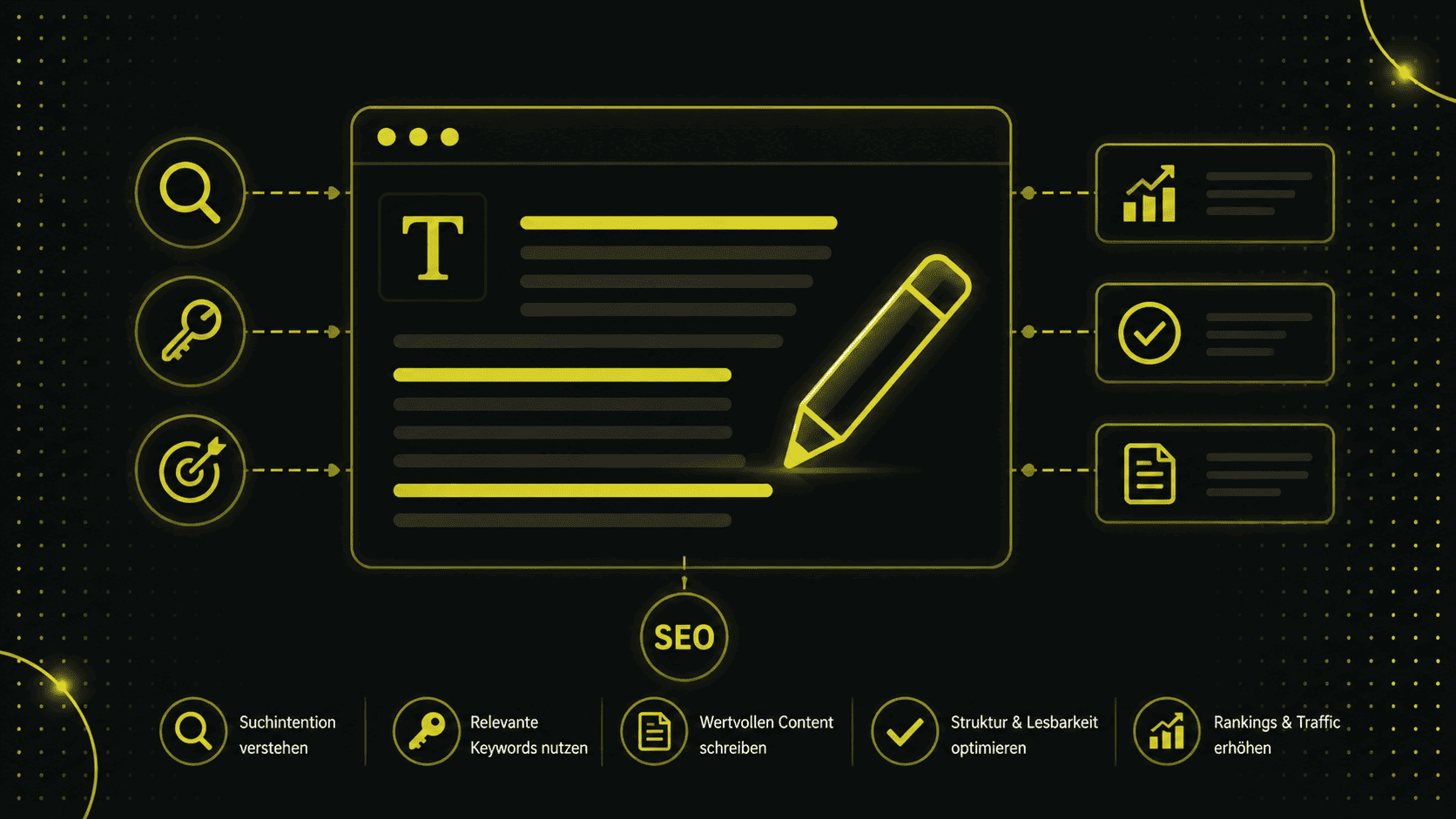
Why SEO texts are important
Millions of online texts are written and published on the Internet every day that are never seen.
Das liegt einerseits daran, dass heutzutage fast alle bei der Generierung von Content auf AI-Tools wie ChatGPT zurückgreifen und Google diese Texte erkennt und abwertet.
Andererseits wissen viele nicht, dass sie bei der Erstellung ihrer Texte die SEO berücksichtigen müssen, damit diese von der Suchmaschine als relevant eingestuft werden.
Warum genau ist es jetzt aber wichtig, auf SEO zu achten?
If you take SEO into account when writing your texts, you have the opportunity to rank high on Google with your texts.
Rankt man zu einem bestimmten Thema mit seinen Beiträgen innerhalb der ersten 10 Suchergebnisse, erhält man ganz automatisch natürlichen Traffic auf seiner Website.
And this natural traffic can then in turn lead to potential customers or you can monetize the traffic via Google AdSense or affiliate links.
Traffic is the gold of the World Wide Web.
If you have traffic, you can earn money with it.
Guten SEO Content zu schreiben und zu veröffentlichen, hat im besten Fall also einen direkten Einfluss auf den eigenen Umsatz.
Wahrscheinlich fragst du dich jetzt, ob es schwierig ist, solche SEO-Texte zu schreiben.
You may also be asking yourself whether it is almost impossible to appear at the top of the search results.
Before we move on to writing SEO texts, I would like to tell you from my own experience that it is often easier than it seems at first glance.
Zur Veranschaulichung zeige ich dir ein Beispiel aus einem unserer Blogartikel.
We have written about "What is an SEO analysis?" in a blog article.
Dabei haben wir darauf geachtet, dass wir für die Inhalte kein AI Tool wie ChatGPT verwenden, und haben die entsprechenden Methoden angewandt, um den Text optimal auf SEO auszurichten.
This blog article was published on our website on 21.07.2024.
As early as 22.07.2024, our blog post ranked on the first page of the search results.
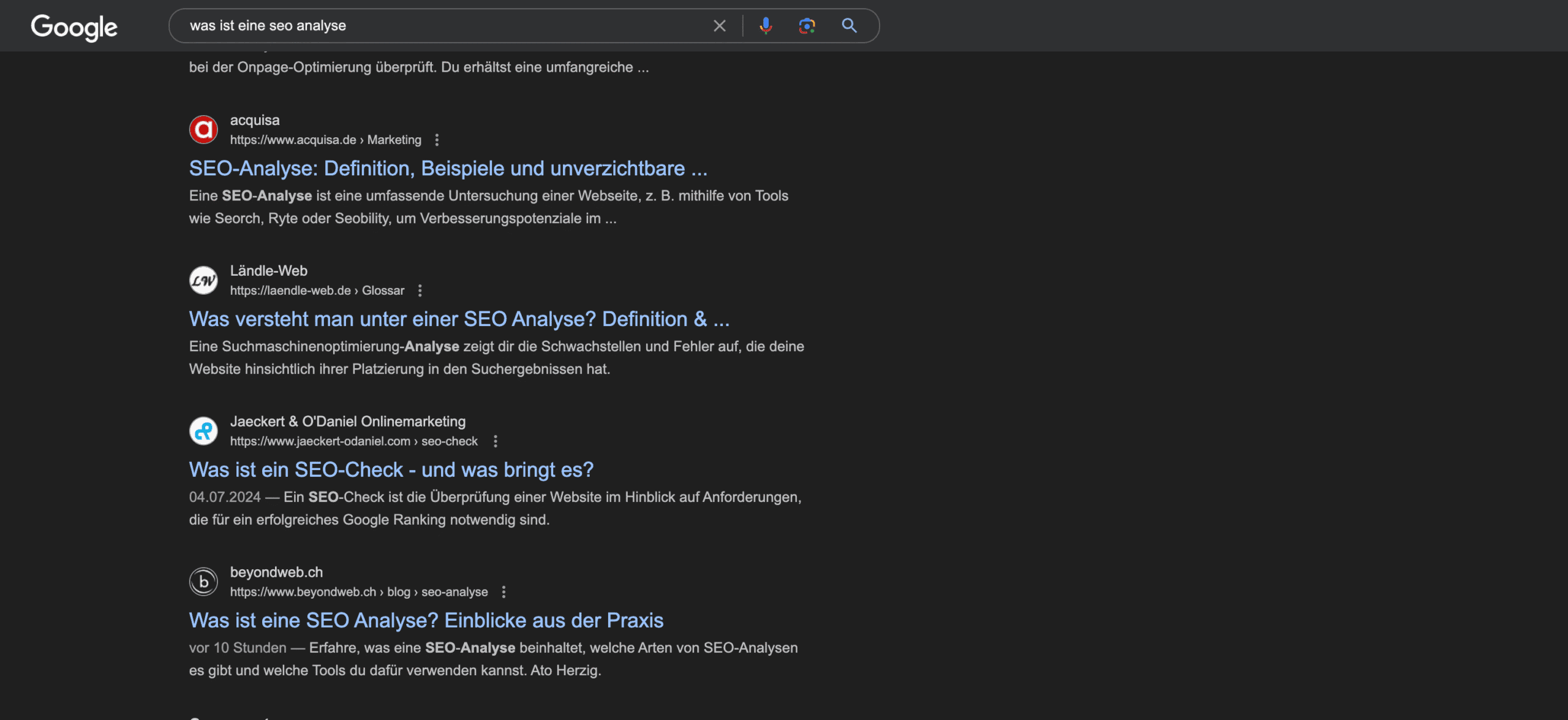
Du siehst also: Wenn du die richtigen Faktoren beim Schreiben von SEO-Texten berücksichtigst und darauf achtest, eigenen, qualitativ hochwertigen Content zu verfassen, der nicht von AI geschrieben ist, stehen deine Chancen, in deinem jeweiligen Fachbereich, ganz weit vorn zu ranken, ausgezeichnet.
As the example above shows, you also have a chance if there are already many posts on this topic.
The key to success is simply to make your text better than the others.
And I will now explain to you exactly how to do this.
5 steps to writing SEO texts
The main goal of your text must be to generate content that is precisely tailored to what people are looking for.
SEO gurus talk about satisfying the search intention in this context.
Your content should be interesting for your target group and not just written because you have the goal of ranking in a search engine like Google.
Google's latest spam updates and Helpful Content Update have long since ensured that generic AI content with low originality and added value is no longer ranked highly in search engines.
This doesn't mean that you can't use AI tools such as ChatGPT, but they must be used in a targeted and measured way.
In the following section, I will now go into the specific steps on how to write SEO text that is better than the competition.
Find a relevant keyword
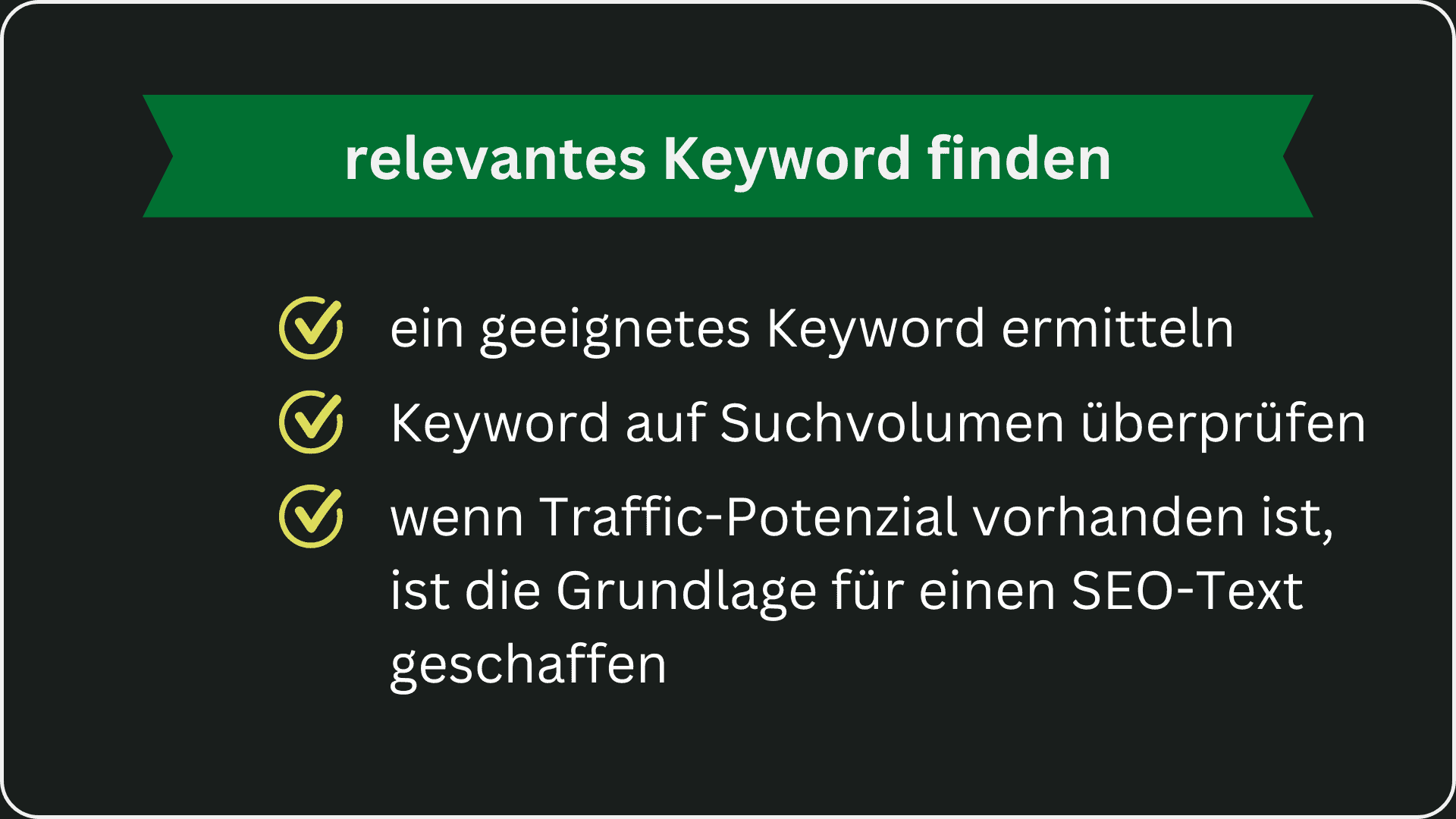
Als Allererstes ist es wichtig, ein geeignetes Keyword zu ermitteln.
It's about finding out which search terms users enter to find information about your products, services or similar content.
Of course, the most interesting terms are those for which a purchase intention can be derived.
Das heisst, User, welche diese Keywords in der Suchmaschine eingeben, sind bereit, etwas zu kaufen.
A simple example: "Buy Nike shoes", "Buy backlinks"
Neben diesen Begriffen mit einer Kaufintention gibt es auch Begriffe mit einer informellen Suchintention.
Bei diesen Begriffen möchten sich die User über ein Produkt oder ein allgemeines Thema.
These terms are not directly purchased, but with your own content you definitely have the opportunity to influence the purchase decision process or encourage users to buy your product.
To check whether this keyword actually contains search volume, i.e. whether it is worth writing SEO text in this area, we use the Ahrefs tool.
With the Ahrefs Keyword Explorer, you can search directly for the respective terms and then receive a list that shows whether the respective keyword has traffic potential.
If the answer is yes, you have found your focus keyword and thus created the basis for writing your first SEO text.
Aber Achtung: Beim Suchvolumen gilt nicht der Grundsatz mehr = besser!
Gerade zu Beginn sollte man eher mit Keywords mit tiefem Suchvolumen arbeiten, da einem mit einer neuen Webseite schlicht und einfach die Backlinks fehlen, um zu ranken.
Long-tail keywords are recommended at the beginning, i.e. smaller word series or questions with less search volume but specific search intent.
It is therefore important to take a close look at the competition, especially at the beginning.
If you see on Google that large companies such as Apple or Mediamarkt appear on the first page for the keyword you have chosen for the time being, you know immediately that it will be difficult for you to rank for this term.
Determine the search intention
Once you've found a suitable focus keyword, you need to think about what the people searching for it want to find.
If you do not satisfy the search intent, there is a high probability that you will not appear in the search results.
But how do you determine the search intention in practice?
Here is a concrete example.
Let's assume that we have defined the focus keyword "backlink guide".
In the previous step, we used Ahrefs to determine that the keyword has a corresponding search volume and is feasible for us in terms of the competitive situation.
Now we enter the keyword into Google.
The following screenshot shows the first 3 search results for the keyword "backlink guide".
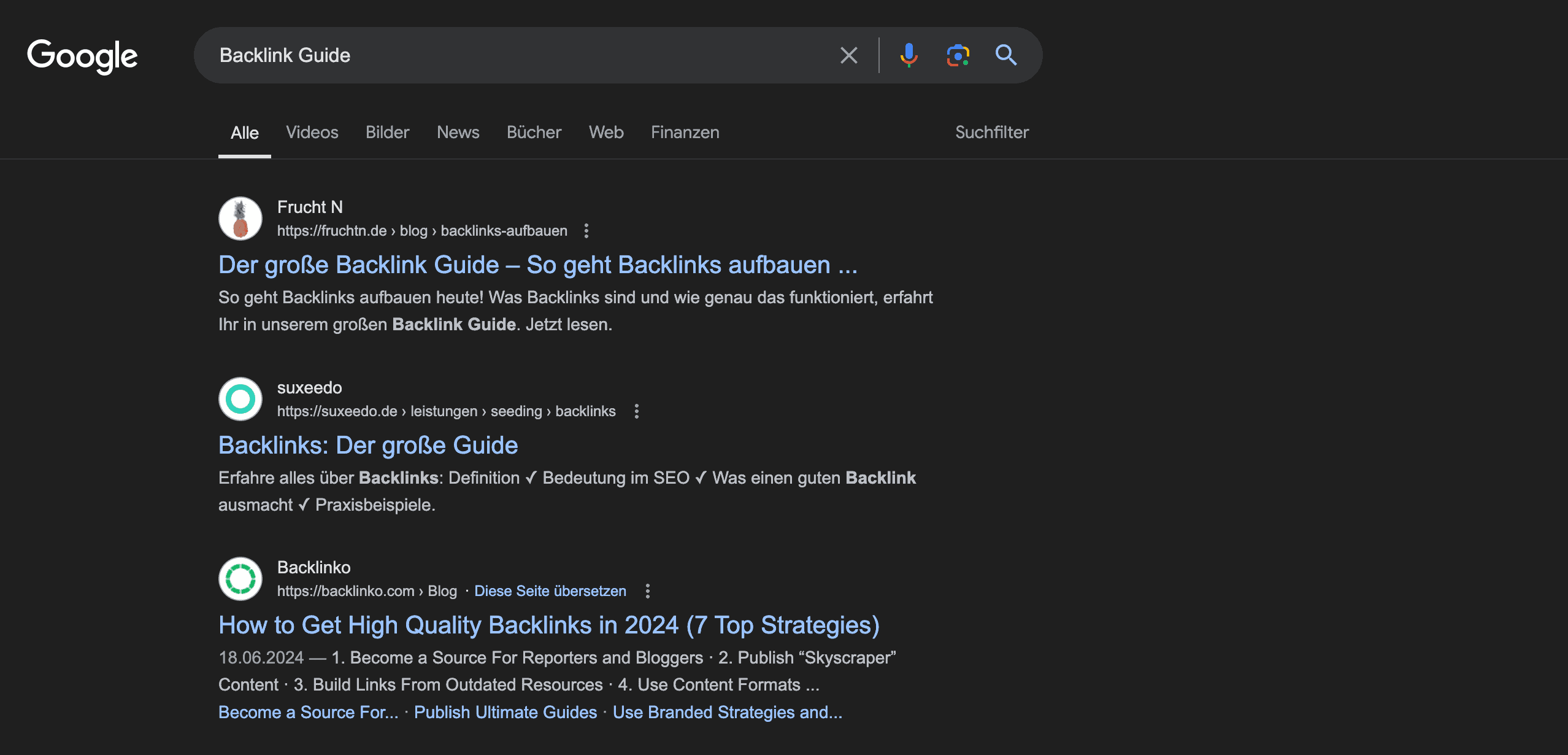
We will now analyze these three results for the following three things:
- The type of content
- The format of the content
- The approach or perspective of the content
Type of the respective content
Achte darauf, ob die ersten drei Suchergebnisse eine Landing-Page, einen Blogartikel, ein Video oder etwas anderes darstellen.
In the case of our example, the first three search results are all blog articles, with the second search result also containing a video.
In other words, we know that we have to write an informative blog article in order to land in the top ranking.
So people searching for the term "backlink guide" want to learn something and get information on this topic.
The format of the content
Hierbei geht es darum, festzustellen, ob die geschriebenen SEO Texte in Form einer Liste dargestellt wurden (Listenartikel), wir eine Anleitung haben oder etwa einen Leitfaden.
Depending on how the content is structured, you should use a similar structure.
Let's go back to our example.
If we take a closer look at the content on the topic of "backlink guide", we can see that the first three search results offer a guide through the topic of "backlinks".
For us, this means not only writing a blog article with the possible integration of a video, but also designing a guide to lead people who are interested in the topic of "backlinks" through it.
Approach or perspective of the content
The point here is to pay attention to how the individual perspectives and opinions are presented in the first three search results.
An example of this would be that the content was written specifically for beginners.
Let's look again at the content of the first three search results for our "backlink guide".
It is immediately noticeable that all three blog articles offer complete guides that are particularly suitable for beginners who have no experience in the field of backlinks.
Determine subtopics
Once we have determined our focus keyword and the search intention, we next turn to the subtopics.
For this, we turn back to the research and look at all pages that are displayed in the top ranking.
To determine the subtopics, we have the following options:
1. analyze the content and headlines of competitors
This method is very simple.
You only look at the respective headings and subheadings of all pages in the top ranking.
This will give you an idea of which companies could still be important for your page or blog article.
You may also get a few ideas on how you could expand your contributions and make them more original.
Now let's look at our example again.
This shows that many articles in the top ranking "Backlink Guide" contain subheadings such as "What is a backlink?
This shows me that I definitely need to include such a definition in my backlink guide
2. check PAA boxes (further questions)
To check the PAA (People Also Ask) boxes, re-enter your focus keyword into Google.
In many cases, you will then see these PAA boxes that show questions that people who have also searched for your topic had in mind.
In our example, the PAA boxes look like this:
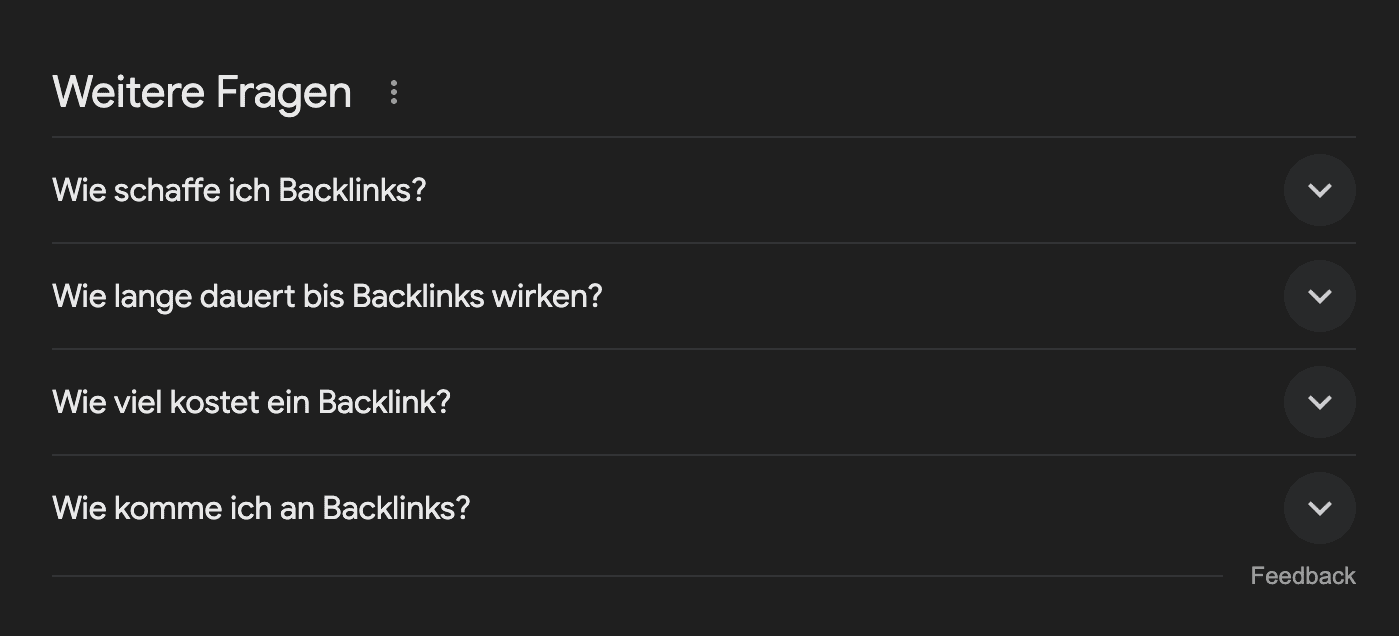
Of course, we don't have to answer every question you see there in our blog article.
For some of these questions, it is necessary to write a separate blog article.
But the PAAs can help to develop further ideas or a better understanding of the topic.
Create an outline
Before we start writing the SEO text, we need to create an outline.
There are two ways to do this.
You can either use ChatGPT to use a table of contents or you can create your own outline.
In the following section, I will explain both options in more detail.
1. chatGPT
In version 4o, you can give the AI tool specific URLs of competitors.
The first three search results are again the most suitable.
Gib ChatGPT dann einen konkreten Prompt und weise ihn an, dir anhand dieser Suchergebnisse zu deinem entsprechenden Thema ein Inhaltsverzeichnis mit entsprechenden Überschriften (H1, H2, H3 …) zu entwerfen, das alle relevanten Themen enthält.
Once you have done this, you can also instruct ChatGPT to revise the table of contents so that it not only contains the subject areas that already contain the first three search results, but that it should also include a section that is thematically appropriate and original.
This is about offering something that others don't yet offer - in other words, being unique.
2. design the outline yourself
If you want to design your outline yourself, it is best to start with an H1, which serves as a provisional title at the beginning of the outline.
Then create a logical sequence of headings.
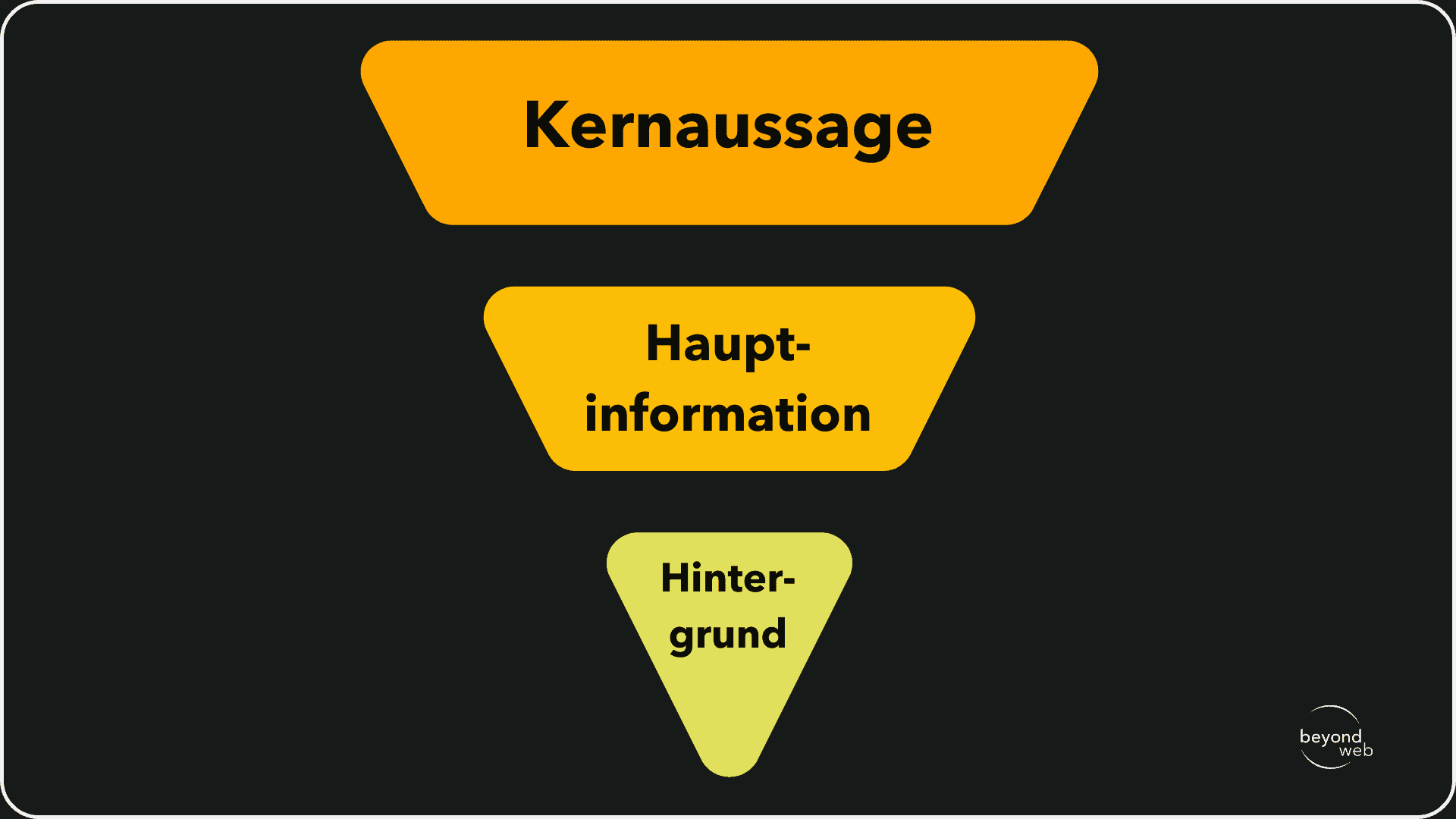
We are talking here about the "inverted pyramid" approach.
So you start with the most important points and then logically expand your argument in the article to other topics.
Egal, ob man nun seine Gliederung mit AI oder selbst erstellt: Das Wichtigste dabei ist, dass man genau überlegt, wie man eine neue Perspektive in die Thematik einbringen kann, die bisher nicht von allen anderen abgedeckt wurde.
This is again about the keyword unique.
In addition, you should make sure to bring in experience that underlines your own expertise in the respective subject area.
Butwhy is that so important?
This is about the so-called E-E-A-T criteria from Google, formerly also known as E-A-T criteria.
E-A-T steht für Expertise, Authoritativeness, Trustworthiness, also für Expertise, Autorität und Vertrauenswürdigkeit.
Diesen Kriterien hat Google nun ein weiteres E hinzugefüht, dass für Experience, also Erfahrung, steht.
Google wants the content you publish to not only exude expertise and trust, but also show that you have experience in the field.
The guidelines also clearly state how important it is for users to have content that is personalized and helpful.
If you pay attention to incorporating your own experience in your structure and then also in your content, you have taken an important step towards ranking in search engines such as Google.
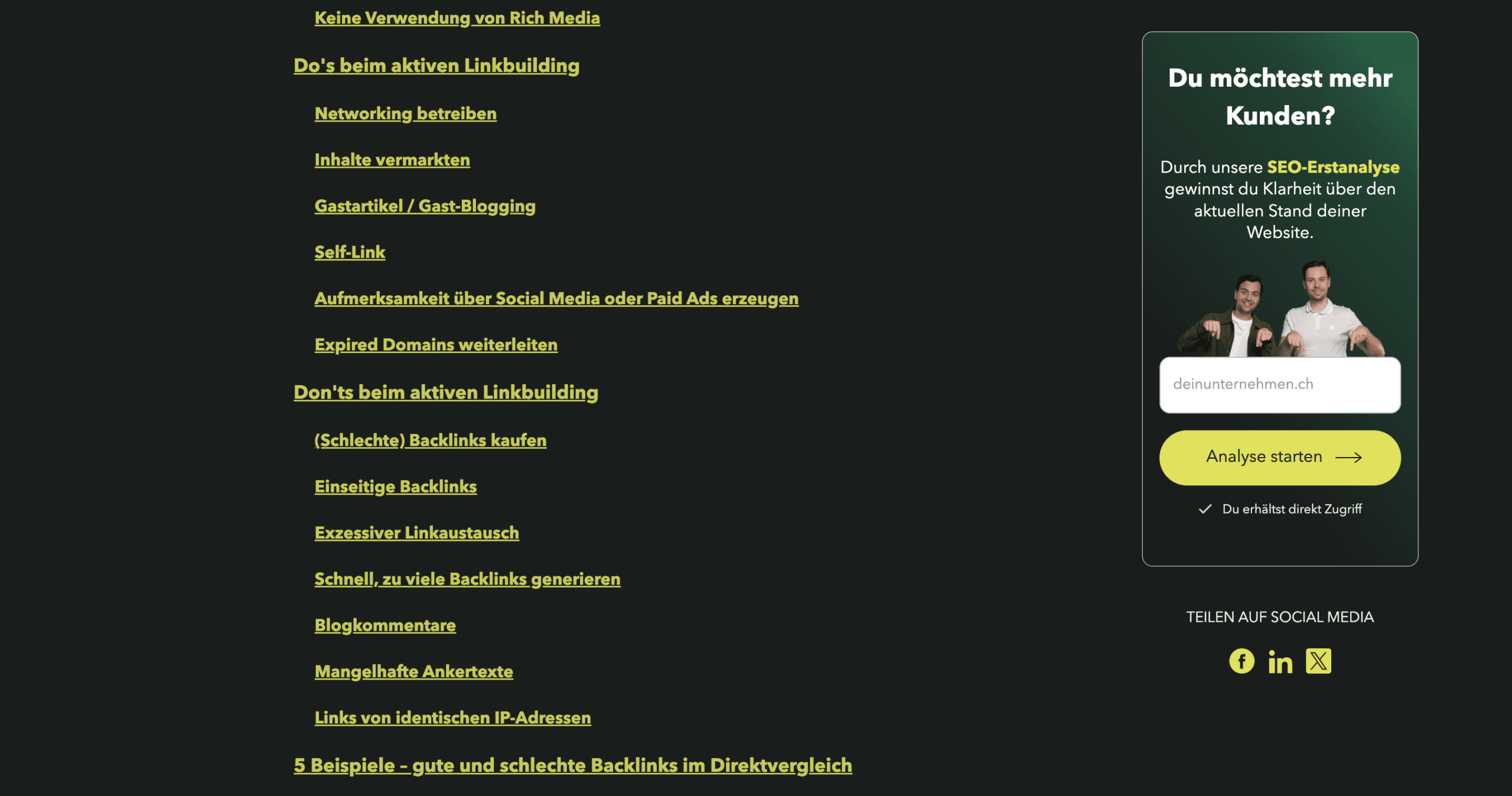
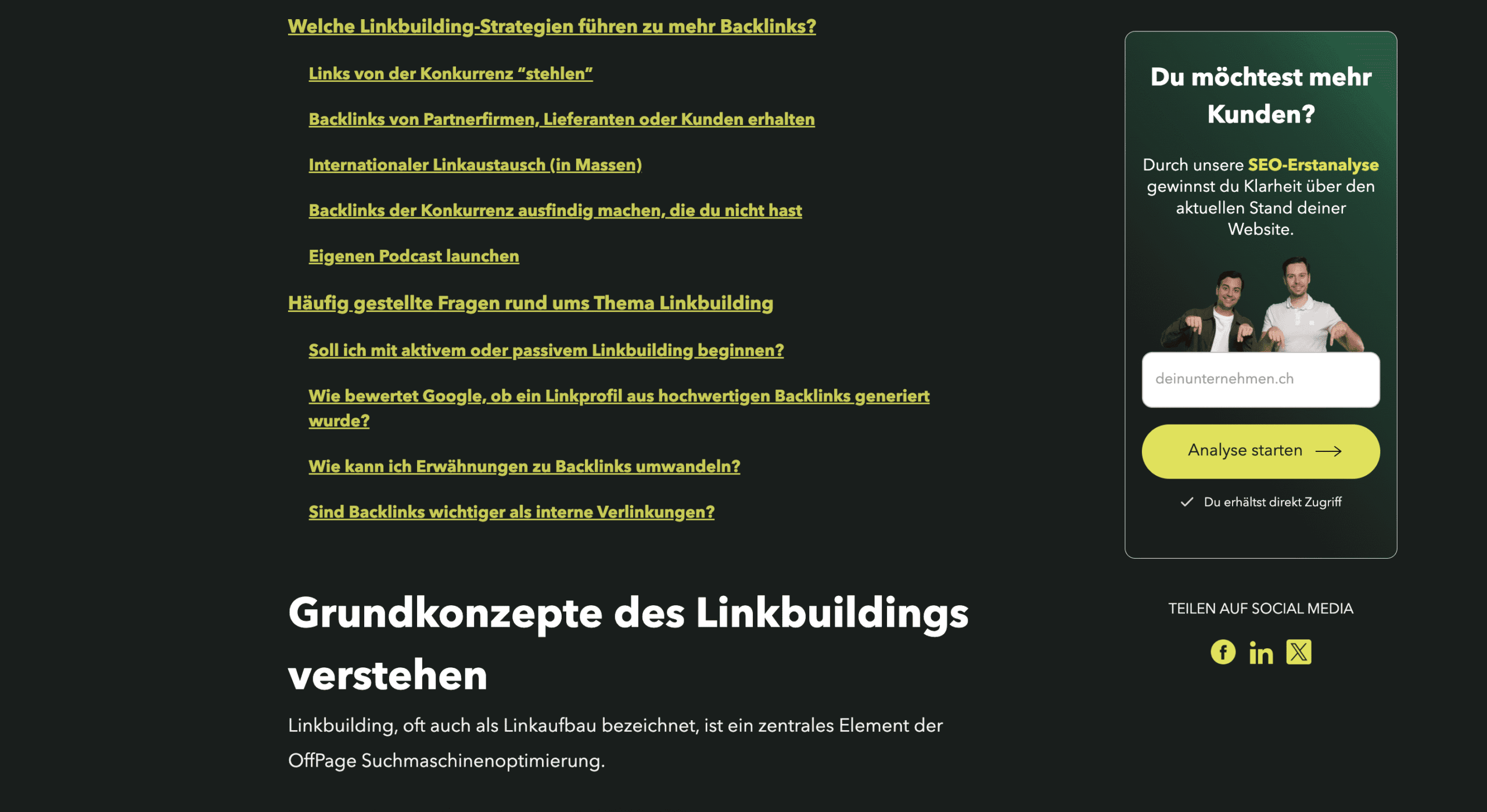
To illustrate the whole thing better, I'll now give you a practical example of what our structure for the keyword "backlink guide" looks like.
H1: BACKLINK GUIDE 2026: WIE KANN ICH MEHR BACKLINKS GENERIEREN?
H2: Understanding the basic concepts of link building
H2: What is link building?
H2: Do's and don'ts in passive link building
H2: Do's and don'ts in active link building
H2: 5 examples - comparing good and bad backlinks
H2: Which link building strategies lead to more backlinks?
H2: Frequently asked questions about link building
This preliminary outline only shows the H1 and the corresponding H2 headings.
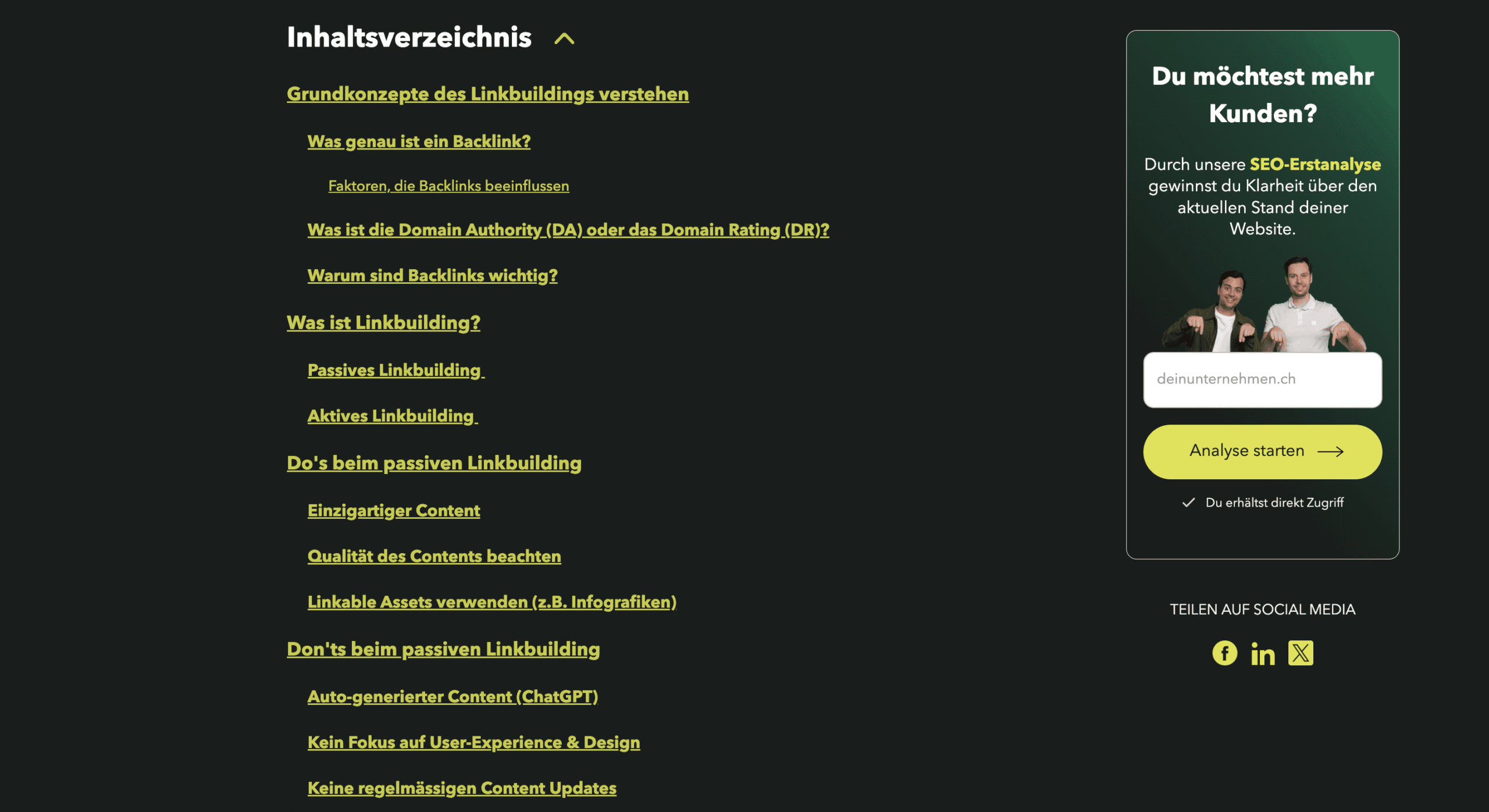
These are provided with H3 titles for better structure and comprehensibility.
At the end, the table of contents will look like this:
Write the article
Wenn die Gliederung schliesslich steht, bist du an dem Punkt angekommen, bei dem es darum geht, deinen SEO Text zu verfassen.
When writing, there are a few points you should consider.
Consider your target group and write in a friendly way
When writing SEO texts, you should make sure to write as naturally as possible.
To achieve this, you should choose a colloquial style and avoid unnecessary nested sentences.
You should also consider your target group.
This can change the tone of voice, for example whether you write in the "you" or "you" form, but also how much and what information you provide.
For example, a blog article aimed at beginners must contain more background information than a blog article aimed at people who already have more background knowledge.
You should also take care to adapt your use of technical jargon.
Adapt your vocabulary
Grundsätzlich sollten ein Blogbeitrag und der darin vorkommende Wortschatz deinem Wissen entsprechen.
This means that if you are not an expert in a certain field, you should not use words or phrases that you do not know exactly.
Because it can always happen that a subject matter expert looks at your blog post and realizes that you have used certain terms incorrectly in your SEO text, for example.
This is bad and damages your credibility.
Wenn dir, um einen Blogbeitrag verfassen zu können, Expertenwissen fehlt, ist es etwa deutlich besser, einen Experten zu interviewen und dessen Inhalte in den eigenen Blog einzubeziehen.
Füge ein Element zu deinem Artikel hinzu, das einzigartig ist
It is important to Google that your SEO text not only contains what everyone else's text contains, but that you offer readers something unique.
This could be a video, a special graphic or even a case study that you have undertaken.
A so-called link-worthy element.
Stick to the outline, but be prepared to change it
The outline you have created for your SEO text provides you with a good framework and an initial structure.
During the writing process, however, you may need to adjust the outline.
However, this is completely normal and usually helpful to make the content even clearer and more structured.
Tips for better SEO texts
To make your SEO texts even better and more interesting for readers, there are other factors that you can take into account.
I'll now show you what they are and what they can do for you.
Create an appealing title
Your title tag, or your H1 title, is the most important element for the search engine results list.
If your title isn't interesting, people won't click on it.
Current studies show that the following aspects have a significant influence on whether a title tag is interesting and is clicked or not:
- Aktualität
User zeigen mehr Interesse für aktuelle Ereignisse oder Informationen, die auf einem kürzlichen Ereignis basieren. - Relevanz
User interessieren sich mehr für Themen aus ihrem Interessengebiet. - Berühmtheit
Die Inklusion prominenter Persönlichkeiten steigert das Interesse. - Geografische Nähe
User interessieren sich tendenziell eher für Inhalte, die auf eine geografische Nähe zu ihnen hinweisen - Konflikte
User fühlen sich von Titeln mit konträren Ideen oder oppositären Menschen eher angezogen. - Unusual
Users are more attracted to titles with strange, bizarre ideas.
This means it's even more important that your title tag is really interesting and encourages people to click on your search result.
To create an optimal title, you should do the following:
- Look at your competitors and see how they have designed their titles
- Include the focus keyword in the title
In addition, you can fall back on some elements, such as:
- Numbers (example: the 10 best backlinks)
- Adjectives (example: simple, fast, ...)
- Aktualität (Beispiel: Der aktuelle Leitfaden für 2026)
- Brand names (example: Beyondwebs Backlink Guide)
- Value proposition (example: how you can write an SEO text in under an hour)
- oder Einzigartiges (Beispiel: SEO Kosten 2026 – Marktstudie von 19 Schweizer Anbietern)
Only use the respective elements if the content of your blog or page really corresponds to them!
Wählst du einen Titel nur, um die Leute anzulocken, bringt das auf Dauer nichts.
Sie werden feststellen, dass die Inhalte nicht dem entsprechen, und deine Seite sofort wieder verlassen.
Choose clear URL slug
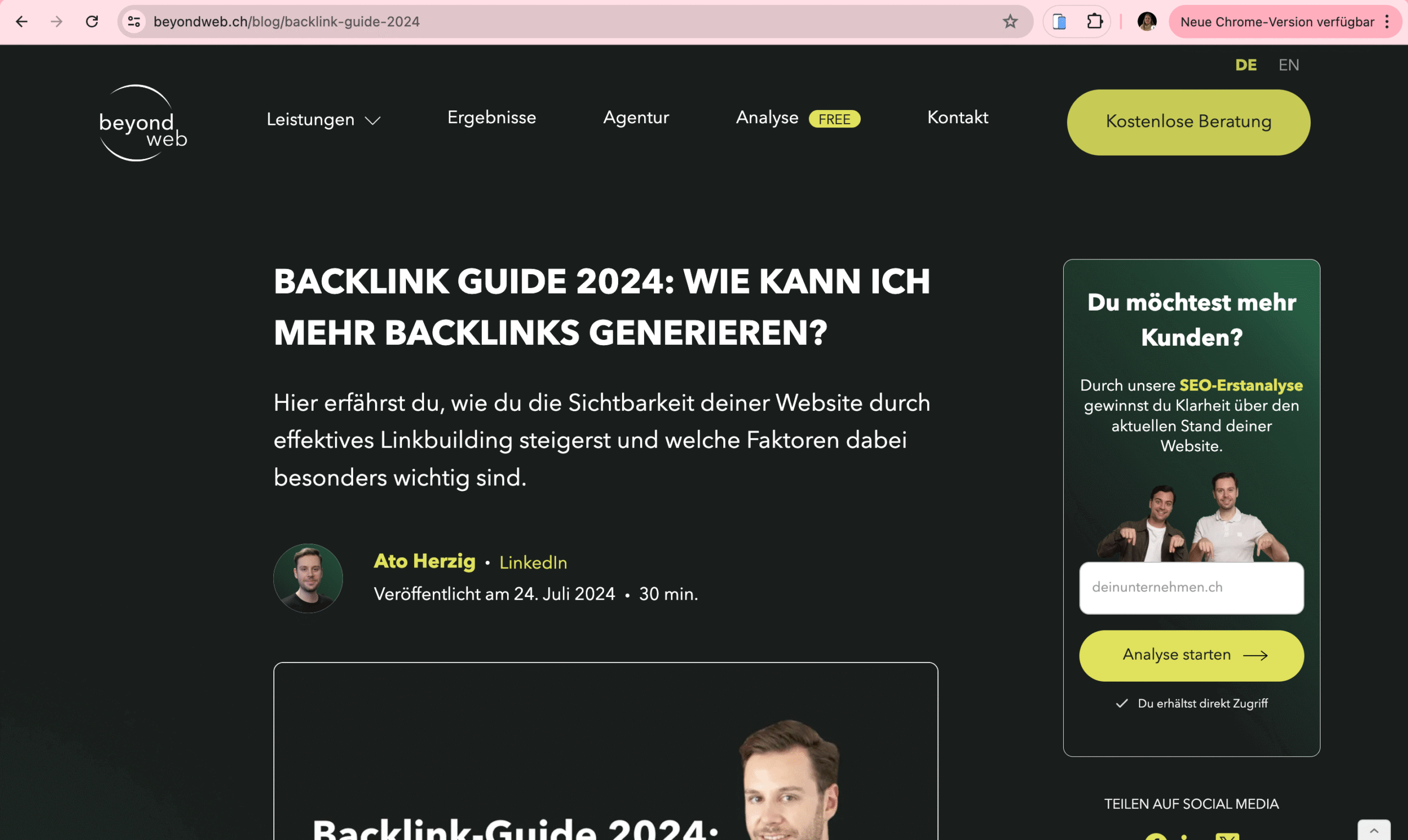
Der URL-Slug ist der Zusatz nach deinem Domain-Namen (z.B. www.beyondweb.ch/[URL-SLUG]).
Hier geht es darum, die URL so kurz und einfach wie möglich zu halten.
Only then is a URL SEO-friendly because it can be read better.
URLs that are too long are usually abbreviated in the search results list, which means that the context is lost.
As a rule, it is sufficient if the URL contains the focus keyword.
If we go back to our example with the backlink guide, the URL looks like this:
Optimize text for featured snippets
Featured snippets are displayed at the top of Google's organic search results.
In principle, they represent a brief summary.
Many search queries lead to featured snippets, and if you manage to secure one of these, your work will get instant visibility in search results.
Existiert bereits ein Featured Snippet für die Suchanfrage, für die du einen SEO Text schreiben möchtest, ergibt es Sinn, dieses genauer zu betrachten.
There are basically two forms of featured snippets:
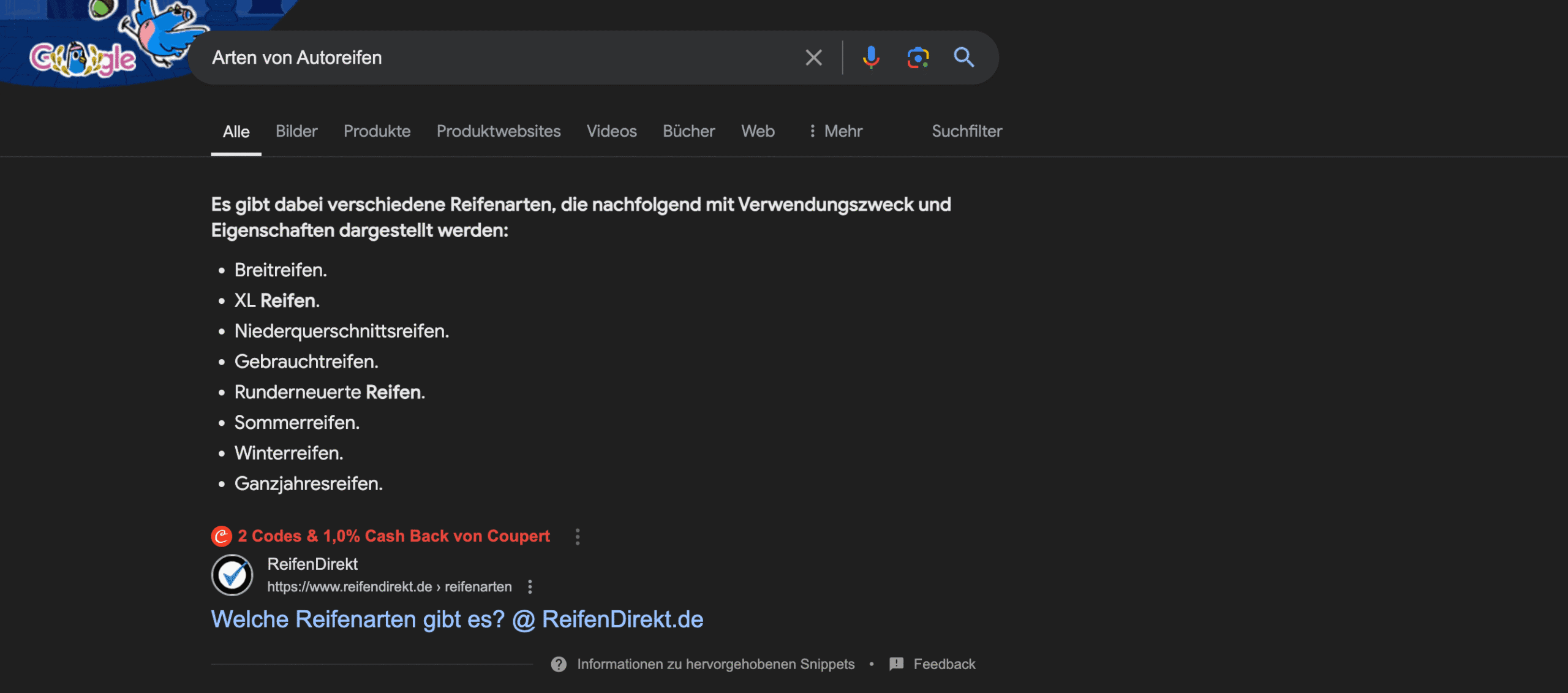
1st list snippet
As a rule, these are created by your headings.
So if you want to replace an existing list snippet, you should also automatically optimize your content for this snippet by structuring your article logically.
2nd paragraph snippet
As the name suggests, a paragraph snippet consists of a paragraph, i.e. a short text or a short summary.
If you want to use this snippet, it is important to answer the search query briefly and directly.
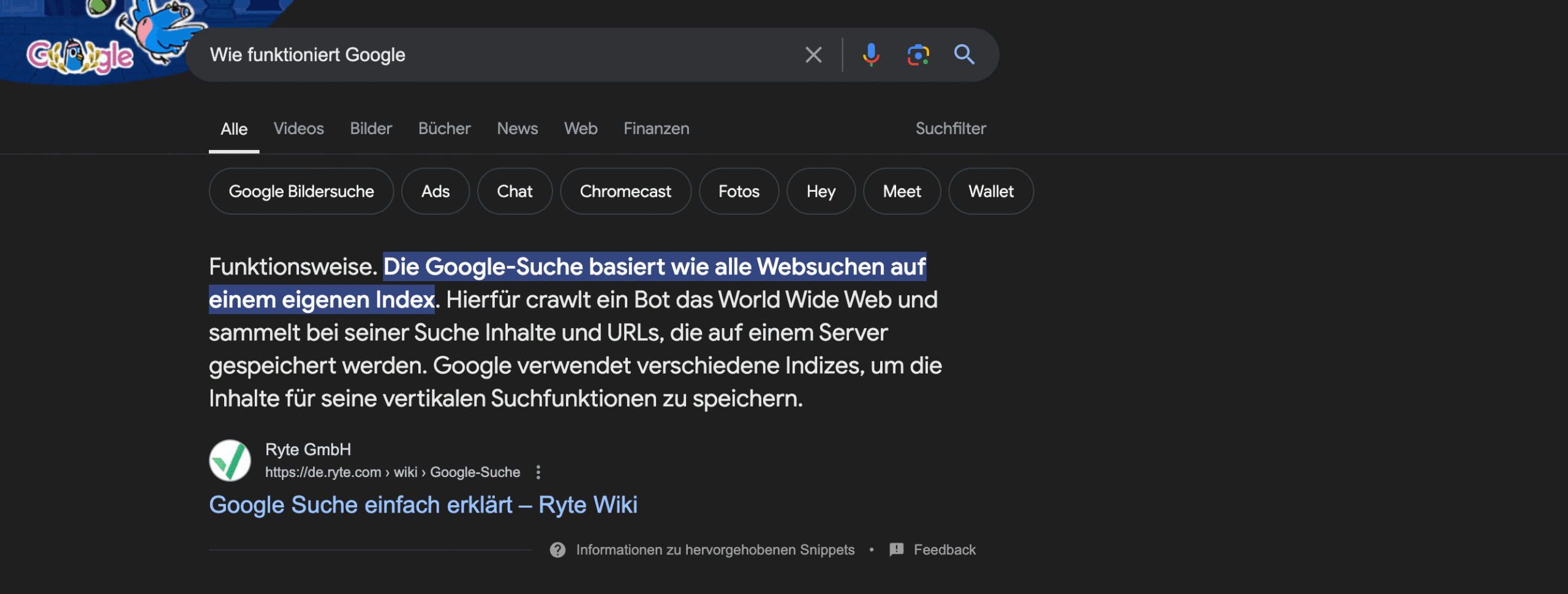
Whether the snippet is successful or not usually depends on the competition and the quality of the content.
Use internal linking
Innerhalb einer Seite oder eines Blogartikels ist es essenziell, interne Verlinkungen zu nutzen.
Du kannst schliesslich nicht alles in deinem Artikel genau erklären, und dementsprechend ist es sinnvoll, deine Leser/innen auf weitere Ressourcen, die sie nutzen können, hinzuweisen.
In addition, the internal links also help you for SEO, as Google also uses the internal links to find new content.
As you have probably noticed, we also have some internal links in our blog.
An example of this would be the Ahrefs Content Gap Tool.
Here we link to the respective tool so that you land on the right page immediately if you want to use it
Use images
In addition to writing SEO texts, you should think about improving your texts with images.
Images not only break up the text, they also help the reader to understand the content better by illustrating complex information, conveying emotions or generally increasing attention.
Ausserdem tragen gut optimierte Bilder mit beschreibenden Alt-Texten auch zur SEO bei.
Advanced techniques for SEO texts
Now that you have received a step-by-step guide from me and know how to write SEO texts and which elements you can use to make them even better, we will move on to the advanced techniques in this section.
This is about giving you even deeper insights into SEO copywriting and explaining how you can improve it even further.
Create content clusters
A content cluster is about choosing a central topic and writing an article about it, which is then linked to several thematically related sub-articles.
This approach not only signals that you have sufficient authority in a certain subject area, but also strengthens your own website through the internal links.
In addition, a content cluster makes it easier for users to navigate and find related information.
This also significantly improves the user experience.
Optimize user experience
The main aim here is to offer users a good user experience (UX).
The following elements are important for this:
- Fast loading times
- Easy navigation
- appealing design
If loading times are too long, most users will be frustrated and leave your site before they have even seen your content.
This leads to a high bounce rate and can have a negative impact on your ranking.
The same applies to navigation.
If it is too difficult for users to find your information, they will leave your site.
To increase the time users spend on your site, it is therefore important to use fast loading times and simple navigation.
If you also use an appealing design, you also promote engagement and readability.
Grundsätzlich tragen aber alle Elemente dazu bei, dass die Website von Suchmaschinen freundlich bewertet wird und das Ranking verbessert wird.
Use of data and statistics
When writing SEO copy, you can use relevant data and statistics to support the arguments you are making.
This increases your credibility, at least if you use statistics that are based on a reasonable methodology.
In addition, data and statistics are often sought and quoted by journalists.
This has the advantage that you then receive so-called linkable assets, i.e. backlinks that you gain organically.
These help you to rank better.
In addition, you can make your content even more informative by including figures, studies or research results.
The use of such data helps to illustrate complex issues, and it also shows search engines like Google that your content is well researched.
Dadurch stärkst du automatisch die Autorität deiner Seite und verbesserst dein Ranking.
Creative content formats
Wenn du SEO Content erstellst, solltest du diesen mit Videos, Infografiken oder anderen interaktiven Elementen ausbauen.
This makes your content more lively and appealing, which can increase user loyalty.
Videos mainly help to illustrate more complex topics more simply, while infographics present figures, data and facts more clearly.
Interactive elements such as quizzes or surveys can also increase user activity.
Generell gilt aber: Der Einsatz solcher Inhaltsformate, hebt dich von der Konkurrenz ab und macht deinen Content zu etwas Einzigartigem.
And this in turn always has a positive effect on the SEO ranking.
Common mistakes and how to avoid them
Now that you not only know how to write an SEO text and which elements and factors you need to consider in order to optimize it for SEO, I would like to show you the most common mistakes you should avoid.
1. keyword stuffing
Keyword stuffing occurs when you randomly squeeze a lot of keywords into your text.
Not only will your text be difficult to read, but search engines like Google will recognize your keyword stuffing and devalue your article accordingly.
So make sure to integrate the respective keywords naturally into the text.
2. lack of search intention
I have already explained to you how to align your text with the corresponding search intention.
This is about meeting the expectations and needs of users.
However, if your content is not aligned with the search intent, it is more or less worthless and will not rank.
3. duplicated content
It is important that you create unique content.
Each of your articles should offer its own added value.
If you go and simply copy content or use it multiple times, then it is no longer unique and will not rank accordingly.
4. missing internal links
As already explained, it is very important to use internal links.
On the one hand, because you can't shed light on every topic in detail, on the other hand, because it has a positive effect on your SEO.
In addition, internal links also improve your structure.
Omitting them would therefore be bad and should be avoided at all costs.
5. insufficient meta data
Very important: Don't forget the meta title and meta description!
These are crucial for the click rate and ranking and should be optimized accordingly.
The meta title can be 50-60 characters long and should always contain the focus keyword.
The meta description offers space for 150-160 characters and usually also contains the focus keyword.
Both should be designed in such a way that they encourage the user to click.
Wenn du diese Fehler vermeidest und alle anderen Schritte sowie Tipps berücksichtigst, steht deinem Schreiben eines perfekten SEO-Textes nichts mehr im Weg.
Frequently asked questions
Im folgenden Abschnitt möchte ich noch auf die häufig gestellte Fragen im Bereich “SEO-Texte schreiben lernen“ eingehen und dir entsprechende Antworten liefern:
How long should SEO texts be?
Most SEO texts have a length of 1,000 to 2,000 words.
However, it is important to pay attention to the respective topic and the competition.
For example, there are also blog posts that contain well over 5,000 words or informative pages that require less than 1,000 words.
A good tool for estimating how long the respective text should be is SurferSEO.
SEO Surfer not only tells you how many words you should write for your topic, but also shows you which titles, how many paragraphs and images you should include in the text.
In addition, SEO Surfer tells you which keywords you should integrate into your text and is therefore a very good tool for writing SEO texts.
In principle, however, the word count is not a ranking factor!
Despite this, it is important to write a little longer for certain topics, partly due to the readers' search intention.
How often should a keyword appear in the text?
Basically, your text should remain natural and reader-friendly.
Integrating too many keywords into your text leads to keyword stuffing and is not appreciated by Google.
Today, there is no longer a keyword density and an associated guideline value as there used to be.
Nowadays we speak of the WDF * IDF criteria.
In principle, WDF * IDF is a further development of pure keyword density.
This means that keywords are no longer considered in isolation, but Google tries to determine other keywords that are related to the keyword.
Accordingly, the focus is not - as in the past - on the pure keyword, but on the entire text content.
And this entire text content is compared with the content of the best 10, 15 or more websites that exist for the respective keyword.
The question: "How often should a keyword appear in the text?" can therefore not be answered with a specific number.
Vielmehr sollte darauf geachtet werden, dass sowohl das Fokus-Keyword als auch die thematisch verwandten Keywords, wie zuvor erwähnt, so natürlich in den Text integriert werden, dass es nicht als Keyword Stuffing gilt und die Lesbarkeit des Textes nicht beeinträchtigt wird.
Is it important to publish new content on a regular basis?
Yes, that is actually very important!
If you regularly publish new content or update your existing content, this will have a positive effect on your visibility and ranking.
This is because search engines such as Google are constantly looking for new, relevant content in order to provide their users with the most up-to-date information.
If your website or blog is updated regularly, this increases your chances of search engines such as Google crawling and indexing it more frequently.
This in turn leads to a better ranking in the search results.
In addition, regular updates also signal to users that your website is active and being maintained, which can have a positive effect on user loyalty and trust.
What role does social media play for SEO texts?
Social media can theoretically increase the visibility and traffic of your SEO texts.
This is referred to as "social signals".
All in all, however, these "social signals" are a weak ranking factor.
In principle, however, it still makes sense to share website content via social media in order to generate more reach.
Can I write SEO texts without technical knowledge?
Yes, you can!
Of course, basic knowledge is never a bad thing and will help you get to grips with writing SEO texts more quickly.
Basically, however, there are as many tools as SEO Surfer that can help you write SEO texts.
Wenn du dich zusätzlich an unserer Schritt-für-Schritt-Anleitung orientierst, ist es auch für jemanden ohne Grundkenntnisse möglich, SEO-Texte zu schreiben.
How can I measure the performance of my SEO texts?
Tools such as Google Analytics and Google Search Console are ideal for this.
With these you can monitor not only the traffic on your site, but also the click rate and ranking.
Damit erhältst du einen guten Überblick darüber, wie deine SEO-Texte abschneiden, und kannst deren Leistung messen.
Are backlinks important for SEO texts?
Backlinks are generally important.
This is because they increase the authority of your site and improve the ranking.
And a site that publishes SEO texts that already has a high reputation with search engines such as Google will probably rank faster than a site that does not.
Accordingly, you should also make sure that your website has appropriate backlinks.
What role does user experience (UX) play in SEO?
The user experience plays a very important role!
If users encounter a slow loading time, poor navigation or an outdated design, this usually results in them leaving your website before they've even given your content a chance.
This results in a high bounce rate, which in turn has a negative effect on the ranking.
Make sure you offer your users a good user experience to increase the time they spend on your site and reduce the bounce rate.
How can I avoid duplicate content?
Duplicate content can have a negative impact on your SEO ranking.
Das liegt daran, dass Suchmaschinen durch den Duplicate Content Schwierigkeiten haben, die relevanteste Version deiner Seite auszuwählen.
To avoid duplicate content, you should therefore make sure that every text on your website is unique and offers added value.
You can also use tools such as Copyscape or Grammarly.
Both help you to identify duplicate content and correct it if necessary.
In addition, you should also make sure that the different pages do not have the same or almost identical meta titles and meta descriptions.
With product-related texts, duplicate content can sometimes be unavoidable.
However, you should then use canonical tags to indicate to search engines which version they should prefer.