
Reasons that speak for SEO?
Die digitale Welt verändert sich rasend schnell – Künstliche Intelligenz (KI), Zero-Click-Suchen und AI Overviews prägen die Art und Weise, wie Menschen im Internet nach Informationen suchen.
The SEO field is dynamic and constantly evolving, which means that strategies and technologies are constantly changing and need to be adapted to new trends and user preferences.
Als SEO Agentur befinden auch wir uns aktuell in einer Phase des Wandels.
While some claim that SEO no longer has a place in this fast-changing world, the figures show a different picture: SEO remains one of the most profitable channels in online marketing.
Trotz der zunehmenden Integration von KI und generativen Suchsystemen wie ChatGPT bleibt Google die weltweit führende Suchmaschine.
And this is precisely where the opportunity lies:
Companies that adapt their SEO strategy to the new rules of the game can not only secure their visibility in Google search results, but also be present in AI search systems.
Doch was spricht konkret dafür, auch 2026 in SEO zu investieren?
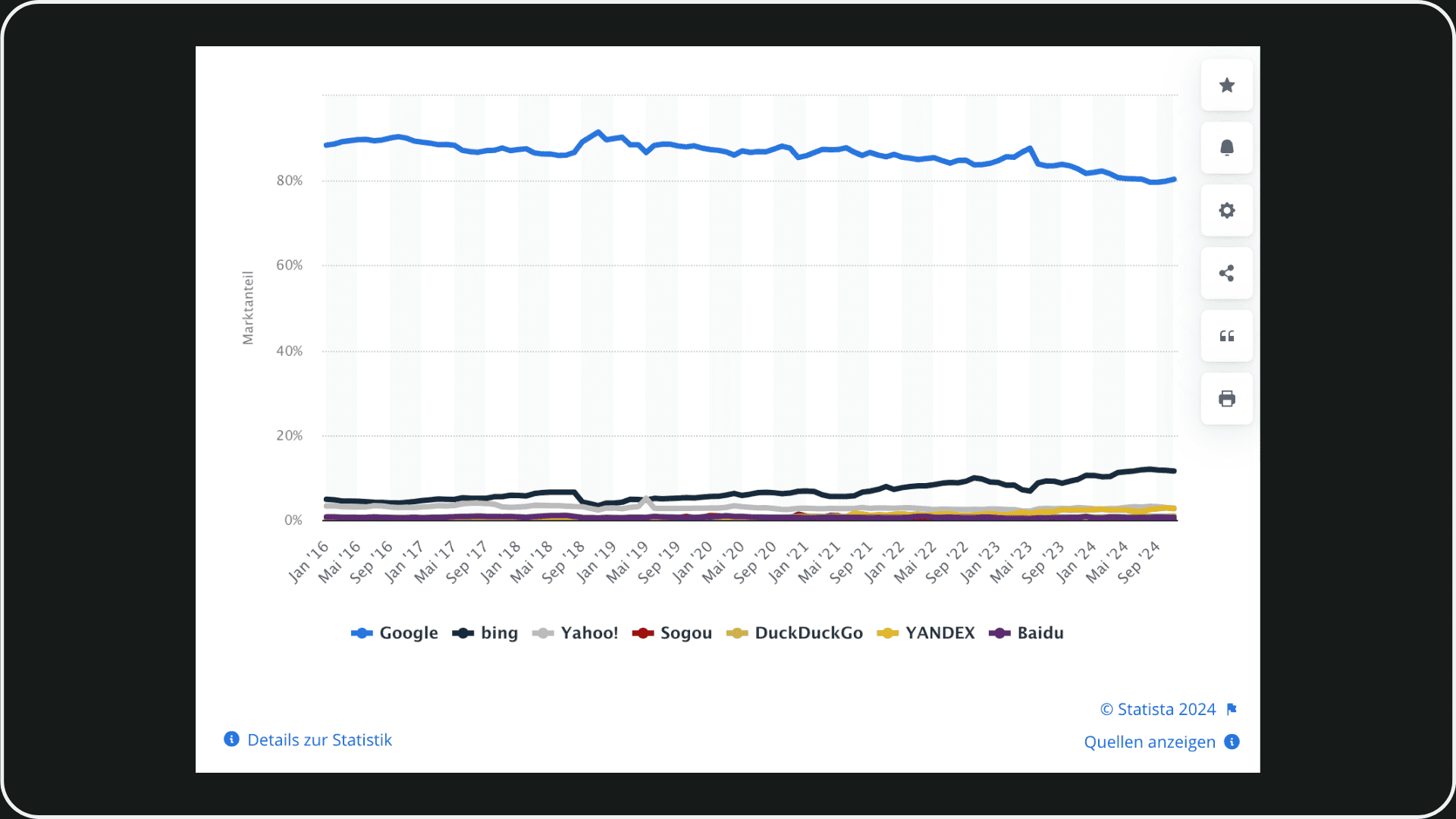
Google remains the number 1 search engine
In the same period, around 94% of mobile device users used Google for their search queries.
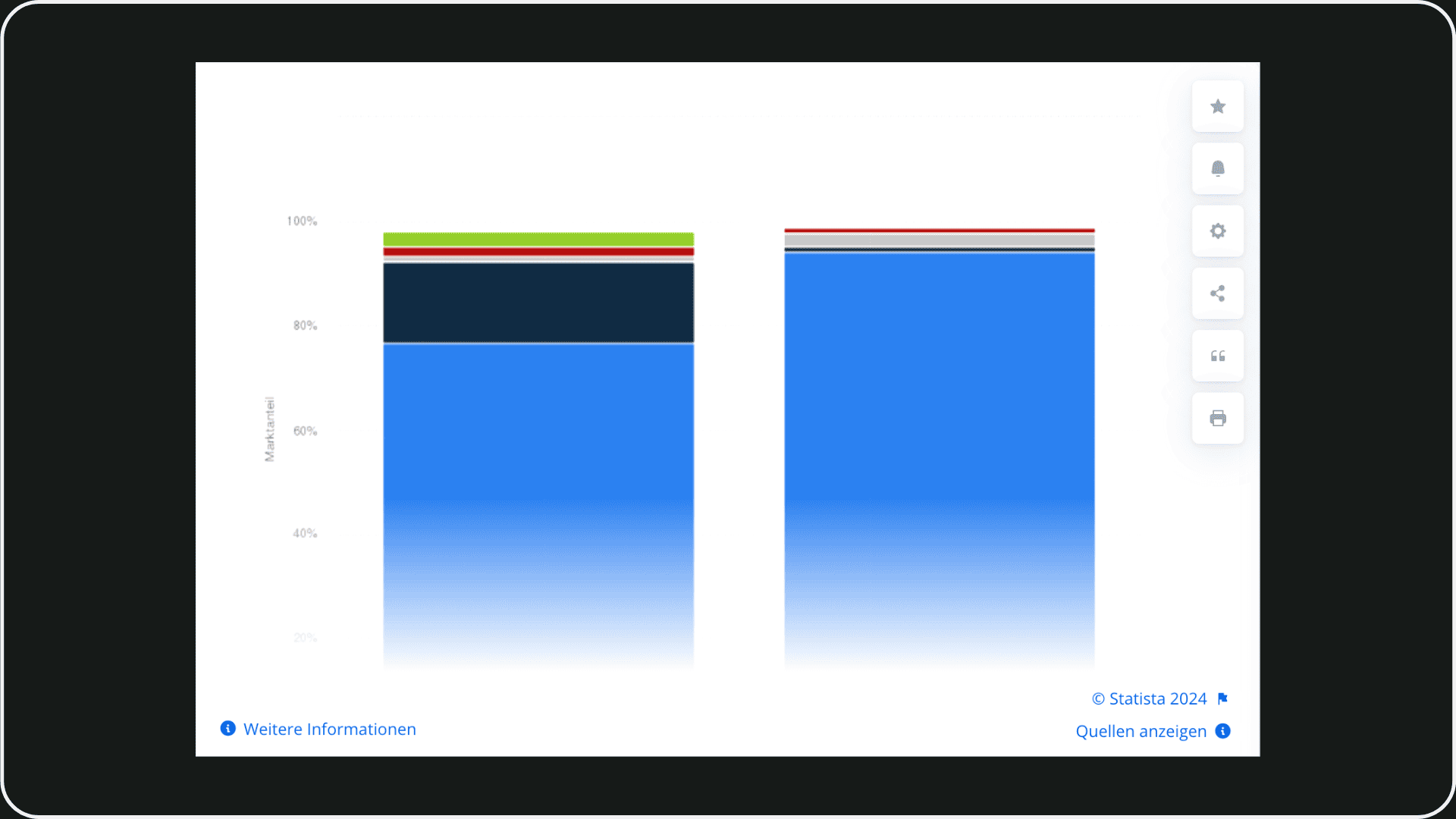
These figures show the enormous relevance of Google as the main access point for information on the Internet.
It is therefore all the more important for companies to optimize their websites for this platform.
This includes not only the content design, but also technical aspects such as loading speed and mobile optimization.
The aim is to meet both the requirements of the user and the requirements of the search engine.
E-commerce is growing - and the majority of traffic comes via Google
Online retail continues to boom and shows no signs of slowing down.
Laut der Grand View Research-Studie wird der E-Commerce-Markt bis 2030 voraussichtlich einen Wert von 83,26 Billionen USD erreichen, bei einer jährlichen Wachstumsrate von 18,9 %.
This enormous growth makes it clear how much online retail is gaining in importance, but also how important it is to be present in Google search results for relevant search queries.
But how do customers actually find their way to the stores?
The answer is clear: via Google.
Many purchasing decisions start with a Google search.
Whether terms such as "buy best headphones" or "book cheap flights " - users with a clear intention to buy use Google to compare products, prices and providers.
This makes SEO a must for companies in the e-commerce sector for the following reasons.
1. users who are ready to buy find products via Google
The crucial keywords that consumers enter when they are about to make a purchase are called bottom-of-the-funnel keywords.
Users searching for "buy now", "compare product" or "buy cheap" are in the final phase of their customer journey.
These search queries therefore show that users are ready to buy - and this is precisely where there is a great opportunity.
Wenn beispielsweise ein Nutzer nach „beste Laufband-Angebote 2026“ sucht und deine Seite hier sichtbar ist, stehen die Chancen gut, dass der Nutzer auf deine Website klickt und ein Produkt kauft.
2. competitive advantage through targeted keyword optimization
Companies that manage to optimize specifically for these keywords secure a massive competitive advantage.
Those who appear on the first page of Google for transactional search queries have a significantly higher chance of attracting buyers to their website.
My tip:
Use keyword research tools such as Ahrefs or SEMrush to identify the really profitable bottom-of-the-funnel keywords.
3 AI tools such as ChatGPT are not (yet) competitors for purchasing decisions
While AI tools such as ChatGPT can answer many information-based queries, they are not (yet) a competitor for transactional searches.
Customers who actually want to buy products use Google because they can find prices, product comparisons and real stores there.
ChatGPT may be able to provide product information, but it does not lead users directly to a purchase.
Companies that neglect their SEO and rely on AI tools such as ChatGPT may remain invisible within the user's purchasing decision.
Since Google remains the place where purchasing decisions are made, stores must ensure their visibility in Google search queries.
Was bedeutet das nun konkret für SEO im Jahr 2026?
Für Online-Shop-Betreiber bleibt SEO auch im Jahr 2026 unverzichtbar.
Those who focus on transactional keywords and align their content with this type of search query have the best chance of increasing their visibility among users who are ready to buy.
Older target groups hardly use AI
The use of search engines and AI tools varies greatly between age groups.
While younger people are increasingly relying on AI-based applications such as ChatGPT, older target groups remain true to their habits and prefer Google.
Laut der IGEM-Digimonitor-Studie 2024 nutzen nur 40 % der Schweizer:innen KI-Tools wie ChatGPT – bei den 15- bis 19-Jährigen sind es dagegen beeindruckende 70 %.
This shows: The willingness to integrate new technologies such as AI into everyday life is significantly higher among young people than among older target groups.
But that's not all.
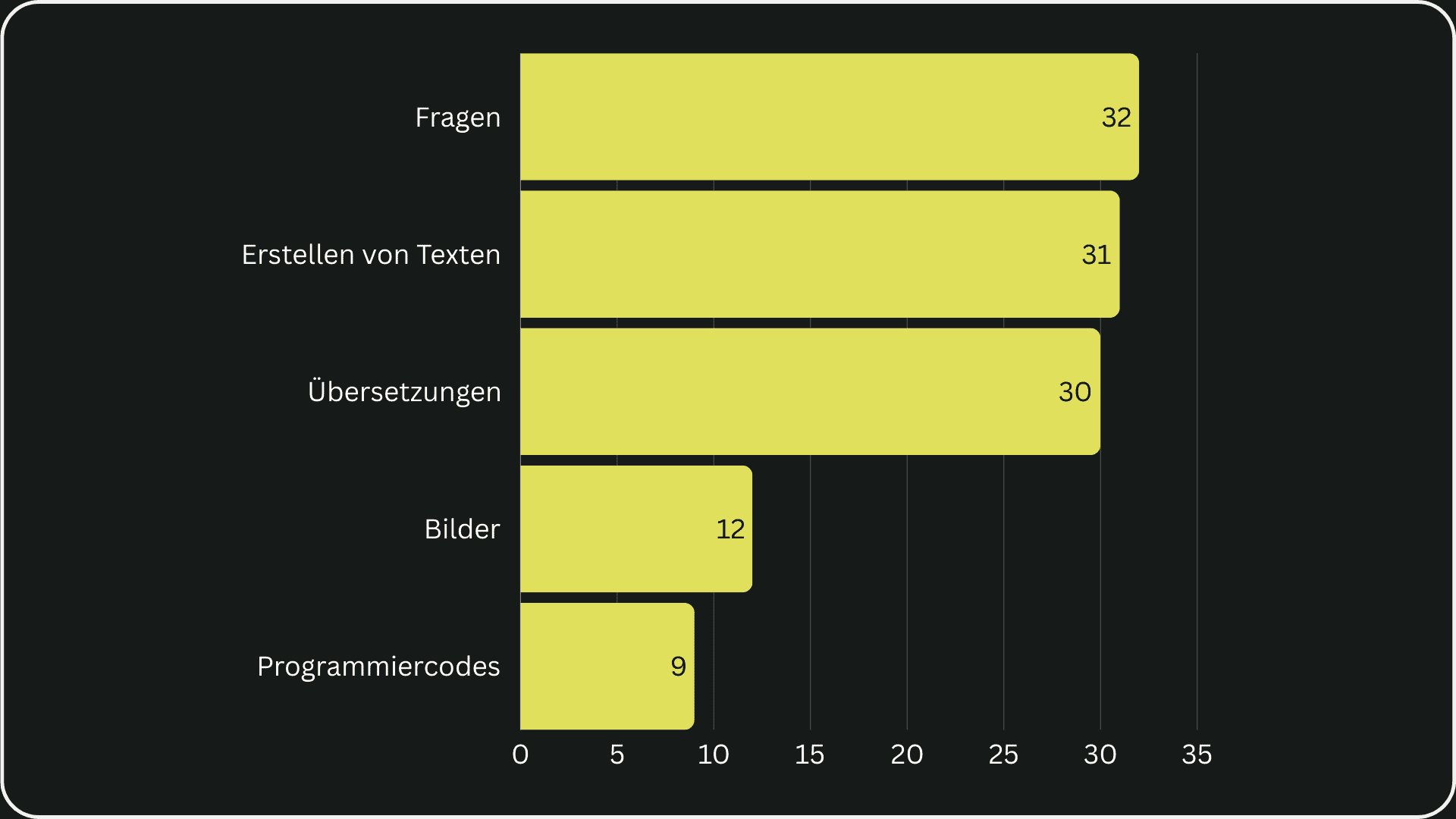
The IGEM Digimonitor study also provides insights into the main uses of AI tools in Switzerland:
- 32% of Swiss people use AI to answer questions
- 31 % use them to create texts
- 30% rely on AI to carry out translations
This shows that AI tools such as ChatGPT are preferred above all for information-based queries - not for transactional searches or product purchases.
While younger users are adapting quickly to new technologies, the IGEM Digimonitor Study 2024 also shows that older target groups continue to rely on traditional search engines.
Google remains the preferred choice for search queries.
There are several reasons for this:
Trust and habit
Older users stick to platforms that they have been using for years and that they trust.
For many people, Google has been the first port of call for Internet searches since the early 2000s.
This habit has become ingrained - also because Google has continuously optimized its user-friendliness over the years.
Ignorance of new technologies
Many older users do not have direct access to information about new technologies such as AI tools.
They are not familiar with terms such as "ChatGPT" and do not immediately understand the added value of such tools.
This means that Google remains the preferred platform.
Comfort zone
The use of new technologies such as AI tools requires a certain learning curve.
Older target groups tend to stick to the familiar because it is easier and more convenient.
Why should they try out new tools when Google already offers everything they need?
Warum ist das aber nun wichtig für SEO im Jahr 2026?
Older target groups often make up a large proportion of affluent consumers.
This is because their purchasing power is higher than that of younger target groups.
Und da ältere Zielgruppen hauptsächlich auf Google und (noch) nicht auf KI-Tools wie ChatGPT zurückgreifen, ist SEO demnach auch 2026 die beste Möglichkeit, diese Nutzer zu erreichen.
SEO for AI searches
Another exciting development is the increasing combination of SEO and artificial intelligence.
Companies that optimize for Google also benefit from visibility in AI search queries (as in ChatGPT or SearchGPT).
This is because AI models such as ChatGPT rely on publicly accessible content.
So anyone who invests in traditional SEO measures automatically has a chance of being listed in AI-based search systems.
Was bedeutet das nun für deine SEO-Strategie?
Optimization for AI searches and classic Google searches overlap considerably.
By optimizing content for Google SEO (with keywords, core web vitals, structured data, etc.), you also increase the chance that your content will be used in AI-generated answers.
Technical SEO remains relevant
Google is becoming even stricter with the Core Web Vitals (Largest Contentful Paint, First Input Delay and Cumulative Layout Shift).
User experience and loading speed will therefore continue to be important ranking factors.
Websites that load quickly are therefore rated better.
But why is that important?
- Fast websites lead to lower bounce rates.
- Better user experience (UX) leads to better rankings.
- Core Web Vitals are becoming a mandatory program for every website.
What does this mean for your SEO?
As a website operator, you need to ensure that your site loads quickly, is easy to navigate and remains mobile-friendly.
This is because Google rewards a better user experience with higher rankings.
Zero-click searches are on the rise - but SEO still pays off
Zero-click searches (search queries that are answered on the results page without a click) are on the rise.
Google displays weather, currency conversions, definitions and more directly in the search results.
This can lead to a decrease in clicks.
But why is that important now?
And to what extent is SEO still worthwhile?
Users get answers directly in the search and often no longer click on the websites.
This means that content that can be easily answered by AI (e.g. definitions) should no longer be prioritized.
But more in-depth content that an AI cannot answer is becoming all the more important.
You should therefore move away from purely information-based keywords and concentrate on more in-depth content.
And with this in-depth content, you can generate organic traffic and also increase your conversion rate.
Video SEO is becoming more important
Video content is gaining in importance.
Platforms such as YouTube are the second largest search engine in the world.
YouTube videos also frequently appear in Google search results.
Due to the increasing demand for video content, video SEO must be an integral part of any SEO strategy.
But why is this important?
- Google displays videos in the search results.
- Users prefer videos for complex topics.
- Video content is shared more frequently, which increases visibility.
If you are explaining products or services, it is therefore very worthwhile to create video content.
Make sure to optimize the video titles, descriptions and metadata.
Reasons that speak against SEO?
Die Suchmaschinenoptimierung (SEO) wird im Jahr 2026 mit neuen Herausforderungen konfrontiert.
Artificial intelligence (AI), generative search and AI overviews are changing user behavior and influencing the way content is presented in search results.
Accordingly, there are of course not only reasons that speak in favor of SEO, but also reasons that speak against it.
In the following section, I would like to discuss the most important arguments against SEO.
AI and generative search take away traffic
One of the biggest threats to SEO is the introduction of AI Overviews.
Diese Funktion, die bereits ausgerollt wurde, ermöglicht es Suchmaschinen wie Google, KI-generierte Antworten direkt in den Suchergebnissen anzuzeigen – oft oberhalb der klassischen organischen Ergebnisse.
Deshalb fragen sich viele: Lohnt sich SEO überhaupt noch?
But how exactly does AI Overviews work?
When a user enters a question into Google Search, the AI's intelligence generates a direct answer and presents it at the top of the search results.
This means that in most cases, the user no longer sees the need to click on the organic search results, as they already receive their answer at the top of the search results.
According to a Gartner study, up to 25% of organic traffic could be lost as a result.
What does that mean?
Pages that currently rank for informative keywords such as "What is SEO?" or "How does voice search work?" are losing potential traffic because users are already finding their answers in the AI overviews.
In particular, blogging SEO is becoming more difficult, as many informal searches are also requested by users via ChatGPT.
Accordingly, you should focus on deep content, i.e. search queries and keywords where an AI response is not sufficient, but more information is needed to satisfy the search intention.
It is best to focus on long-tail keywords here, where the user wants specific expert opinions and 150-word answers from ChatGPT are definitely not enough.
Affiliate marketing is almost no longer possible
Since the Google Helpful Content Update 2023, it has become difficult for many affiliate websites to remain profitable.
Where a simple product recommendation used to suffice, Google now demands high-quality, user-centered content.
Websites based purely on affiliate links are downgraded algorithmically.
But why is that?
Google wants to improve the user experience (UX) and create rewards for content that offers users real added value.
Pages that are primarily aimed at generating affiliate commissions are therefore classified as "not helpful" - especially if the text does not offer any additional added value.
But what content does Google classify as "unhelpful"?
- "Thin content" (content without real added value)
- Automatically generated product lists without in-depth analyses
- Content pages with too many affiliate links
Eine simple Seite mit einem Affiliate-Link wie „Top 10 Küchenmesser 2026“ reicht demnach nicht mehr aus.
Instead, Google expects expert opinions, personal experiences, test reports and in-depth information on the products.
Those who fail to deliver this risk losing their visibility in the search results.
SEO-Trends 2026: Fokus auf E-A-T
Das Konzept von E-A-T steht bei SEO im Jahr 2026 definitiv im Vordergrund.
E-A-T stands for the following:
- Expertise: Prove your knowledge with well-founded analyses, real tests and personal experience.
- Authority: Show that your website is authorized in a specific area (e.g. electronics, sports equipment).
- Trust: Users should trust your site. This requires transparency, an imprint, author profiles and no misleading affiliate links.
As a website operator, it is therefore essential to move away from the idea of creating simple affiliate sites.
Much more so, you should position yourself as an expert in the respective field and offer users unique content that goes far beyond a simple product list.
SEO is becoming more competitive - and therefore more expensive
SEO wird im Jahr 2026 härter, teurer und anspruchsvoller.
New technologies such as AI overviews and the increasing number of zero-click searches are intensifying competition for the top 3 positions in search results.
Companies that used to be successful with "simple SEO measures" are now faced with a completely new reality.
This is a problem because only the first three places in the search results receive the majority of traffic.
Studies show that over 60% of clicks go to the first three positions.
Since AI overviews will take up a large part of the search interface in the future, the classic organic hits will slide even further down.
Warum wird SEO 2026 so viel kompetitiver?
Introduction of AI Overviews
AI Overviews provide users with an AI-generated answer to their questions in the search results preview - without them having to click on a website.
Was änderte sich dadurch?
- Displacement of classic search results: AI Overviews appear at the top and displace the first organic hits.
- Falling click-through rate (CTR) for organic hits: Many users receive their answers directly in the AI box and no longer click on links.
- More effort for SEO strategies: Companies must optimize their content so that it is recognized as relevant by the AI in order to be included in the AI overviews.
What can you do?
- Create deep content that outperforms AI-driven responses.
- Focus on long-tail keywords that are more specific and deeper than generic questions like "What is SEO?".
- Strengthen E-A-T (expertise, authority, trust) in order to be considered a trustworthy source for AI systems.
Zero-click searches on the rise
Zero-click searches are search queries where the answer is displayed directly in the search results.
Users no longer have to click on a website to find the information they are looking for.
These searches have increased due to featured snippets, knowledge panels and AI overviews.
What will change as a result?
- Falling click rates: Websites that used to generate clicks through informative content are losing this traffic.
- Less traffic, even though you rank: Even if you appear in the top 3, the user can already be satisfied by the AI Overview or the Featured Snippet.
What can you do?
- Focus on content that AI cannot answer directly, such as detailed tutorials, instructions or specific expert opinions.
- Use structured data markup so that Google understands the content better and can use your website as a source in featured snippets.
Competition for the top 3 positions is getting tougher
The top three positions have always been valuable, but now the pressure is even greater.
Während früher auch Positionen 4-10 Traffic generierten, werden diese jetzt durch AI-Boxen, Google Ads und Zero-Click-Suchen nach unten gedrängt.
Why is this problematic?
- 1st to 3rd place is the new obligation: only the first three places receive the majority of clicks.
- Competition is increasing: As companies recognize the importance of the top 3, more and more are investing in SEO, increasing competition.
- Rising costs: SEO agencies and in-house teams have to spend more time and resources to reach the top positions.
What can you do?
- Create content that answers more in-depth questions (deep content) and cannot be covered with a short AI answer.
- Focus on bottom-of-the-funnel keywords (e.g. "buy headphones" instead of "what are the best headphones?").
- Backlinks from reputable sites increase the authority of your website and help you to reach the top 3.
SEO is getting more expensive - but why?
The increased complexity of SEO requires not only more time, but also more expertise.
SEO agencies and internal SEO teams have to deal with technical requirements (core web vitals, loading speed, mobile-first indexing) and content requirements (E-A-T, AI content).
Technical SEO is becoming more demanding:
- Loading speed (Largest Contentful Paint) must be extremely short.
- Core Web Vitals are decisive ranking factors.
- Mobile-first indexing requires that mobile versions of the website function without errors.
Content must be better:
- "Thin content" no longer works. Companies need to create content with added value (deep content).
- Expert opinions, comprehensive product analyses and tutorials are in demand.
Competition is becoming more expensive:
- SEO agencies have to put in more effort to survive in a competitive field.
- Companies have to wait at least 6-12 months for the results, which requires a long-term investment.
What can you do?
- Prioritize technical SEO (core web vitals, loading speed, mobile-first indexing).
- Invest in tools for keyword research and content optimization (e.g. Ahrefs, Semrush, SurferSEO).
- Work with SEO experts to help you survive in a highly competitive market.
SEO takes longer than before
In der Vergangenheit konnte man durch gezielte Massnahmen innerhalb von 3–6 Monaten sichtbare Ergebnisse erzielen.
2026 dauert SEO jedoch länger – 6 bis 12 Monate oder mehr.
This is due to increased competition, higher content requirements and the impact of AI overviews.
- Googletakes longer to rank E-A-T: Websites need to demonstrate authority, trust and expertise.
- Technical changes take longerMeasures such as the optimization of the Core Web Vitals take time.
- Competition for backlinksGetting links from reputable sites takes time.
Google will place more ads - like every year
Google wird auch im Jahr 2026 voraussichtlich mehr Anzeigen (Ads) und Widgets in die Suchergebnisse integrieren.
Das ist ein Trend, den wir bereits in den vergangenen Jahren beobachten konnten, und er hat direkte Auswirkungen auf die Sichtbarkeit der organischen Suchergebnisse.
Ads are taking up more and more space on search results pages, especially on mobile devices where space is limited anyway.
This development is increasingly affecting the ROI of SEO, as the click-through rate (CTR) for organic hits continues to fall.
With the introduction of AI Overviews, the situation becomes even more critical.
As these generated AI answers appear directly above the organic results, traditional search results lose even more visibility.
The combination of Google Ads, AI Overviews and widgets means that organic search results are often only visible "below the fold", which can lead to a drastic drop in clicks.
Companies that have previously relied on purely organic SEO strategies must therefore adapt their approach.
There is also speculation that Google could also integrate advertising into AI Overviews.
This would mean that not only would traditional search results be replaced by ads, but AI-generated answers would also be interspersed with advertising formats.
For companies that rely heavily on organic traffic, this could mean a further loss of visibility.
This development therefore has direct consequences for the SEO strategy of companies.
As the top positions are increasingly taken up by ads and AI widgets, it is becoming more difficult to reach the top positions with organic content.
Companies must therefore focus more on bottom-of-the-funnel keywords that signal a clear intention to buy and prioritize long-tail keywords that have less competition.
In addition, the topic of E-A-T (expertise, authority, trust) is moving further into focus.
Websites that impress with high content relevance and expert opinions have a better chance of being found in organic results.
Google may be split up and lose market share
The US government has proposed in antitrust proceedings that Google should sell its Chrome browser in order to reduce its dominant position in the internet search market.
This measure aims to break up the close integration of Chrome with other Google services, which are considered anti-competitive.
Chrome is currently the world's leading web browser with a market share of over 60 %.
This dominance enables Google to set its search engine as the standard and thus control the flow of data, which further strengthens its position in online marketing.
A forced sale of Chrome could significantly change this dynamic, as Google would then no longer be able to seamlessly integrate its search services into the browser.
If Google is forced to sell Chrome, this could lead to a significant loss of market share.
Many users could then switch to alternative browsers that use other search engines as standard.
In addition, competitors such as Microsoft Edge or Mozilla Firefox could strengthen their positions, which would intensify competition in the browser market.
In addition, innovative search solutions such as SearchGPT could gain in importance and take further market share away from Google.
Such a development would have far-reaching consequences for online marketing.
Unternehmen müssten ihre Strategien anpassen, um in einer diversifizierten Browser- und Suchmaschinenlandschaft effektiv zu bleiben.
Die Notwendigkeit, Inhalte für verschiedene Plattformen zu optimieren, würde steigen, und die Abhängigkeit von Google als primärem Kanal könnte abnehmen.
All in all, the split-up of Google and the possible sale of Chrome could lead to a realignment of the digital market, with potentially positive effects on competition and innovation in the field of search technologies.
SEO 2026 – Komplexer, teurer, aber immer noch unverzichtbar
SEO is changing - and with increasing speed.
Artificial intelligence (AI), AI overviews and zero-click searches are presenting the SEO world with new challenges.
Top-of-the-funnel keywords (i.e. informative queries such as "What is SEO?") are increasingly being answered by AI searches without users having to click on a website.
Doch trotz dieser Veränderungen bleibt Google die dominierende Suchmaschine weltweit – und das wird sich auch 2026 voraussichtlich nicht komplett ändern.
Google is not only the platform on which most people make their purchasing decisions, but also the central point of contact for the boom in e-commerce.
Companies that are highly visible on Google can continue to rely on sustainable organic traffic and thus potentially higher sales.
Warum SEO auch 2026 relevant bleibt
Google remains number 1
Although AI searches such as ChatGPT are becoming increasingly popular, Google remains the most used search engine in the world.
Transactional search queries - i.e. queries with a clear intention to buy - continue to run via Google.
While users often ask simple questions on AI tools, Google and e-commerce platforms are still preferred for purchasing decisions.
SEO is not just Google
SEO is no longer limited to Google.
Many of the measures you implement to optimize your website for Google also have an effect on AI search systems such as ChatGPT or Bing AI.
Optimierungen bei der Ladegeschwindigkeit, der Mobile-First-Indexierung und den Core Web Vitals verbessern die Sichtbarkeit deiner Inhalte – sowohl bei Google als auch bei KI-gestützten Suchsystemen.
SEO prepares you for the future
Even if the rules change, one thing remains certain: SEO remains relevant.
The rules of the game may become more complex, but companies that adapt to these changes now will benefit in the long term.
KI searches will be further developed in the coming years, but these systems also need content that they can display to users.
If your content ranks well in search engines such as Google, there is a good chance that it will also be present in AI searches.
Yes, SEO is getting more expensive - but the ROI remains high
Increasing complexity and growing competition are making SEO more expensive.
Companies that want to be successful with SEO need to invest more time, resources and expertise.
Technical SEO (such as Core Web Vitals), deep content and E-A-T (expertise, authority, trust) are becoming decisive factors.
Doch trotz der höheren Kosten bleibt SEO einer der profitabelsten Kanäle im Online-Marketing.
Compared to paid advertising (Google Ads), SEO offers long-term, "free" traffic.
A top ranking on Google brings visibility, clicks and sales - permanently.
Companies that invest in their SEO strategy at an early stage secure a long-term advantage over the competition.
Free initial SEO analysis for your website
If you are overwhelmed with the optimization of your website or the development of an SEO strategy, we at Beyondweb are the right contact for you.
Our free initial SEO analysis will give you a clear idea of how much traffic potential your website has - and, above all, which errors are currently preventing you from achieving better rankings.
What do you get with the initial SEO analysis?
- Detailed analysis of your website: We examine technical weaknesses, content and the user experience.
- Specific SEO tipsYou will receive individual recommendations from us that will show you how you can increase your visibility.
- Assessing your potentialHow much potential does your website really have? We'll show you where the biggest leverage for more traffic is hidden.
And best of all, the initial SEO analysis is completely free and non-binding.
Just fill out our contact form and our team at Beyondweb will get back to you.
Together, we develop an SEO strategy that is tailored precisely to your website.
It has never been easier to improve your visibility in search engines and benefit from organic traffic in the long term.