

Practical checklist (incl. tools) for the backlink check
Good backlinks depend on various factors.
To help you understand these factors, we have created a checklist including tools for the backlink check.
In the following section, I will explain the individual points step by step:
1. where was the backlink inserted on the website?
The placement of backlinks on a website is an important aspect.
The place where a backlink is placed on a website can have a significant influence on how search engines evaluate this link and what value it has.
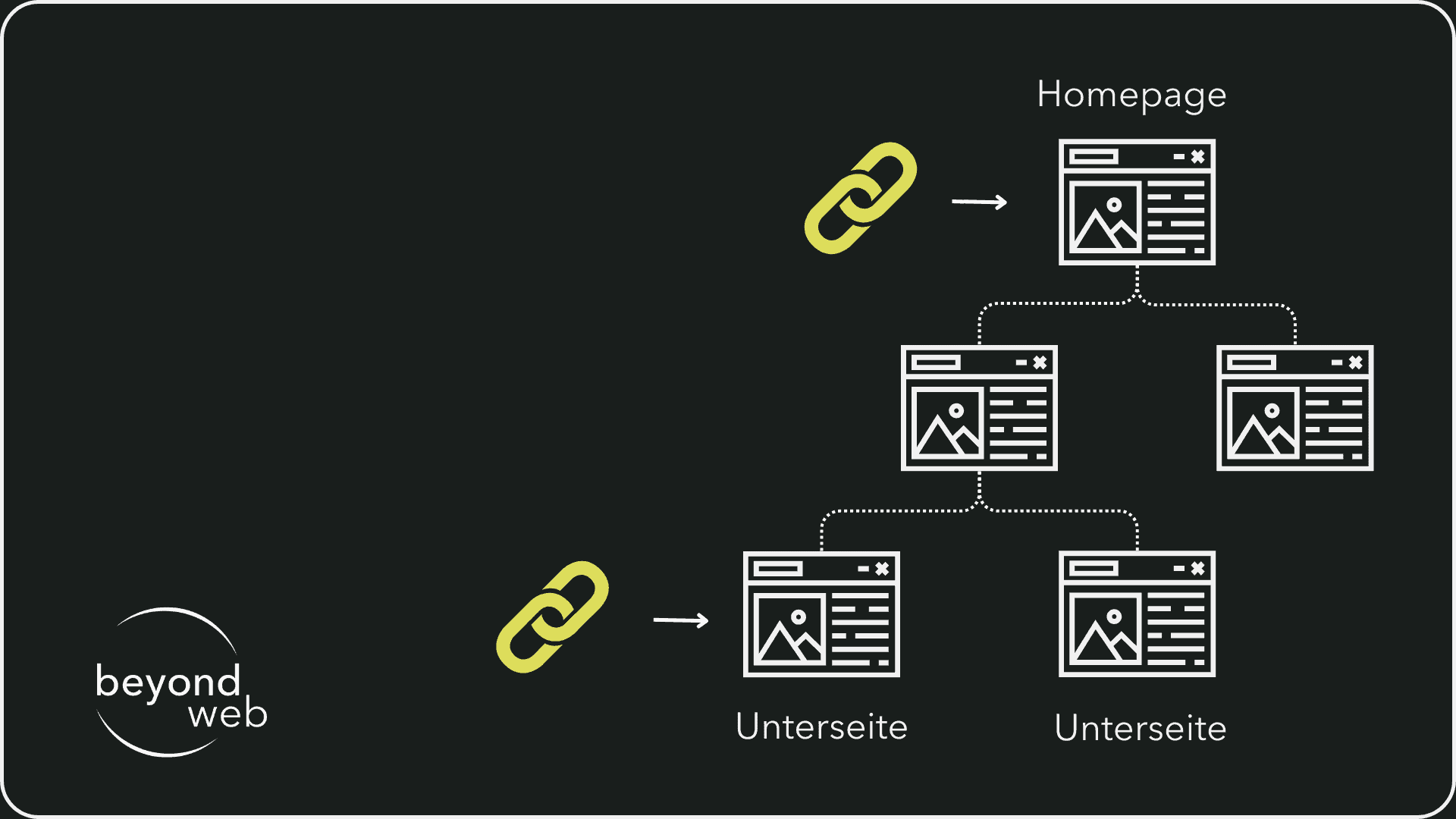
Homepage vs. subpages
Backlinks that are placed directly on the homepage of a website are often considered particularly valuable.
This is because the homepage is usually the page with the highest traffic and the strongest authority within a domain.
A link from the home page is therefore generally seen by search engines as a strong recommendation signal.
It is also more likely that more visitors will see the link and click on it, which can generate additional traffic, which in turn is also seen as a positive signal by search engines.
A backlink that is placed on a subpage, on the other hand, is worth significantly less.
Subpages have a lower authority within a domain, which they can inherit.
In addition, links to subpages are simply seen less often by website visitors and therefore generate less traffic to the target page.
Links to subpages are therefore ranked less highly by the search engine.
Footer links
Backlinks that are placed in the footer of a website are often rated differently by search engines, depending on various factors.
While footer links appear on every page of the website and therefore have frequent visibility, they tend to carry less weight from an SEO perspective due to their ubiquitous presence.
However, footer links can also convey good value if they are thematically relevant and placed in context.
Many web design agencies , for example, place a backlink in the footer for their customers (e.g. Designed by Agency X).
Furthermore, helpful links in the footer can generally contribute to a better user experience.
Context of the link placement
Regardless of the specific page on which a backlink is placed, the context of the link placement plays a decisive role.
A link that is placed in the middle of the main content of a page is often considered more relevant and natural than a link that is isolated or placed together with numerous other links
Therefore, make sure that the backlinks are placed in the body text wherever possible, surrounded by thematically relevant content.
2. ratio of outbound vs. inbound backlinks
When evaluating a backlink, many SEO experts, but also lenders, only look at the domain rating (DR), which provides information about the authority of a domain.
Although the DR provides a good indication, in my experience the ratio of outbound to inbound backlinks of a website is just as relevant when evaluating backlinks.
This metric is crucial because it provides information on how much link equity a website can pass on to a single domain.
Imagine that a renowned online library with a domain rating (DR) of 65, which is made up of 10,000 inbound links, places a backlink to your website.
If this online library has already provided links to 200,000 other websites, the linkjuice that is transferred to your website would, to put it simply, only amount to one two hundred thousandth of the total link power.
However, if the same online library with a DR of 65 would only link to your site (and no other domains), your link would receive the full linkjuice of this website (assuming there are no internal links).
3. authority of the linking website
In addition to the factors I have already mentioned, the authority of a linking website is of course still a decisive factor in the backlink evaluation.
Die Autorität wirkt sich unmittelbar auf die Bewertung der verlinkten Website aus, indem sie auf eine gewisse Weise eine «Empfehlung» für die verlinkte Seite darstellt.
The authority of a website can be measured by various metrics, two of the best known of which are Ahrefs' Domain Rating (DR) and Moz's Domain Authority (DA).
These metrics provide an estimate of how well a website might perform in search engines based on the quality and quantity of its inbound links.
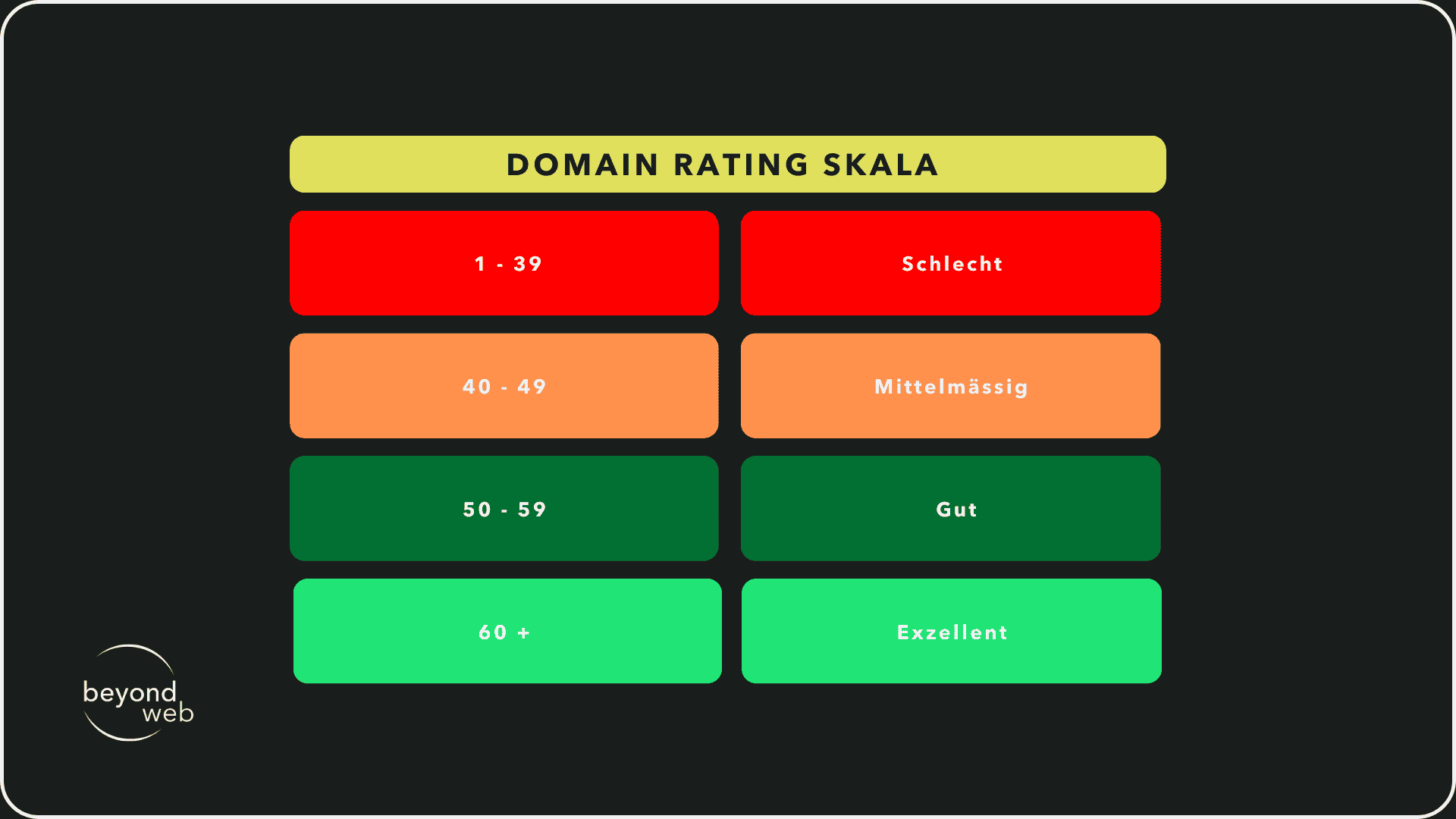
Ahrefs' Domain Rating (DR) assesses the authority of a domain based on the number and quality of its backlinks. It is a numerical value between 0 and 100, with higher values indicating a stronger authority or trustworthiness.
Moz's Domain Authority (DA) works in a similar way, also on a scale from 0 to 100 and based on various factors, including link counts and link quality.
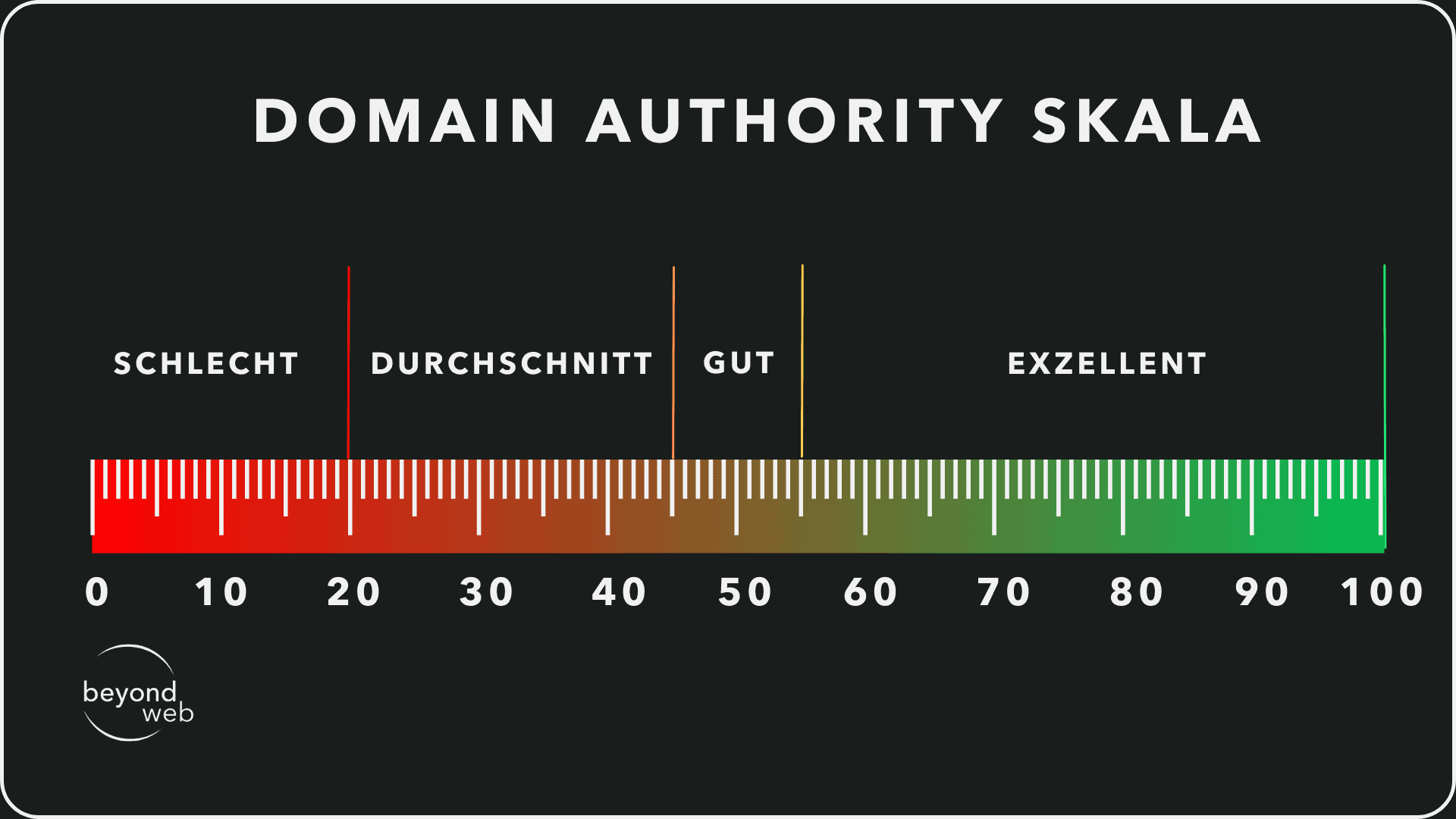
However, the evaluation of metrics, especially those such as Domain Rating (DR), must always be considered in context. It is essential to understand that such rating scales can vary depending on geographic location, industry or other specific factors.
It would be too simplistic to assume that a certain rating, for example a DR of 60+, is considered excellent in every context. A DR of 1 to 39, on the other hand, may seem suboptimal in some contexts, but these numbers alone do not provide the full picture.
For example, a website with a DR of 40 might actually be a leader in a particular niche or industry because it has a higher rating compared to its direct competitors.
In such a scenario, it would be inappropriate to consider the DR of 40 as merely "mediocre" when it is in fact an indicator of market leadership within that specific segment.
It is therefore crucial to consider the context and adjust the rating scale accordingly.
Zusätzlich ist es, sowohl beim Domain Rating von Ahrefs, als auch bei der Domain Authority von Moz, deutlich leichter, niedrigere Werte zu erhöhen, als höhere Werte noch weiter zu erhöhen.
Imagine you have a website with a DR of 10.
Diese Website hat leichtere Bedingungen, ihren Score um +10 auf ein DR von 20 zu erhöhen, als eine Website, die bereits einen DR von 60 besitzt und diesen um +10 auf 70 erhöhen möchte.
There are also some limitations and points of criticism for both metrics:
Werden nicht von Suchmaschinen verwendet
Es ist wichtig zu beachten, dass weder DR noch DA von Suchmaschinen wie Google verwendet werden.
This means that they are not taken into account as a ranking factor by search engines such as Google, but are merely proxies for how Google views the authority of a website.
Unvollständig
Sowohl das Domain Rating als auch die Domain Authority berücksichtigen in meinen Augen nicht alle Faktoren, die für die Autorität einer Seite ausschlaggebend sind.
For example, these metrics do not provide any information about organic traffic, domain age, brand awareness or the thematic relevance of a domain
Manipulierbar
Es gibt Möglichkeiten, solche Metriken durch den Kauf von Backlinks oder andere Black-Hat-SEO-Taktiken künstlich zu erhöhen.
For example, the purchase of mass spam links can increase the domain rating, even if this has a de facto negative impact on the authority of a domain.
In my opinion, you should therefore not rely exclusively on the domain rating or domain authority.
To summarize, I see both metrics as useful tools that give me insights into the potential authority of a website. However, it is important to consider them as part of a larger set of SEO metrics and not as the sole measures of authority.
How do search engines determine authority?
Das Konzept der Autorität entspringt verschiedenen Algorithmen von Suchmaschinen, von denen Googles PageRank der bekannteste ist.
PageRank, developed at the end of the 1990s, is the best-known method for weighting and evaluating websites.
It analyzes how trustworthy and credible a website is on the global web by taking into account factors such as the quality and quantity of incoming links, the content produced and the structure of the website itself.
How does the PageRank algorithm work?
The aim of the algorithm is to find out which websites a user who randomly clicks on the links over a very long period of time is most likely to visit.
The PageRank algorithm works through a sequence of steps:
- It creates a matrix that describes the links between the websites
- A vector is then defined that has as many entries as the matrix has columns
- This vector is then multiplied by the matrix
- Step 3 is repeated with the resulting vector until no more changes occur in the result vector.
Has it been a while since you studied vector geometry at school?
Kein Problem, hier wird das Konzept auf möglichst zugängliche Art und Weise anhand von Florian Dalwigks Youtube-Video veranschaulicht:
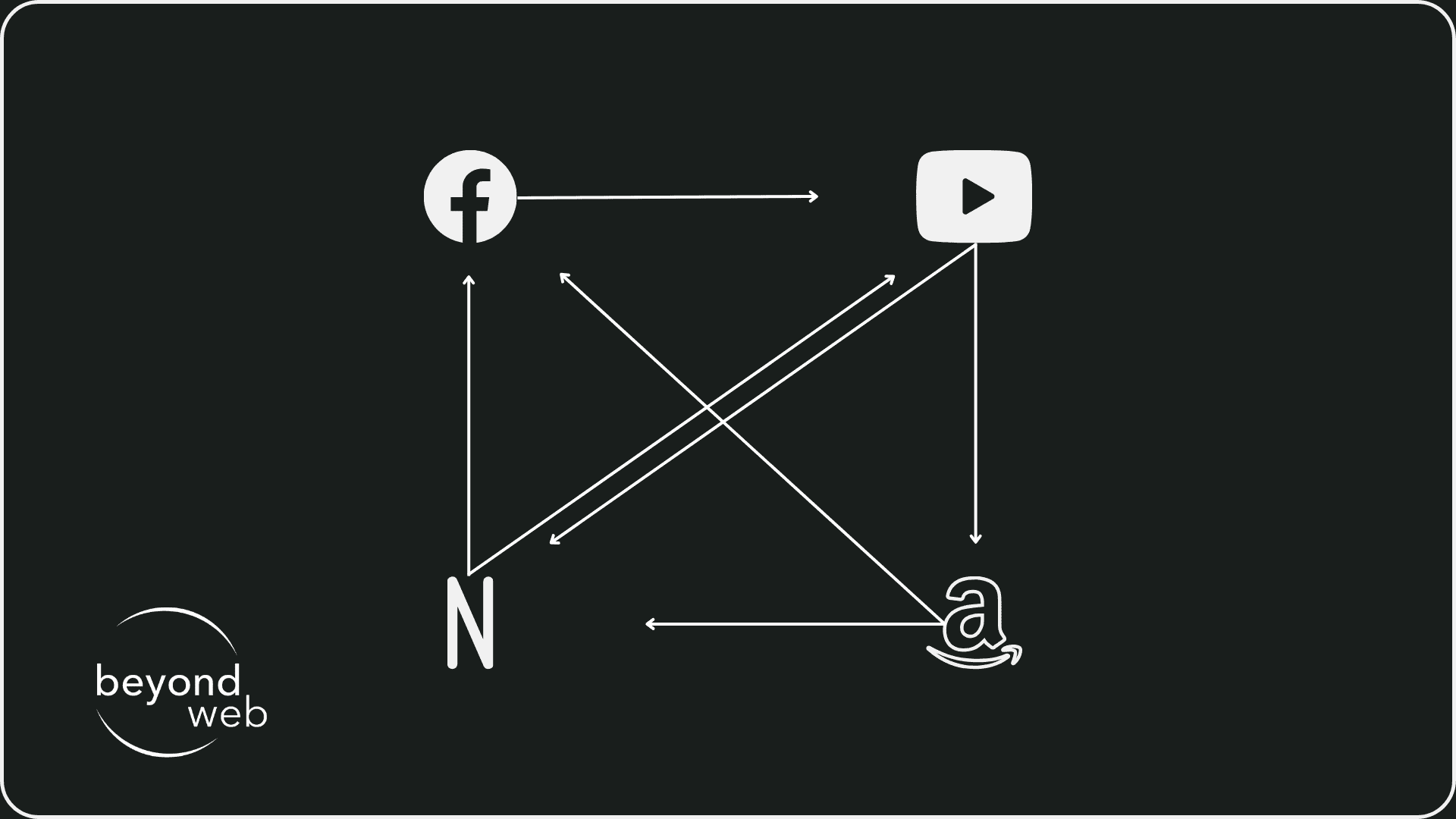
Stell dir vor, dass wir uns in einem «Mikrointernet» befinden, das nur aus den vier Websites Facebook, YouTube, Amazon und Netflix besteht.
Die vier Websites verlinken einander folgendermassen:
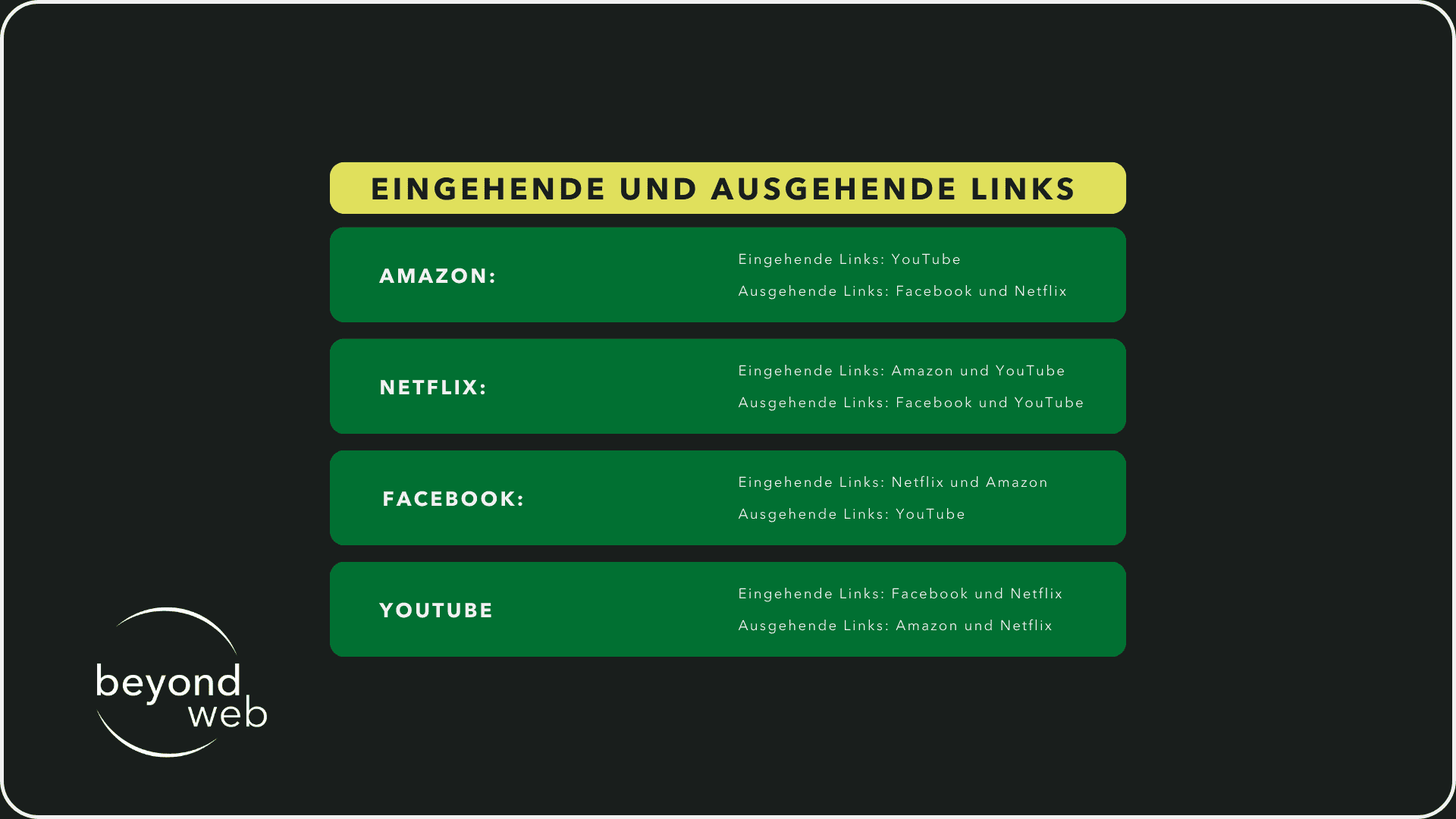
The table shows in more detail which of the four websites has which inbound and outbound links:
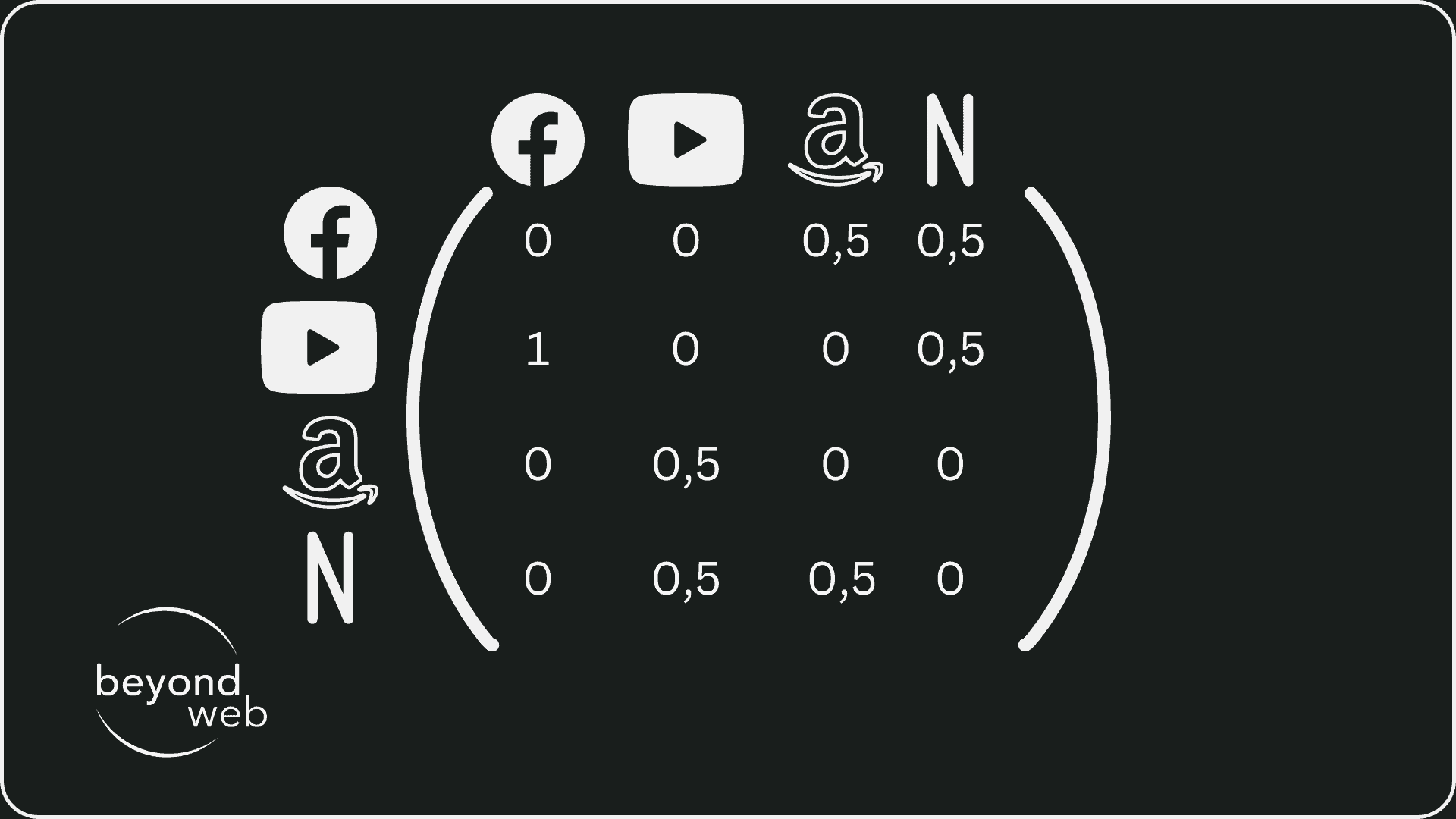
Wenn man davon ausgeht, dass jede dieser Websites durch einen Link auf eine andere einen vollen Punkt – also 100% (1,0) – geben kann, und dieser Punkt sich aufteilt, wenn eine Website auf mehr als eine andere verlinkt, kann man die oben dargestellte Verlinkungsstruktur in eine Matrix übertragen.
For example, when Amazon refers to Facebook and Netflix, both websites are assigned half a point (0.5) each
The resulting matrix looks like this:
Da das Internet in diesem Beispiel nur aus vier Websites besteht, können wir ohne weiteres Wissen die Annahme treffen, dass jede Website eine 25 % (0,25) Wahrscheinlichkeit hat, dass sie besucht wird.
Wenn nun die 25 % Wahrscheinlichkeit eines Besuches mit unserer oben dargestellten Matrix der Verlinkungen multipliziert wird, ergibt sich ein neuer Ergebnisvektor für die vier Websites.
By multiplying the respective result vector several times, it is possible to calculate which of the, in our case, four pages is visited the longest.
Multiplications are carried out until the values in the result vector stabilize, i.e. they no longer change.
According to this logic of the Page Ranks algorithm, YouTube has the highest probability of a visit in our example, followed by Netflix, Facebook and Amazon.
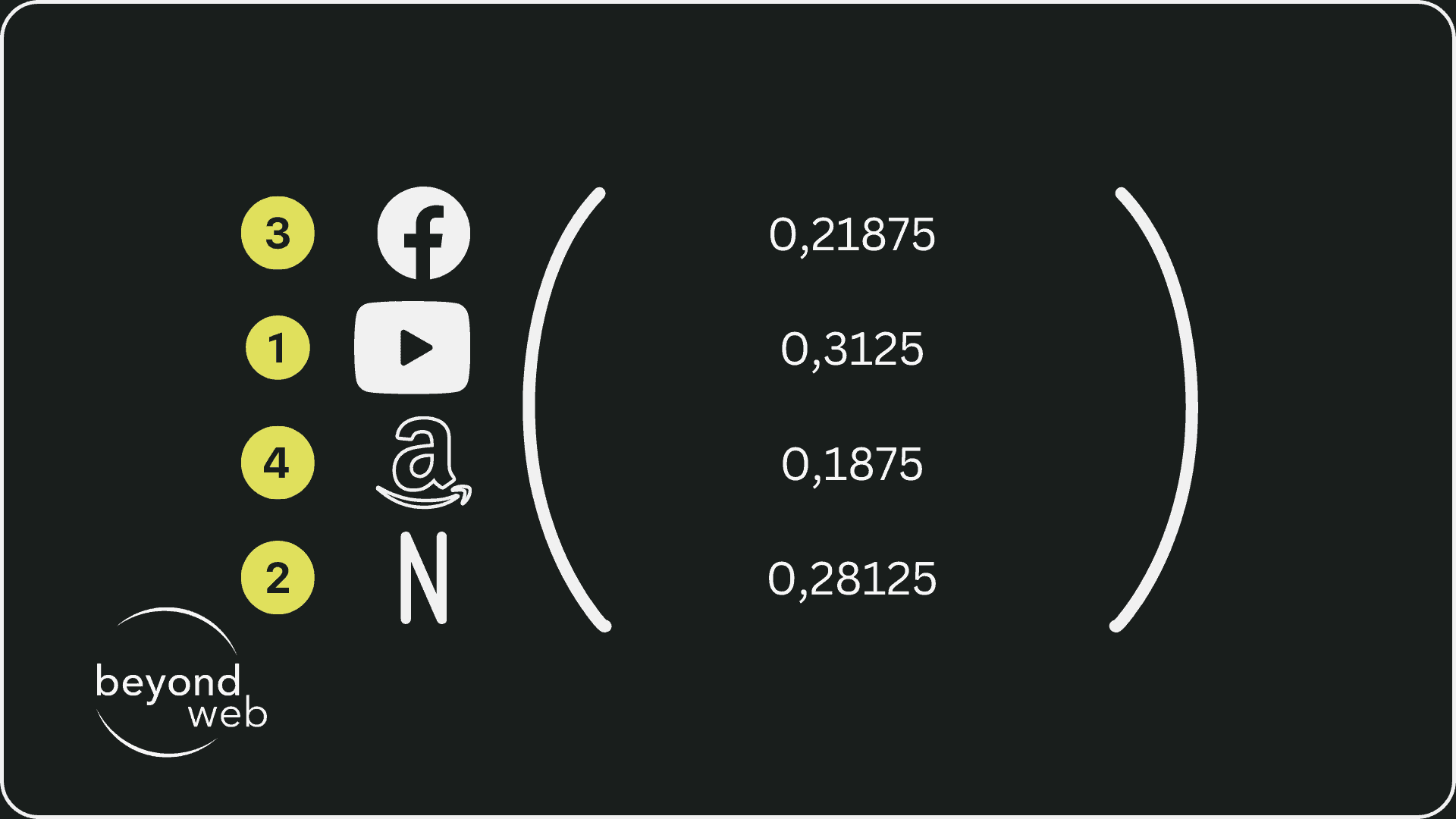
In this example, the fact that Netflix is ranked higher than Facebook deserves special attention, even though both are linked from two links.
The key factor here is that a highly ranked link from #1 ranked YouTube points to Netflix, which gives Netflix's PageRank a significant boost.
This example can also be applied to the real Internet and shows the immense influence that large, authoritative websites such as YouTube have on the ranking of other websites
This is the reason why websites that are linked to from such large sites are often at the top of Google search results.
At the end of the day, this algorithm will be applied to the entire Internet, albeit in a much more complex form.
4. thematic relevance of the backlink
Die thematische Relevanz eines Backlinks spielt eine unerlässliche Rolle für die Qualität und Effektivität einer Verlinkungsstrategie
This is about how closely the content overlaps between the linking and the linked page.
Ideally, the linking content should be clearly related to the content of the linked website.
A thematically relevant backlink sends a strong signal to the search engine that the respective website is an authority in a specific subject area
This not only strengthens the credibility of your own website from the perspective of Google & Co., but also promotes a positive user experience by leading users to further, relevant information through the link
In addition, the thematic relevance of backlinks can help you to position a website in a specific niche or industry
For example, if you are active in the field of "web design" and regularly receive backlinks from renowned websites from the web design industry, this can increase the likelihood that your site will be better positioned for search engine relevant queries from this field
However, it is also crucial to understand that the generation of thematically relevant backlinks should be authentic and natural
Manipulative techniques to generate links can be recognized and punished by search engines
Therefore, the creation of high-quality content that naturally wants to be linked to should always be the focus of any SEO and backlink strategy.
To support the development of thematically relevant backlinks, for example, a content strategy can be developed that not only focuses on your own content, but also on the creation of content that is worth linking to for site operators from your own industry or niche.
This can be, for example, studies, infographics or other content that offers high added value and is interesting enough for other site operators to make it available to their own users.
This creates backlinks that represent real added value for both search engine optimization and the user experience
5. trustworthiness of the linking domain (spam score)
The trustworthiness of a linking domain—often reflected in its spam score—is also a key factor in assessing the quality and reliability of backlinks.
A higher spam score typically indicates potential risks or a history of spam practices for the domain in question.
This in turn can have a negative impact on the search engine optimization (SEO) and online reputation management of the linked website.
The spam score is shown on a scale from 0 to 17, where 0 is interpreted as the lowest risk and 17 as the highest.
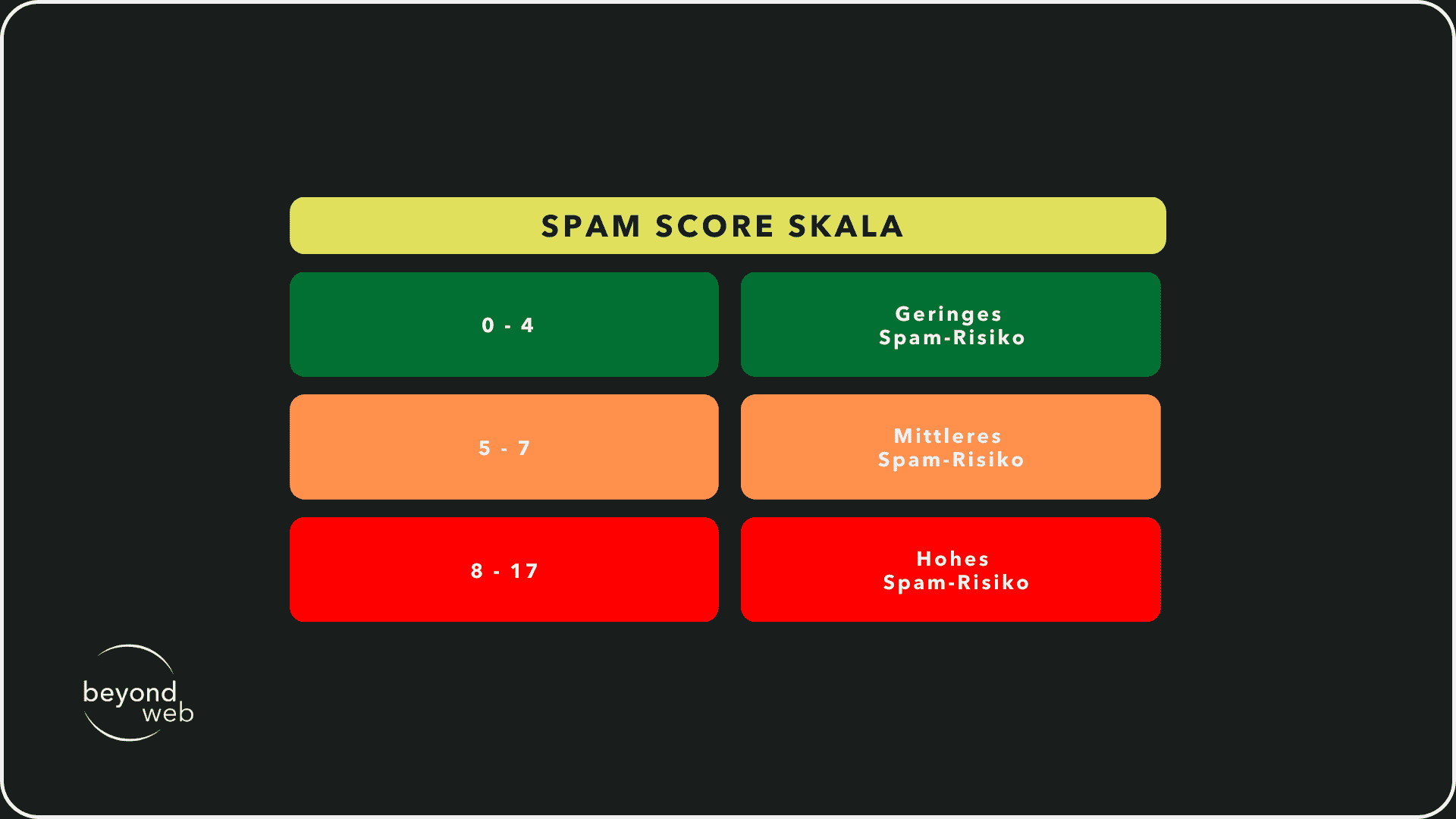
Domains with a high spam score can be detrimental to your Google rankings if they link to your website, as these pages are considered less trustworthy.
Various online tools can be used to check the spam score of a website, such as the Spam Score Domain Checker.
This tool analyzes the trustworthiness and security of a domain by evaluating various SEO and web presence parameters.
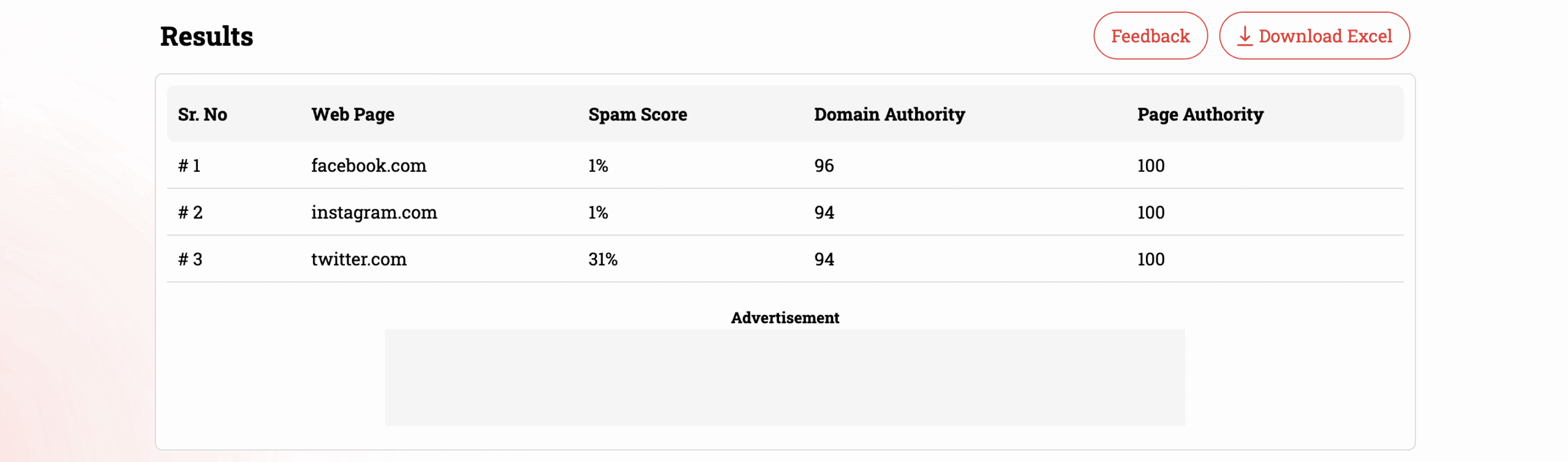
In addition to checking trustworthiness, the tool can also help to identify possible security problems or manipulation attempts, such as the use of black-hat SEO techniques.
Black-Hat-SEO-Techniken sind SEO-Techniken, die versuchen, den Google Algorithmus mit illegalen Mitteln zu manipulieren.
You can find more information on permitted and unauthorized SEO techniques in the Google Search Essential Guidelines.
It is not only wise to keep an eye on the spam score from a search engine optimization perspective, but also from an online reputation management perspective.
Secure and trustworthy link building should always be based on clean and honest methods in order to achieve successful results in both the short and long term.
When checking backlinks, it is therefore essential not only to look at their number and relevance, but also to consider the seriousness and trustworthiness of the linking pages.
This ensures that your backlink profile is not only strong, but also clean and sustainable.
6. is it a DoFollow backlink?
A DoFollow backlink that points to your website and enables interactions or comments on your website contributes significantly to improving search engine optimization (SEO).
This link type signals to search engines that the linking webmaster supports the page and that the search engines should take this link into account when calculating the PageRank.
In contrast, NoFollow links tell the search engine that they should not follow a link and not take it into account when calculating the rank.
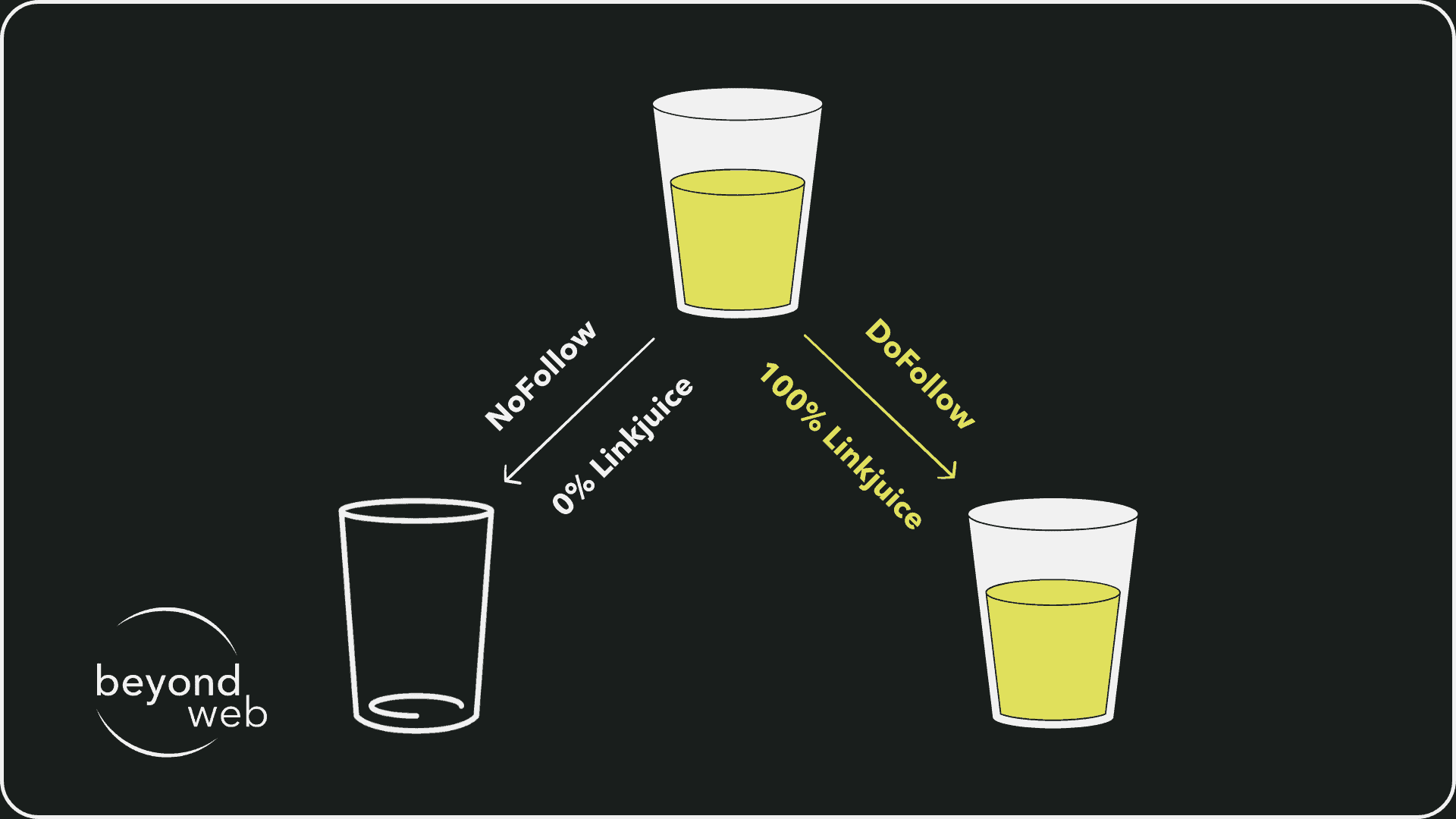
It is essential to maintain a balanced mix of DoFollow and NoFollow links in order to build up a natural-looking backlink profile.
Too many DoFollow links can be seen as an attempt to manipulate the page and may lead to a search engine penalty.
To check the nature of a backlink, whether DoFollow or NoFollow, and to carry out a comprehensive analysis of your backlink profile, I recommend using professional SEO tools.
One of the leading tools in this area comes from Ahrefs.
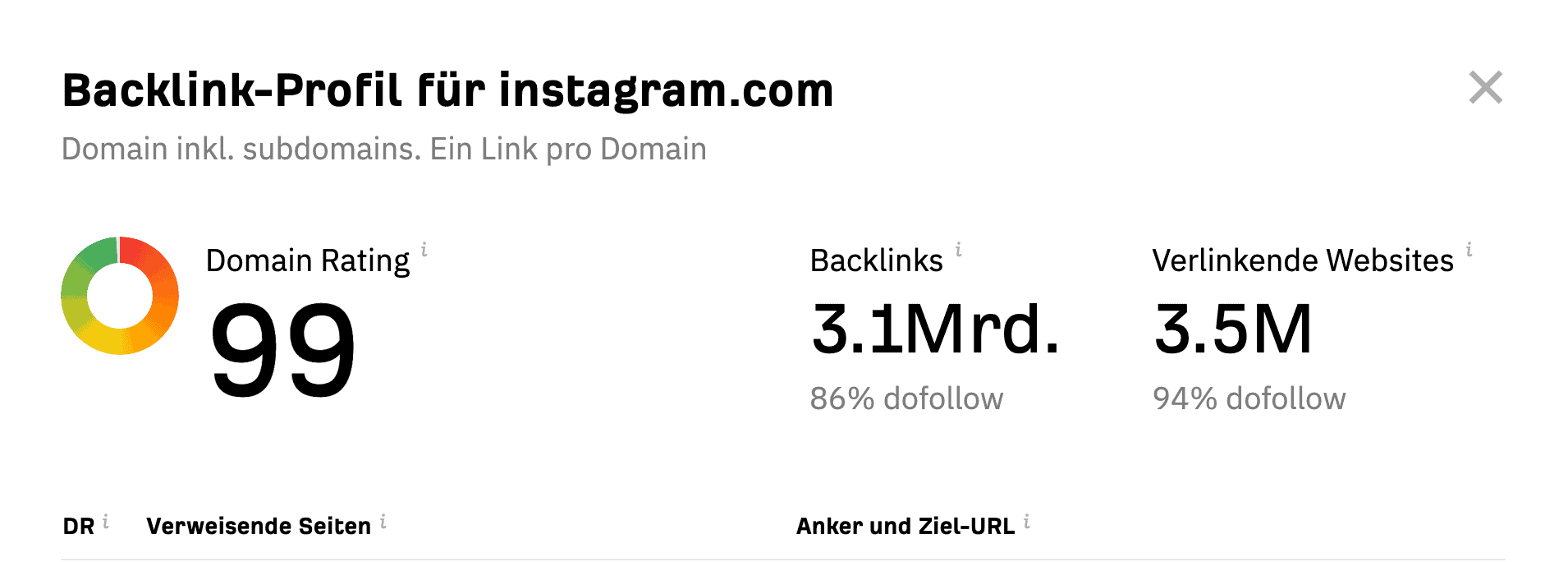
With Ahrefs Backlink Checker you can check the backlink profile of your domain and your competitors free of charge and derive valuable insights.
The tool allows you to assess the strength and authority of your backlink profile and compare it with the competition. You can also identify competitor backlinks that may also be relevant for you.
Des Weiteren bietet Ahrefs auch Informationen über die verwendeten Ankertexte, die Gesamtzahl der Backlinks, das Domain Rating (DR) und das URL Rating (UR).
7. which anchor text was chosen?
In my opinion, the importance of the anchor text cannot be overestimated.
Anchor text, also known as link text, is the visible, clickable word.
This small detail is of great importance, as the anchor text provides both the reader and the search engines with important information about the content of the linked page.
A carefully selected anchor text should be able to offer relevance and added value for both the users of your website and the search engine.
When an anchor text is selected, it should therefore be thematically relevant to the linked page.
Das heisst: Wenn zum Beispiel ein Webdesign-Blog einen Fachbegriff als Ankertext benutzt, um zu einer Erklärungsseite zu linken, dann passt das thematisch gut zusammen.
The selection of suitable anchor text is therefore not only beneficial for increasing the click-through rate (CTR) by arousing the reader's interest or curiosity, but also for improving search engine rankings.
This is because search engines consider anchor texts to be a factor in understanding and categorizing the content of a website.
A relevant and appropriate anchor text therefore helps to emphasize the credibility and relevance of a linked page.
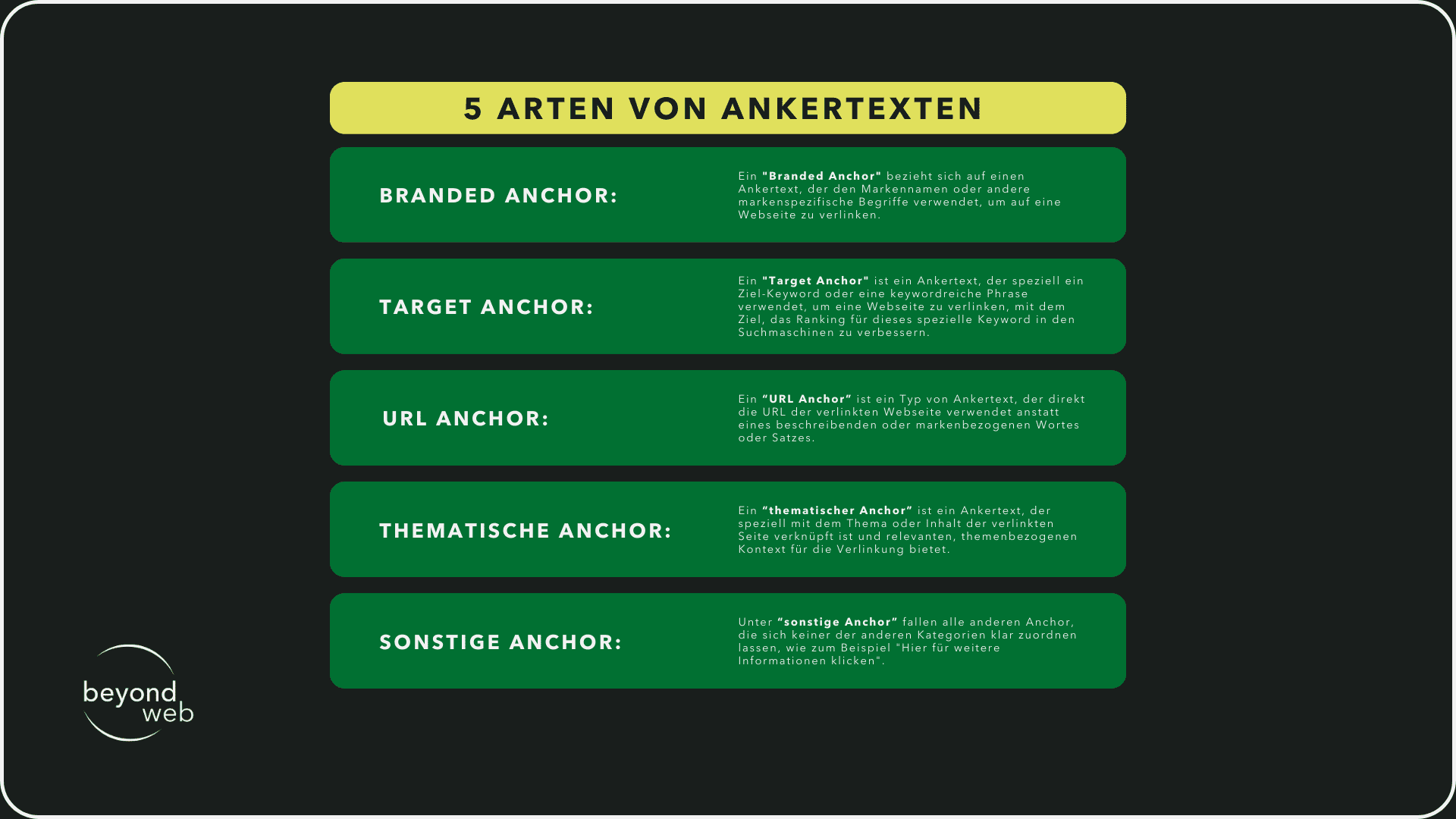
Types of anchor texts
There are many different types of anchor texts.
It is advisable to use different types.
Nur durch das Verwenden verschiedener Arten kann eine Überoptimierung verhindert werden, was den Richtlinien der Suchmaschinen entspricht.
8. keyword rankings of the linking website
Keywords are an indicator of the visibility, authority and even the credibility of a website in a particular subject area.
Ranking for certain keywords, especially those with high search demand and relevance in industries, can affect the amount and quality of traffic a website receives.
In my opinion, however, not only the keywords should be used to evaluate a backlink, but also targeted visibility metrics.
Particularly noteworthy in this context are the Sistrix Visibility Index (SI) and the XOVI Online Value Index (OVI).
Both metrics reflect the "estimated visibility" of a domain.
Backlinks from websites with strong visibility metrics, especially high SI or OVI values, have a significantly stronger influence on Google rankings
It is therefore wise to pay attention to both keywords and relevant visibility metrics when assessing the value and importance of a backlink.
Keyword rankings in connection with backlinks
The keyword rankings of the linking website have a multidimensional influence on the value that a backlink adds to a website.
First, a website that ranks high in search engines for relevant and competitive keywords is automatically considered an authoritative and knowledgeable source.
A backlink from such a source can be considered stronger and more valuable because it implies a kind of recommendation.
For example, if a website that ranks highly for important keywords related to “web design” links to another web design website, search engines interpret this link as a sign of trust.
The assumption here is that a website with good rankings for relevant keywords carefully chooses who it links to in order to maintain its own credibility and user value.
Secondly, there is the traffic aspect.
Websites that rank for popular keywords usually attract a significant volume of organic traffic.
Organic traffic refers to the number of visitors who come via specific search results.
Ein Backlink von einer solchen Website, die für beliebte Keywords hoch rangiert, bringt einerseits also Vorteile durch erhöhte Übertragung von Linkjuice, andererseits aber auch, weil ein solcher Backlink die Chance besitzt, einen höheren Traffic zu übertragen.
Users searching for relevant information on the linking website can therefore navigate through the backlink and end up on the linked website as referral traffic.
Referral traffic refers to visits to your own website via links on another website.
Nevertheless, not all backlinks from websites with high keyword rankings are valuable per se.
Factors such as thematic relevance, link placement and link context must be weighted equally in order to assess the actual value of a backlink.
9. tools for analyzing backlinks
To be able to analyze the factors mentioned above, I recommend using various SEO tools.
I will present my favorites in more detail in the following sections:
Ahrefs
Wie bereits kurz erwähnt, hat sich Ahrefs als unverzichtbares SEO-Tool etabliert, das uns SEO-Spezialisten bei der Optimierung der Online-Präsenz unterstützt.
Ahrefs claims to have the largest backlink database (next to Google) and thus enables a detailed analysis of a website's backlink profile, which is essential for the development of effective link building strategies.
The tool also facilitates keyword research by identifying relevant keywords and providing valuable metrics such as search volume.
Diese Einblicke sind unerlässlich für die Ausarbeitung gezielter Content- und SEO-Strategien, die sowohl für Nutzer als auch für Suchmaschinen relevant sind.
Ahrefs ermöglicht ausserdem, die Rangpositionen von Websites für bestimmte Keywords zu verfolgen und dabei die SEO-Leistung ständig im Blick zu behalten.
For example, I can react quickly to changes in search result rankings.
Another plus point is Ahrefs' ability to decipher the SEO tactics of competitors through so-called competitive analysis.
This knowledge enables them to refine their own strategies and gain a stronger position in the digital space.
The Ahrefs site audit tool offers a further advantage.
Es ermöglicht umfassende Website-Analysen und hilft dabei, sowohl technische als auch On-Page SEO-Probleme zu identifizieren und zu beheben.
Kurz gesagt: Ahrefs ist mit seiner breiten Palette an Funktionen ein Schatz für jeden, der sich im digitalen Marketing und insbesondere im Bereich SEO bewegt.
Similarweb
Thanks to its extensive database and versatile analysis tools, Similarweb provides in-depth insights into web traffic and user behavior
Compared to Ahrefs, Similarweb focuses even more strongly on the competitive analysis of competing websites.
The tool allows users to explore traffic sources, target group behavior and engagement metrics of competitors.
This information is invaluable for identifying market trends, adapting your own strategies and discovering potential business opportunities.
Another useful and additional feature of Similarweb is the ability to divide website traffic into different channels.
This allows you to see exactly whether visitors come to the website mainly via paid ads, organic search, social media or other sources.
Diese Einsichten ermöglichen es, die eigenen Marketingstrategien zu verfeinern und Investitionen in die Kanäle zu lenken, die den grössten Traffic generieren.
Similarweb also helps you identify new, relevant keywords and find influencers who have an impact in your industry, for example.
These findings can then be used to make marketing campaigns more effective and strengthen the online presence.
Keyword Rankings
Hierbei soll das Tool helfen, den Rang bestimmter Keywords in den Suchergebnisseiten (SERPs) von Suchmaschinen wie Google zu verfolgen und zu analysieren
Ahrefs also offers this function, but Keywordrankings updates its databases faster and you get more accurate insights into the current rankings of your own website and the competition.
Ein zusätzlicher, zentraler Aspekt von Keyword-Rankings ist die Fähigkeit, die Entwicklung der Keyword-Positionen über Zeiträume hinweg zu verfolgen.
The tool usually offers visual representations of the SERP rankings, making trends, improvements or deteriorations recognizable at a glance
Dies ermöglicht es, zeitnah auf Veränderungen im Suchmaschinenranking zu reagieren und Strategien entsprechend anzupassen.
Ein weiteres Feature von Keyword-Ranking-Tools ist die Fähigkeit, die Performance von Keywords in Bezug auf verschiedene geografische Standorte und Gerätetypen zu analysieren.
These regional and device-specific insights are particularly valuable for companies that want to focus on local markets or optimize their website for mobile devices.
Darüber hinaus bieten Keyword-Rankings-Tools oft auch Einblicke in die Keyword-Strategien von Wettbewerbern.
By understanding which keywords your competitors are ranking for, you can adjust your own strategy accordingly and possibly identify new, profitable keywords that have been overlooked so far.
SEMrush
Alongside Ahrefs, SEMrush is probably the best-known all-round SEO tool.
Es ermöglicht dir, deine Online-Präsenz effektiv zu analysieren und zu optimieren.
SEMrush offers functions such as in-depth keyword and competition analyses.
It also provides insights into competitors' SEO and paid strategies and provides data to make informed strategic decisions
In addition, SEMrush offers on-page SEO analyses and technical audits.
Dadurch ist es möglich, Websites nachhaltig zu verbessern und deren Performance zu steigern.
Die umfangreichen Berichtsfunktionen ermöglichen zudem, personalisierte und detaillierte Reports zu erstellen, um den Erfolg von Online-Marketing-Strategien transparent zu präsentieren.
Im Vergleich zu Ahrefs, das sich hauptsächlich auf die SEO-Performance fokussiert, ist SEMrush auch für PPC-Werbung einsetzbar.
My conclusion
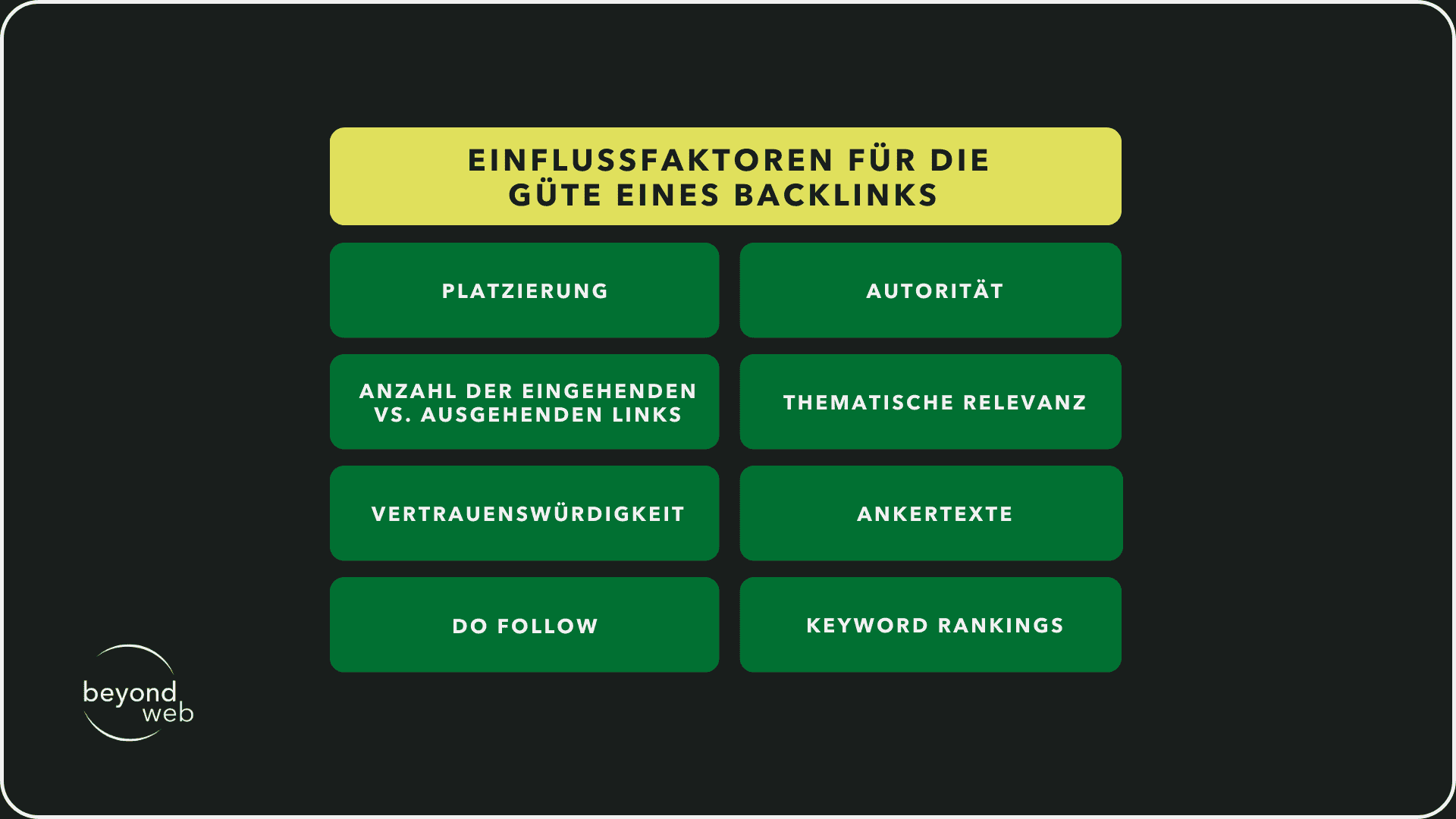
In conclusion, it is clear that a high-quality backlink is influenced by a variety of factors
This includes not only the location of its placement on the website and the ratio of outbound to inbound backlinks, but also the authority and trustworthiness of the linking domain.
The thematic relevance, the choice of anchor text and the question of whether it is a DoFollow backlink are also essential.
Added to this is the importance of the keyword ranking of the linking website.
It is crucial to consider all of these points, as a company's backlink profile significantly influences the ranking factors in search engines such as Google
The following graphic illustrates once again the parameters mentioned, which can be used to identify a high-quality backlink: