


Methodik
Zur Ermittlung der oben genannten Leitfragen wurde im März 2025 mit 204 Personen eine qualitative Umfrage mittels eines Online-Fragebogens durchgeführt.
Demografisch berücksichtigt wurden Personen mit den Jahrgängen 1995 bis 2010, die nach der Definition von Simon Schnetzer (2024) zur GenZ gehören. Die Befragten wurden nach Bildungsstand sowie dem Geschlecht segmentiert. Zudem wurde das Haushaltseinkommen erhoben.
Die Qualitätssicherung der Antworten wurde mittels einer Marktforschungsplattform gewährleistet.
Die befragte Grundpopulation setzt sich folgendermassen zusammen:
- Geschlecht: 40 % männlich, 58 % weiblich, 2 % divers
- Ausbildung: 28 % mit tertiärer Bildung, 72 % ohne tertiäre Bildung
- Haushaltseinkommen: 42 % bis 50’000 CHF, 58 % über 50’000 CHF
Ergebnisse
Im Folgenden werden alle Fragen und die jeweiligen Umfrageergebnisse genau erläutert. Eine Interpretation der Ergebnisse befindet sich im darauffolgenden Abschnitt.
Nutzung von ChatGPT
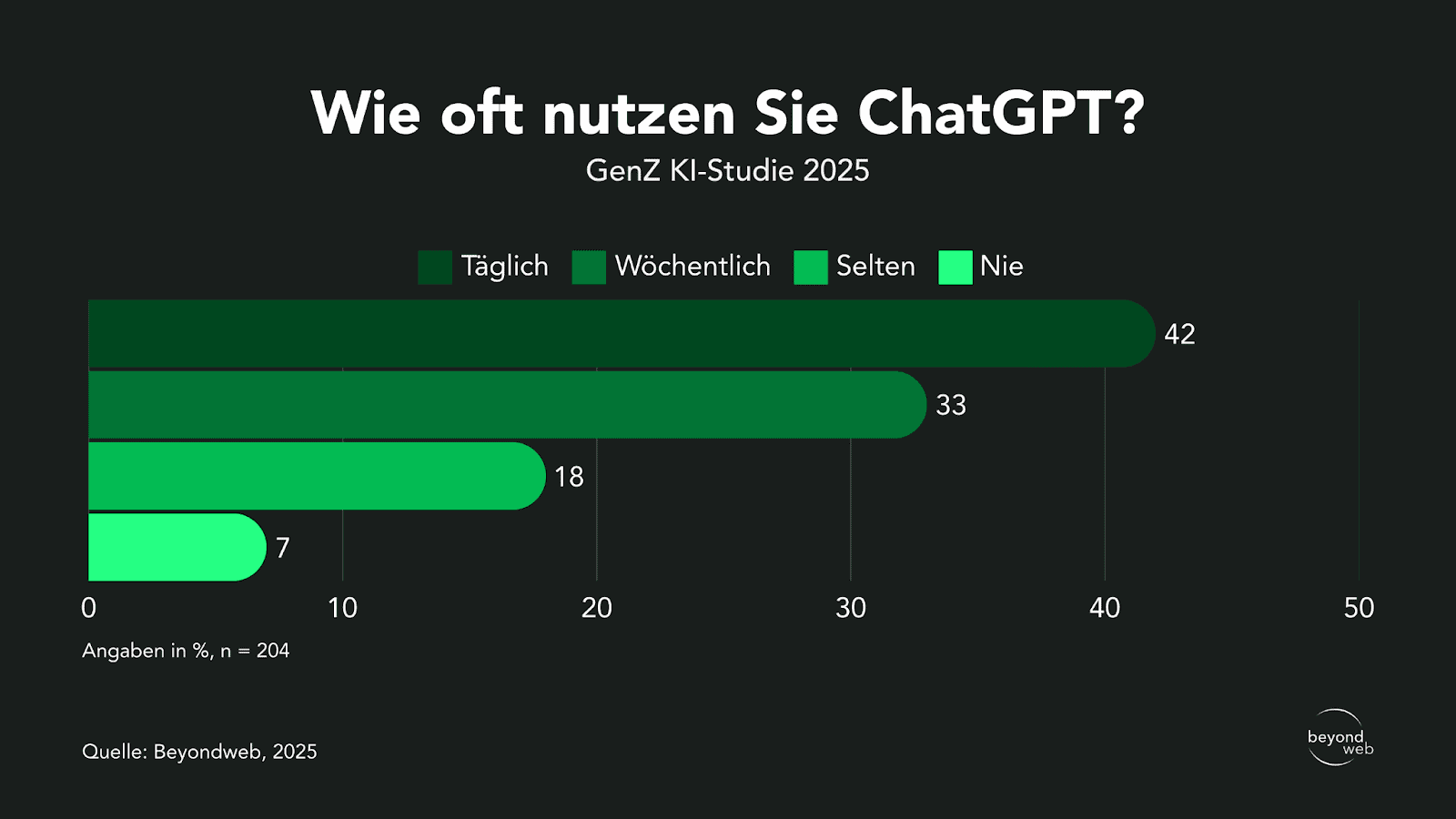
Laut unseren Studienresultaten nutzen 42 % der Befragten ChatGPT täglich, während 33 % das Tool wöchentlich verwenden. 18 % greifen nur selten auf ChatGPT zurück, und 7 % der Befragten gaben an, es gar nicht zu nutzen.
Allgemeine Ergebnisse
Alle Befragten
Unterteilung nach Geschlecht
Unterteilt nach dem Geschlecht nutzen 52 % der Männer ChatGPT täglich, während 34 % der Frauen das Tool täglich verwenden. Jeweils 33 % der Männer und Frauen greifen wöchentlich darauf zurück. 11 % der Männer nutzen ChatGPT selten, während es 22 % der Frauen sind. 5 % der Männer haben das Tool noch nie genutzt, während dieser Anteil bei den Frauen bei 10 % liegt.

Unterteilung nach Bildungsstand
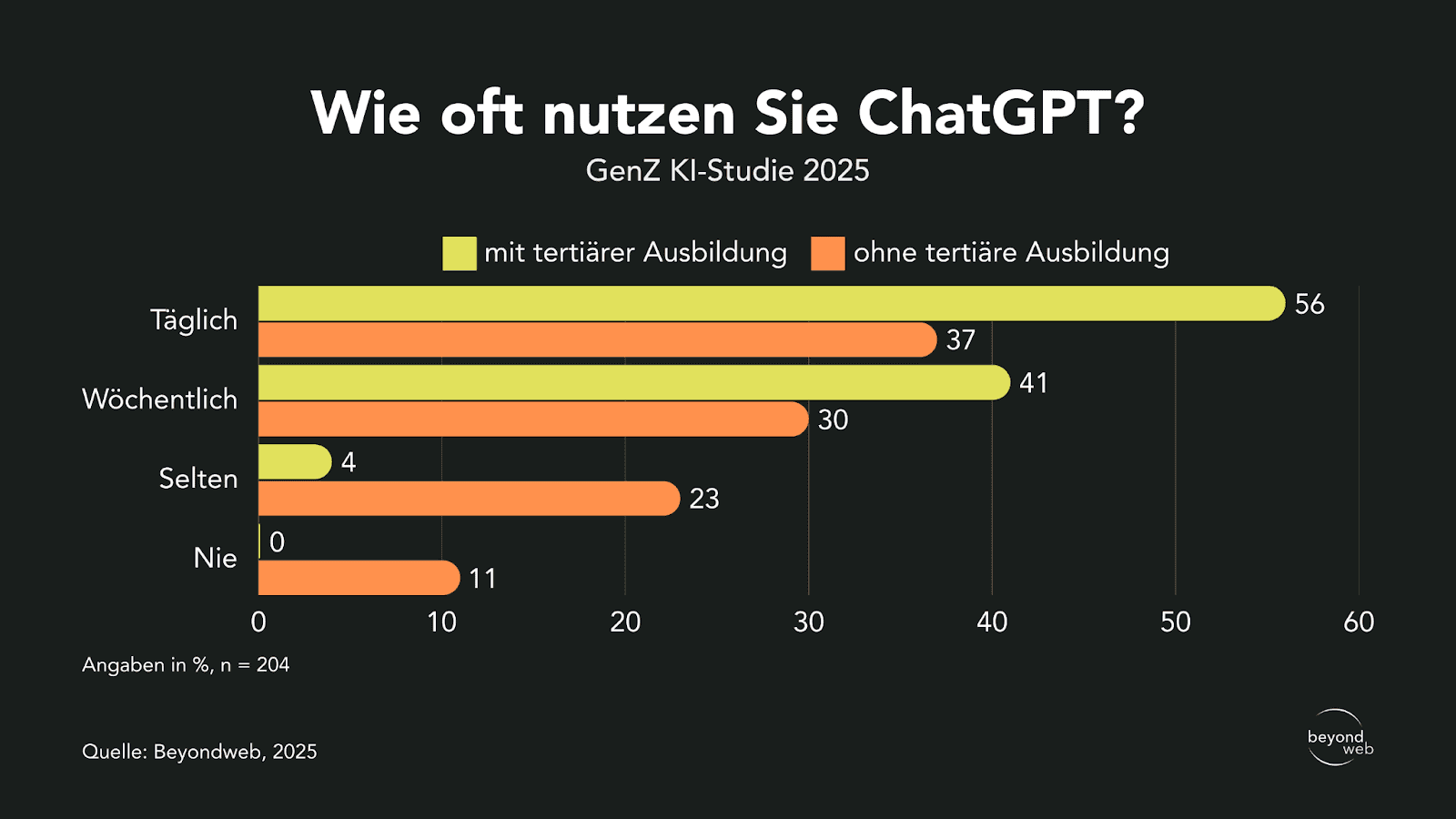
Personen mit tertiärer Ausbildung nutzen ChatGPT häufiger als jene ohne höheren Bildungsabschluss. 56 % der Akademiker geben an, das Tool täglich zu verwenden, während dieser Anteil bei Personen ohne tertiäre Ausbildung bei 37 % liegt. 41 % der Befragten mit Universitäts- oder Fachhochschulabschluss greifen wöchentlich auf ChatGPT zurück, im Vergleich zu 30 % der Befragten ohne tertiäre Bildung. Selten wird das Tool von 4 % der Personen mit höherem Bildungsabschluss genutzt, während 23 % der Befragten ohne tertiäre Ausbildung es nur gelegentlich verwenden. Keiner der Befragten mit akademischem Abschluss hat ChatGPT noch nie genutzt, während 11 % der Befragten ohne höhere Bildung angeben, das Tool noch nie verwendet zu haben.
Nutzung von KI-Tools für Recherche
Alle Befragten
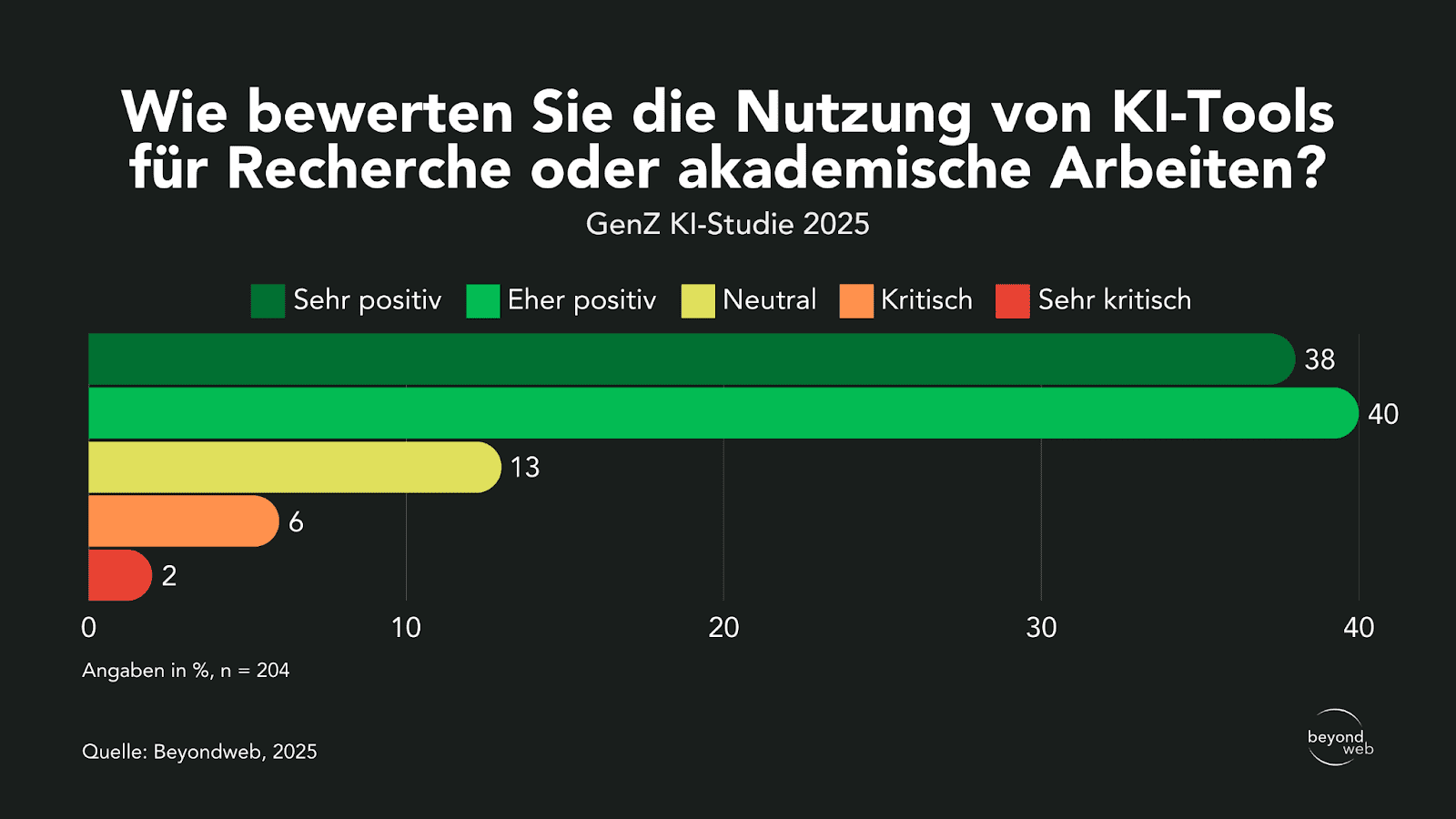
Die Bewertung der Nutzung von KI-Tools für Recherche und akademische Arbeiten fällt überwiegend positiv aus. 38 % der Befragten beurteilen den Einsatz solcher Tools als sehr positiv, während 40 % ihn eher positiv sehen. 13 % stehen der Nutzung neutral gegenüber. Kritische Stimmen machen einen kleineren Anteil aus: 6 % der Befragten bewerten den Einsatz von KI in diesem Bereich kritisch, und 2 % äussern sich sehr kritisch dazu.
Unterteilung nach Geschlecht
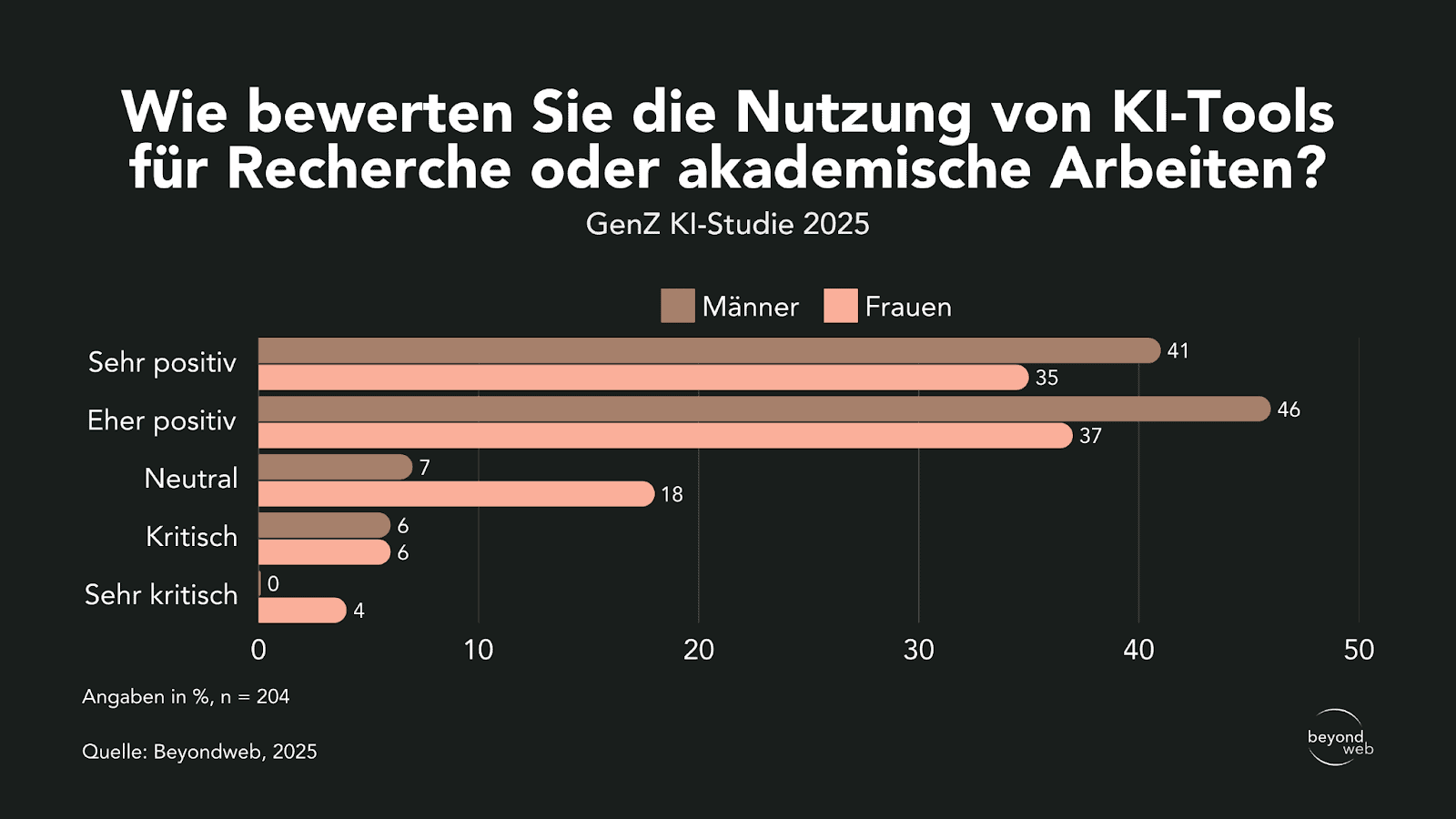
Weiter beurteilen 41 % der Männer und 35 % der Frauen den Einsatz dieser Tools als sehr positiv. Eher positiv sehen ihn 46 % der Männer und 37 % der Frauen. Während 7 % der Männer eine neutrale Haltung einnehmen, liegt dieser Anteil bei den Frauen bei 18 %. Kritisch stehen jeweils 6 % der Männer und Frauen der Nutzung gegenüber. Sehr kritisch bewerten 4 % der Frauen den Einsatz von KI-Tools, während keiner der befragten Männer diese Meinung teilt.
Unterteilung nach Bildungsstand
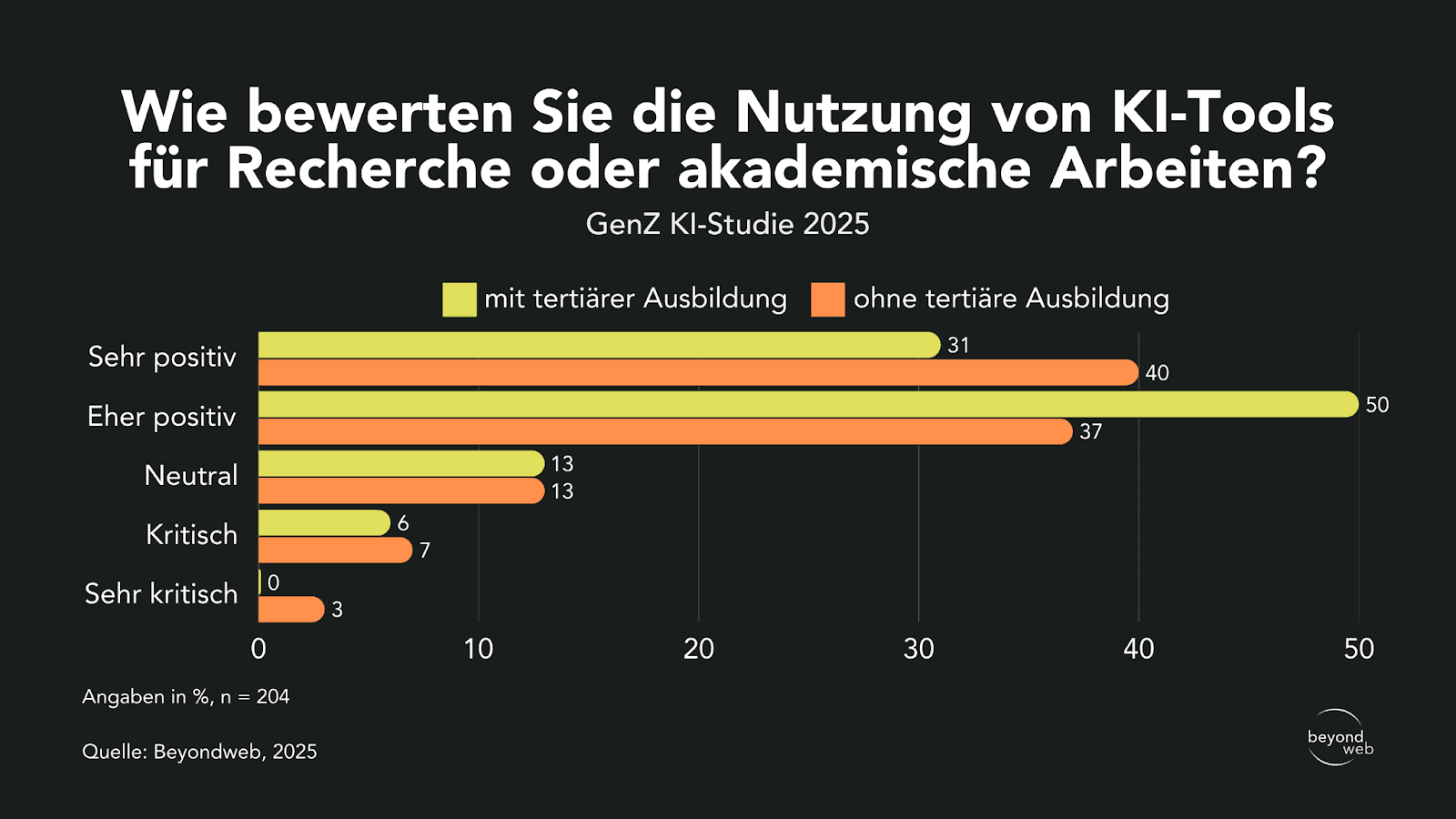
Die Bewertung der Nutzung von KI-Tools für Recherche und akademische Arbeiten unterscheidet sich nach Bildungsstand. 31 % der Befragten mit tertiärer Ausbildung bewerten den Einsatz als sehr positiv, während dieser Anteil bei Personen ohne tertiären Abschluss bei 40 % liegt. Eher positiv äussern sich 50 % der Personen mit höherer Bildung und 37 % der Befragten ohne tertiären Abschluss. Eine neutrale Haltung vertreten jeweils 13 % in beiden Gruppen. Kritisch sehen die Nutzung 6 % der Befragten mit tertiärer Ausbildung und 7 % derjenigen ohne höheren Bildungsabschluss. Sehr kritisch äussern sich 3 % der Befragten ohne tertiäre Ausbildung, während keiner der Befragten mit akademischem Abschluss diese Meinung teilt.
KI-Tools Nutzung nach Situationen
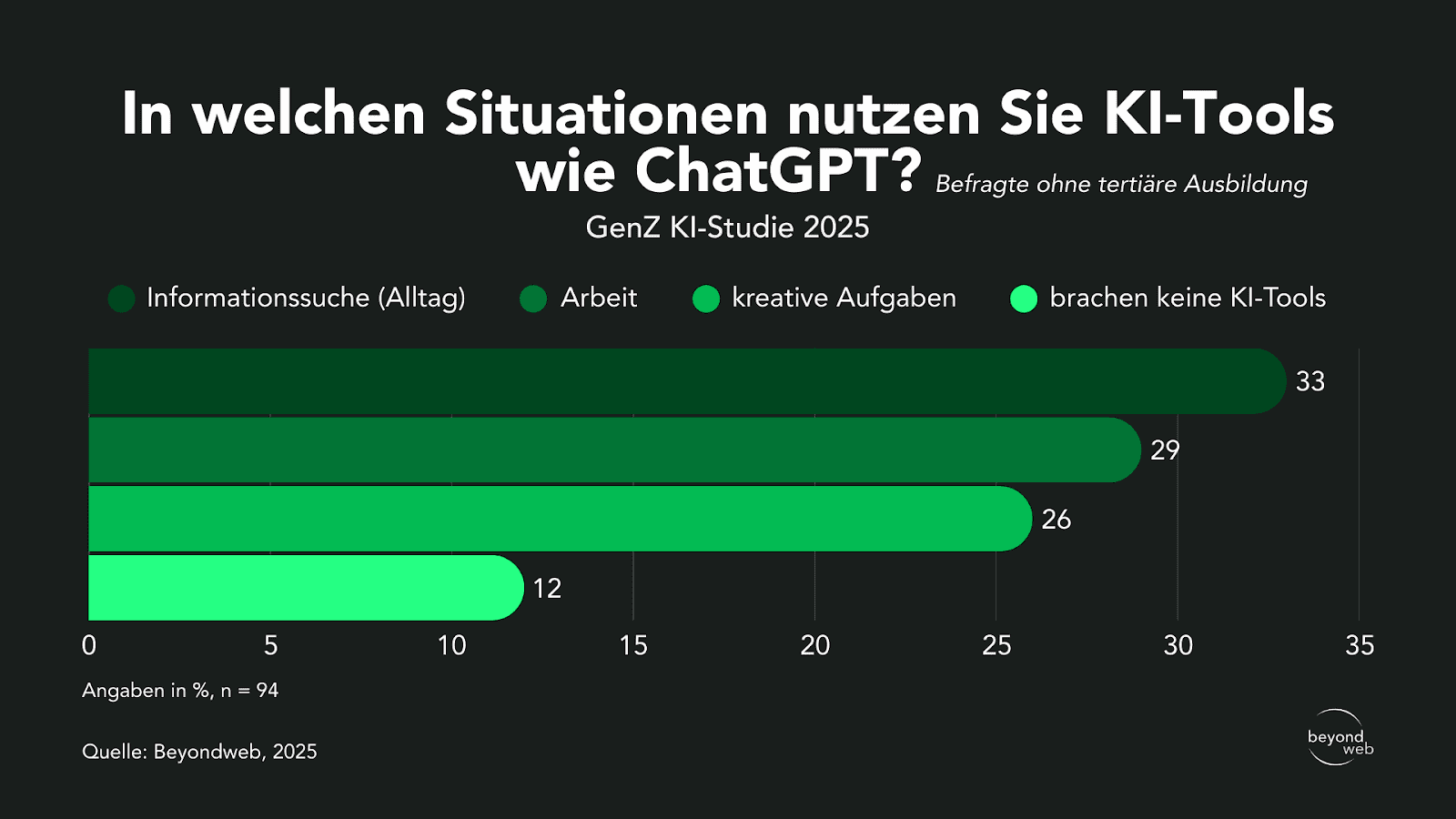
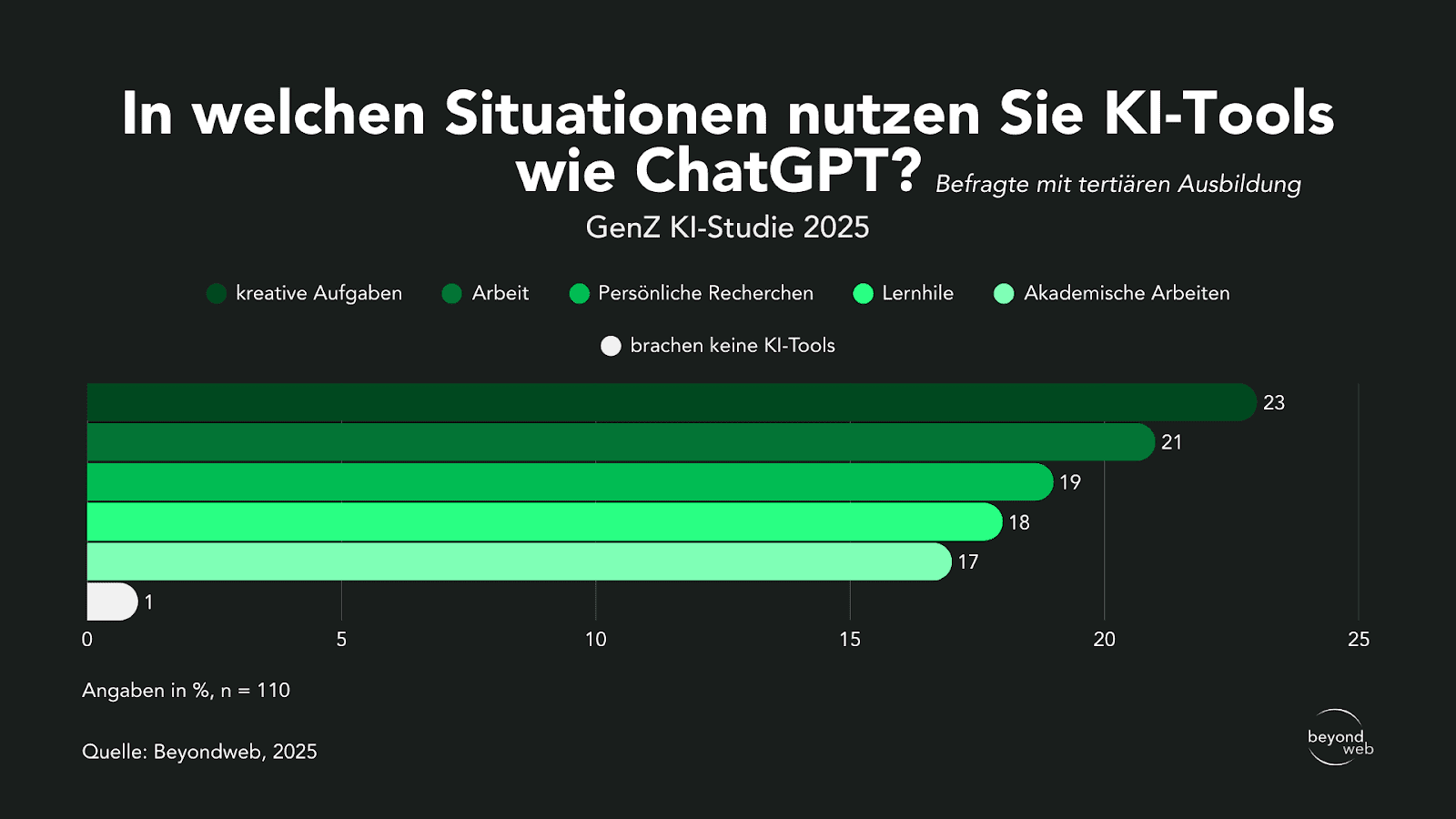
Diese Frage wurde spezifisch für zwei Gruppen gestellt – Personen mit und ohne tertiäre Ausbildung –, da sich die relevanten Anwendungsbereiche unterscheiden. Während für Befragte ohne höheren Bildungsabschluss vor allem Informationssuche, Arbeit und kreative Aufgaben im Vordergrund stehen, sind für Personen mit tertiärer Ausbildung zudem Lernen, Recherche und akademische Arbeiten von Bedeutung.
Die Nutzung von KI-Tools unter Befragten ohne tertiäre Ausbildung verteilt sich auf verschiedene Anwendungsbereiche. 33 % verwenden KI-Tools für die Informationssuche im Alltag. 29 % setzen sie bei der Arbeit ein, während 26 % sie für kreative Aufgaben nutzen. 12 % der Befragten ohne höheren Bildungsabschluss geben an, keine KI-Tools zu verwenden.
Personen mit tertiärer Ausbildung nutzen KI-Tools in verschiedenen Bereichen. 23 % setzen sie für kreative Aufgaben ein, 21 % verwenden sie im Arbeitskontext und 19 % für persönliche Recherchen. 18 % der Befragten geben an, KI-Tools als Lernhilfe zu nutzen, während 17 % sie für akademische Arbeiten einsetzen. Nur 1 % der Befragten mit höherer Ausbildung nutzt keine KI-Tools.
Vertrauen in Antworten von ChatGPT
Alle Befragten
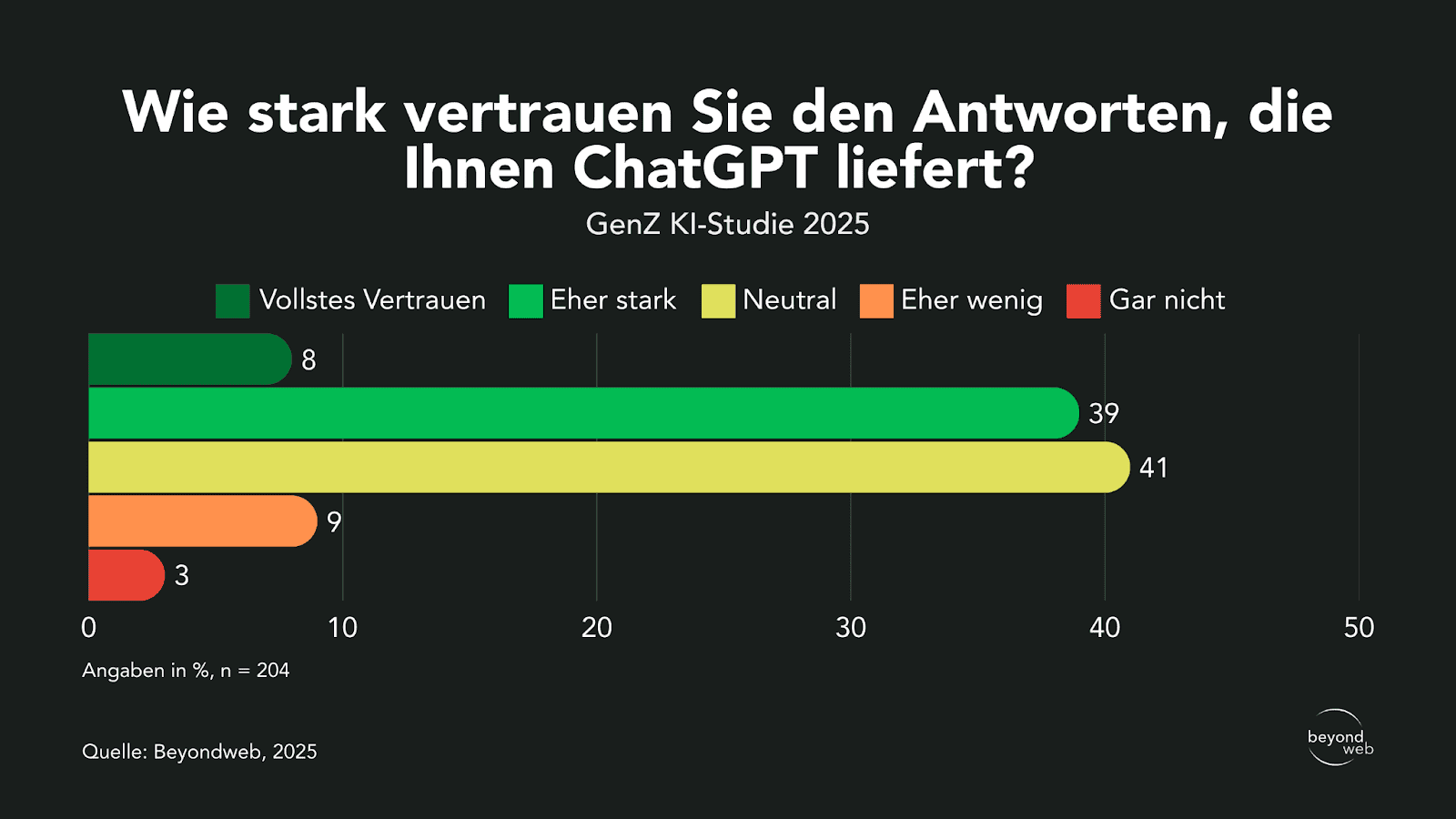
Das Vertrauen in die Antworten von ChatGPT variiert unter den Befragten. 8 % haben volles Vertrauen in die generierten Antworten, während 39 % ihnen eher stark vertrauen. 41 % der Befragten stehen den Antworten neutral gegenüber. 9 % zeigen eher wenig Vertrauen, und 3 % vertrauen den Antworten von ChatGPT gar nicht.
Unterteilung nach Geschlecht
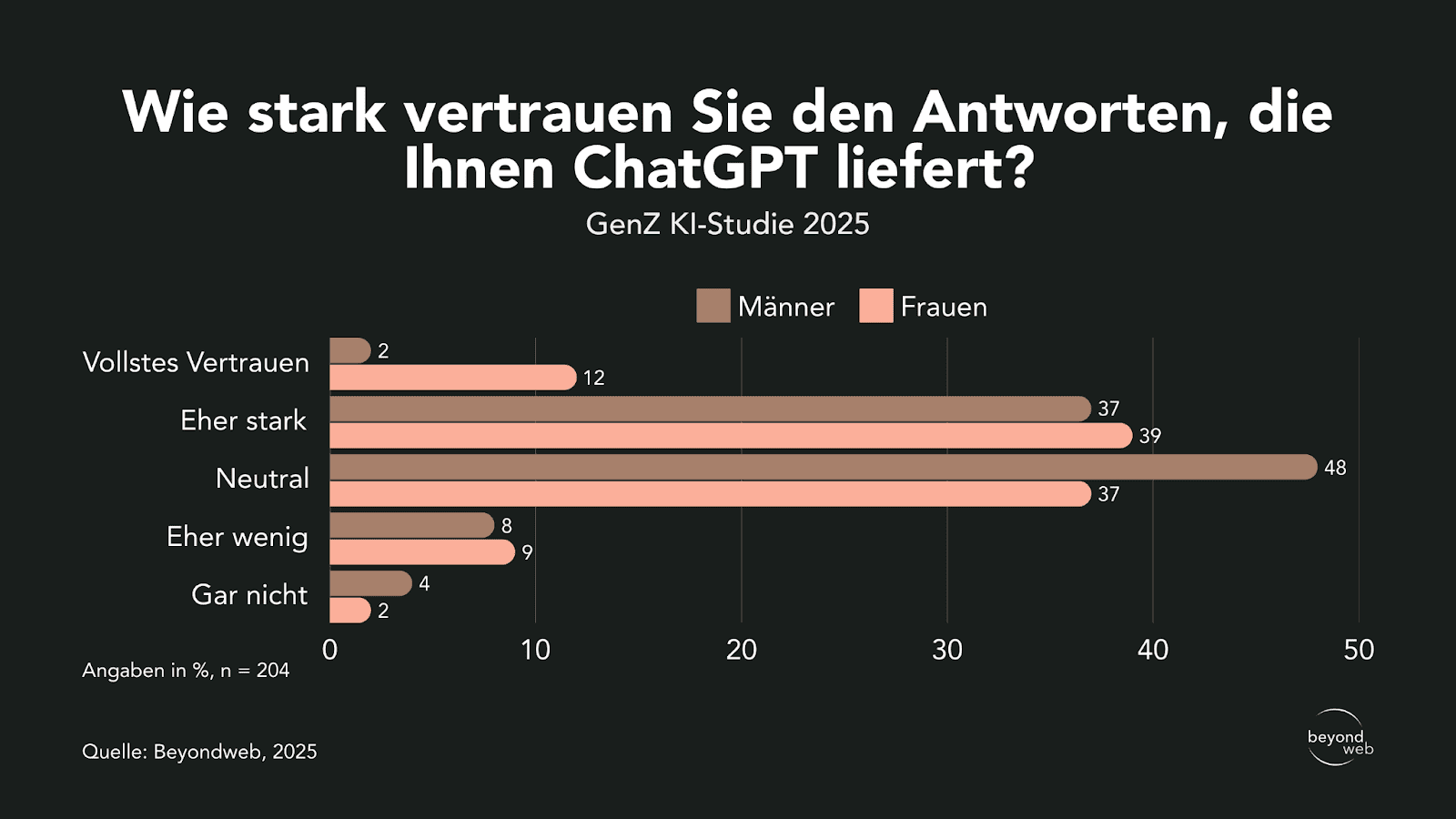
Unterteilt nach Geschlechtern haben 2 % der Männer und 12 % der Frauen volles Vertrauen in die von ChatGPT generierten Antworten. 37 % der Männer und 39 % der Frauen vertrauen den Antworten eher stark. Eine neutrale Haltung nehmen 48 % der Männer und 37 % der Frauen ein. 8 % der Männer und 9 % der Frauen zeigen eher wenig Vertrauen, während 4 % der Männer und 2 % der Frauen den Antworten von ChatGPT gar nicht vertrauen.
Unterteilung nach Bildungsstand
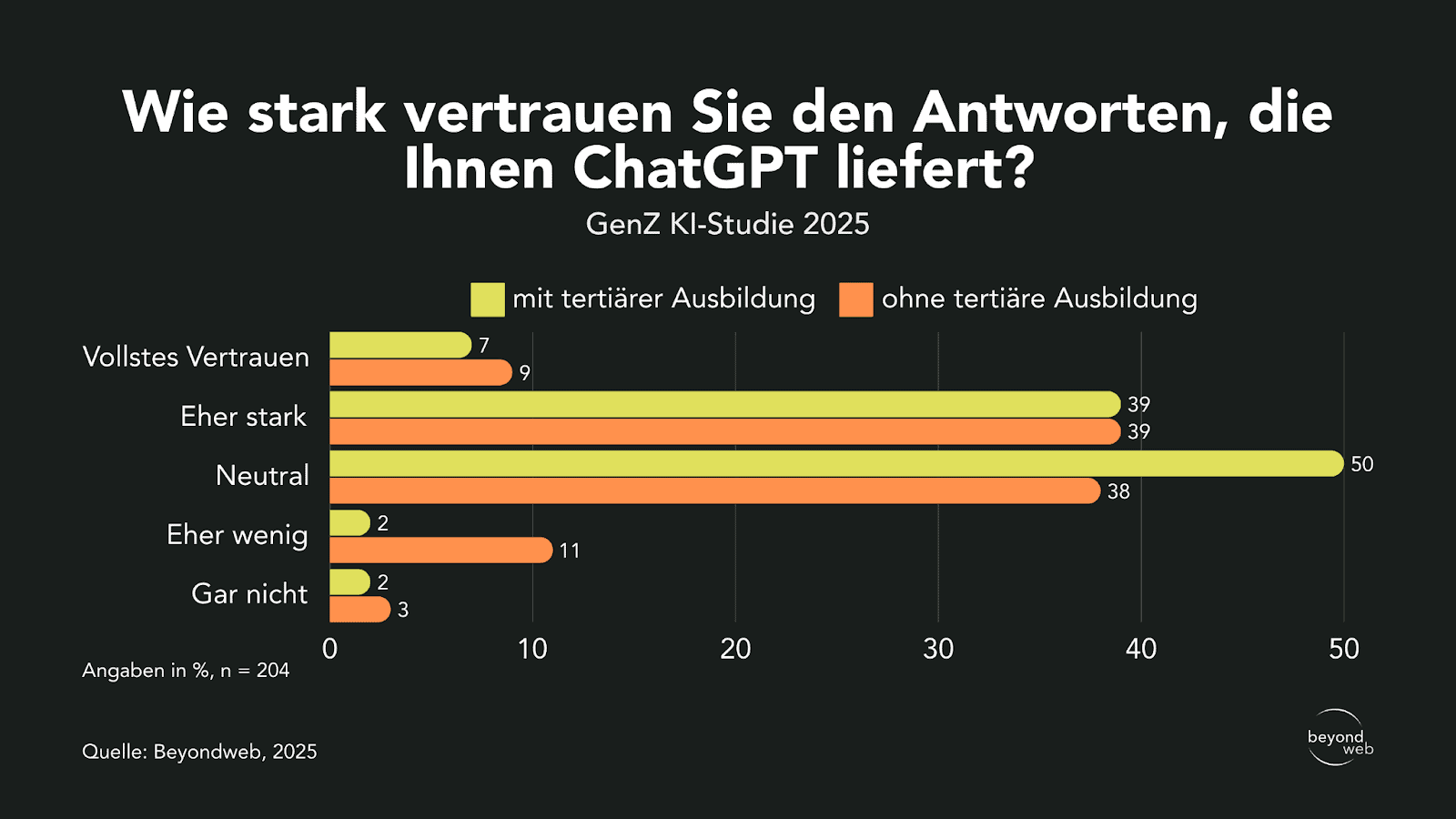
Das Vertrauen in die Antworten von ChatGPT variiert je nach Bildungsstand. 7 % der Befragten mit tertiärer Ausbildung und 9 % der Befragten ohne höheren Bildungsabschluss haben volles Vertrauen in die generierten Antworten. Jeweils 39 % in beiden Gruppen vertrauen den Antworten eher stark. 50 % der Personen mit tertiärer Ausbildung und 38 % der Befragten ohne höheren Bildungsabschluss stehen den Antworten neutral gegenüber. 2 % der Akademiker und 11 % der Befragten ohne tertiäre Ausbildung vertrauen den Antworten eher nicht. 2 % der Personen mit höherer Bildung und 3 % der Befragten ohne tertiären Abschluss vertrauen den Antworten gar nicht.
Bevorzugte Quellen zur Informationssuche
Alle Befragten
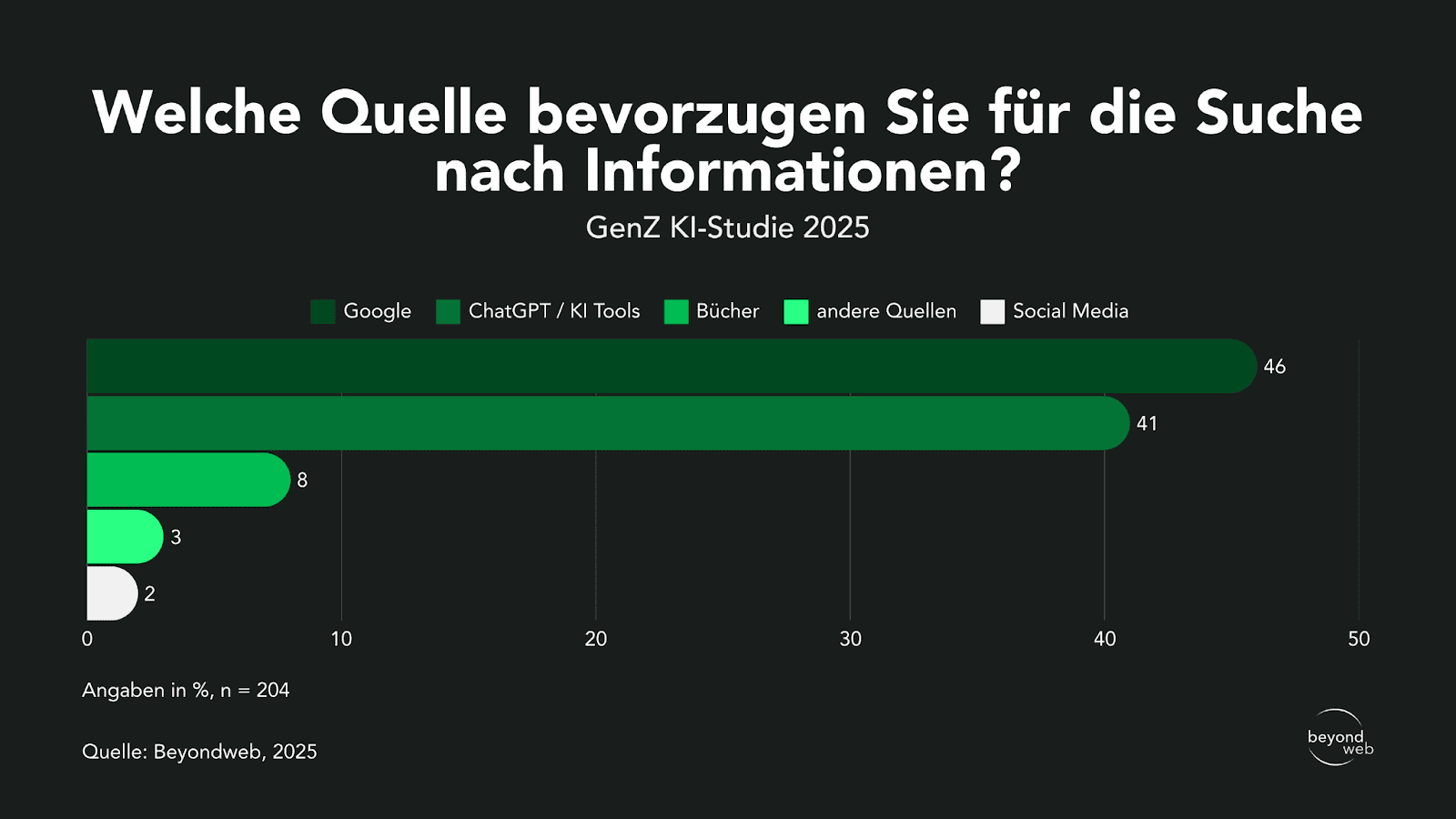
Die bevorzugten Informationsquellen der Befragten variieren. 46 % aller Befragten greifen für die Suche nach Informationen bevorzugt auf Google zurück. 41 % nutzen primär ChatGPT und andere KI-gestützte Tools. Bücher werden von 8 % der Befragten als bevorzugte Informationsquelle genannt. 3 % der Teilnehmenden setzen auf andere Quellen, während 2 % Informationen vorrangig über Social Media beziehen.
Unterteilung nach Geschlecht
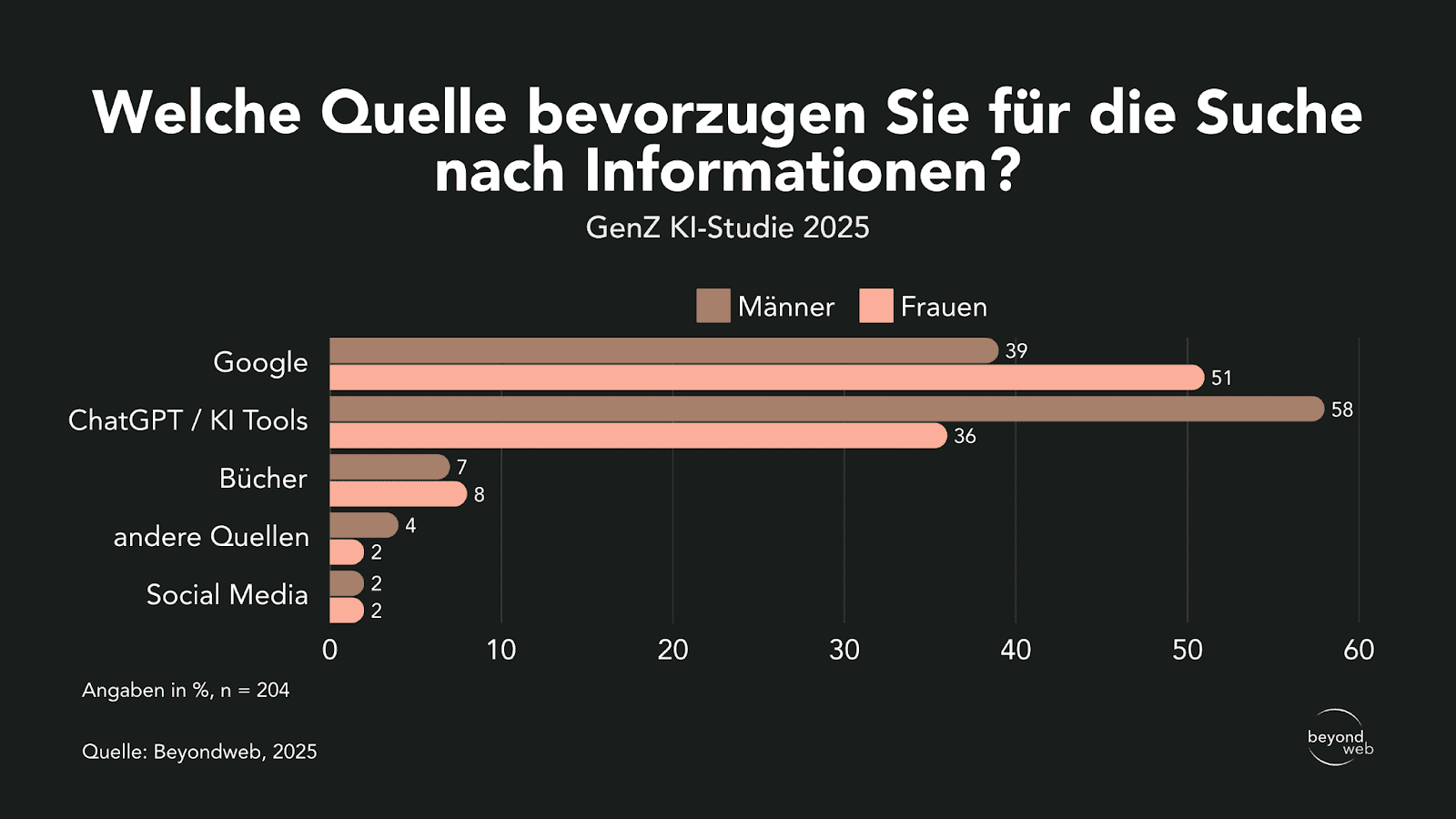
Die bevorzugten Informationsquellen unterscheiden sich je nach Geschlecht. 39 % der befragten Männer und 51 % der befragten Frauen nutzen Google vorrangig für die Suche nach Informationen. 58 % der Männer bevorzugen hingegen ChatGPT und andere KI-Tools, während dies nur auf 36 % der Frauen zutrifft. Bücher werden von 7 % der Männer und 8 % der Frauen als primäre Informationsquelle genannt. 4 % der Männer und 2 % der Frauen greifen auf andere Quellen zurück. Jeweils 2 % in beiden Gruppen nutzen bevorzugt Social Media zur Informationssuche.
Unterteilung nach Bildungsstand
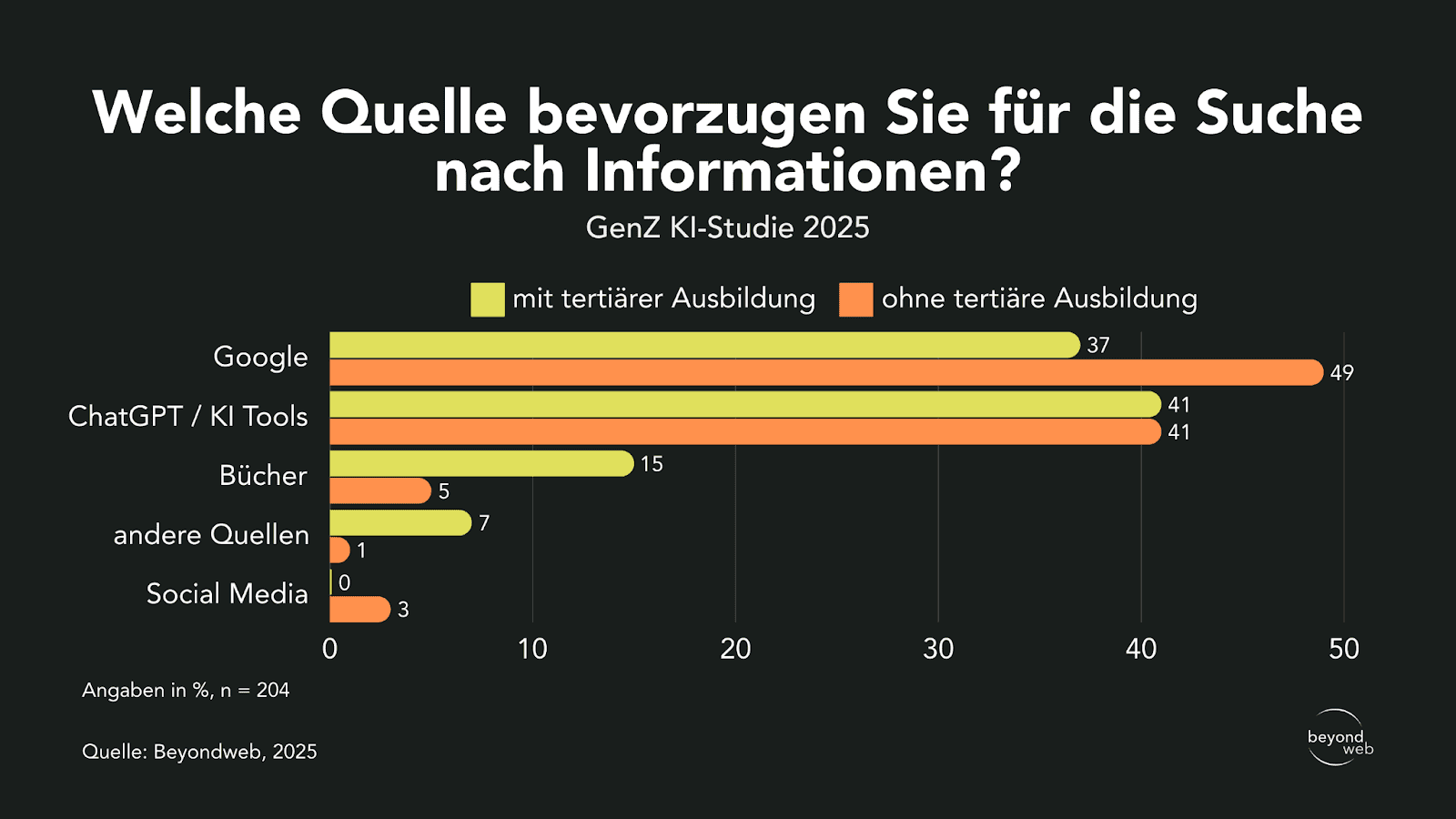
Die bevorzugten Informationsquellen variieren je nach Bildungsstand. 37 % der Befragten mit tertiärer Ausbildung und 49 % der Befragten ohne tertiären Abschluss nutzen bevorzugt Google zur Informationssuche. Jeweils 41 % in beiden Gruppen setzen auf ChatGPT und andere KI-gestützte Tools. Bücher werden von 15 % der Befragten mit tertiärer Ausbildung als primäre Informationsquelle genannt, während dies nur auf 5 % der Befragten ohne höheren Bildungsabschluss zutrifft. 7 % der Akademiker und 1 % der Befragten ohne tertiäre Ausbildung greifen auf andere Quellen zurück. Social Media wird von keiner Person mit tertiärem Bildungsabschluss bevorzugt, während 3 % der Befragten ohne tertiäre Ausbildung diese Plattformen als primäre Informationsquelle nutzen.
Warum bevorzugen Sie ChatGPT gegenüber Google für bestimmte Suchanfragen?
Alle Befragten
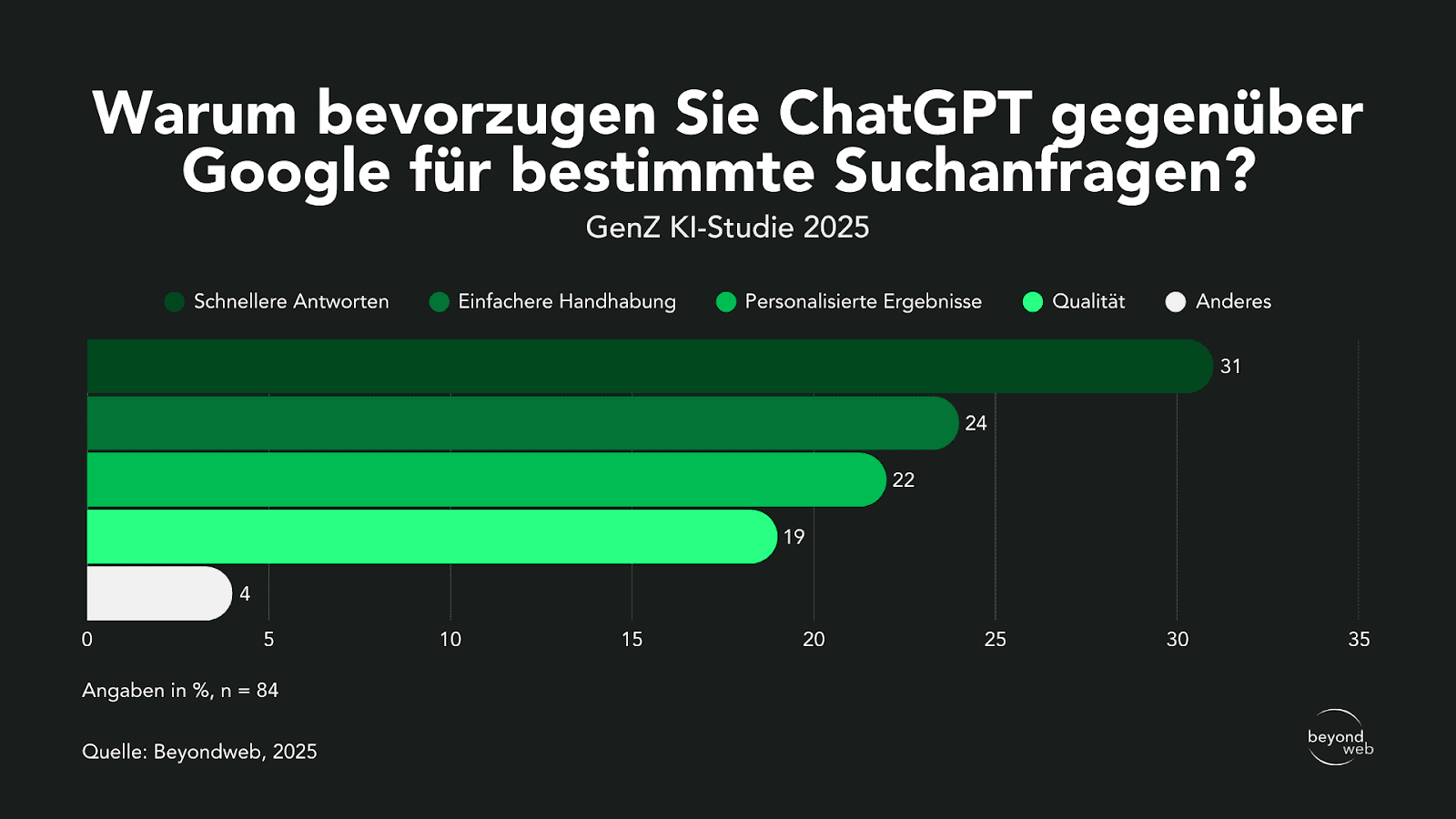
Die Gründe für die Bevorzugung von ChatGPT gegenüber Google variieren. 31 % der Befragten nutzen ChatGPT für bestimmte Suchanfragen, weil sie schnellere Antworten erhalten. 24 % schätzen die einfachere Handhabung des Tools. 22 % bevorzugen ChatGPT aufgrund der personalisierten Ergebnisse. 19 % der Befragten sehen die höhere Qualität der Antworten als entscheidenden Vorteil. 4 % nennen andere Gründe für ihre Präferenz.
Unterteilung nach Geschlecht
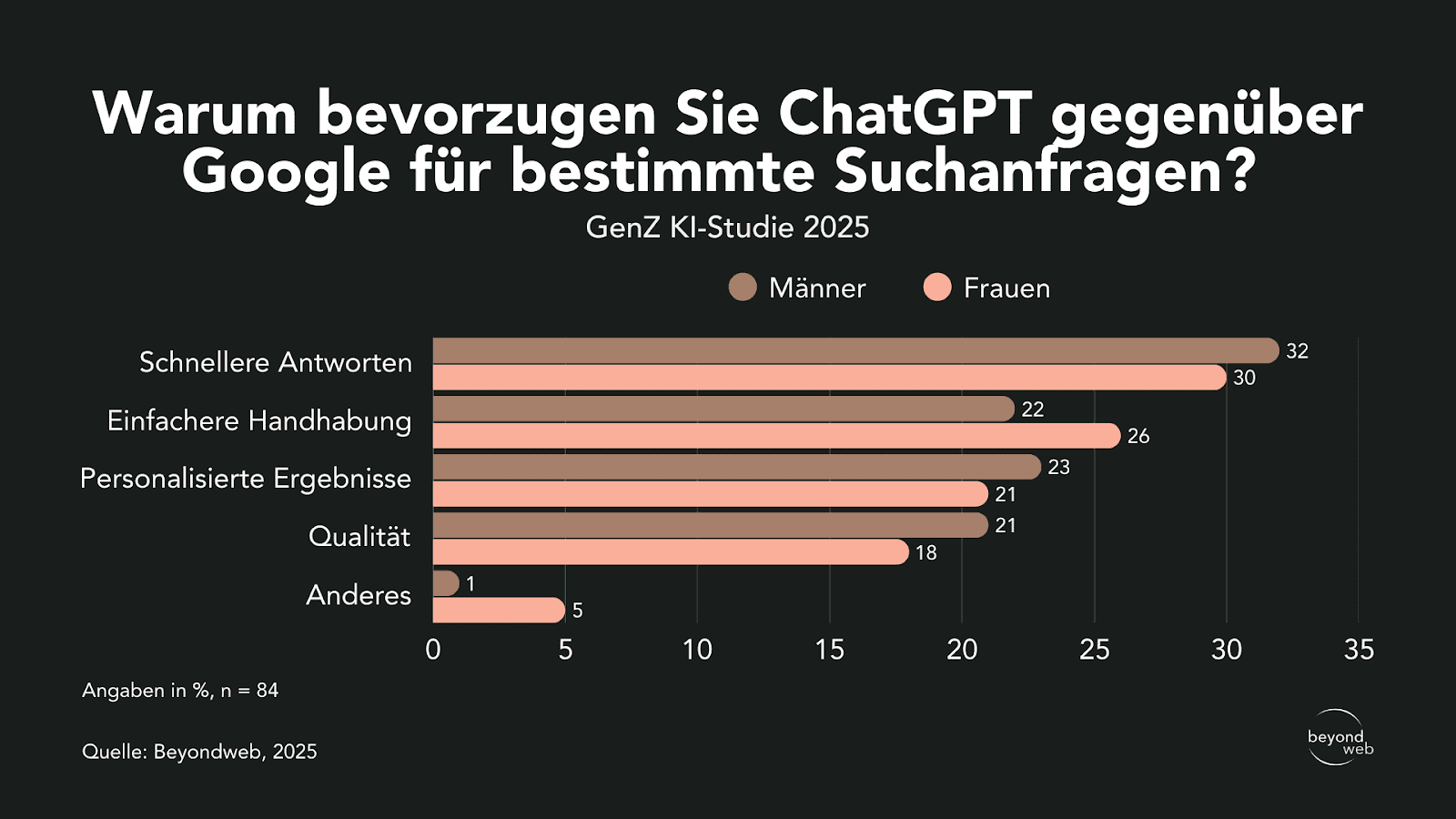
Die Gründe für die Bevorzugung von ChatGPT gegenüber Google unterscheiden sich je nach Geschlecht. 32 % der Männer und 30 % der Frauen nutzen ChatGPT für bestimmte Suchanfragen, weil sie schnellere Antworten erhalten. 22 % der Männer und 26 % der Frauen bevorzugen das Tool aufgrund der einfacheren Handhabung. Personalisierte Ergebnisse sind für 23 % der Männer und 21 % der Frauen ein entscheidender Faktor. 21 % der Männer und 18 % der Frauen schätzen die höhere Qualität der Antworten. 1 % der Männer und 5 % der Frauen nennen andere Gründe für ihre Präferenz.
Unterteilung nach Bildungsstand
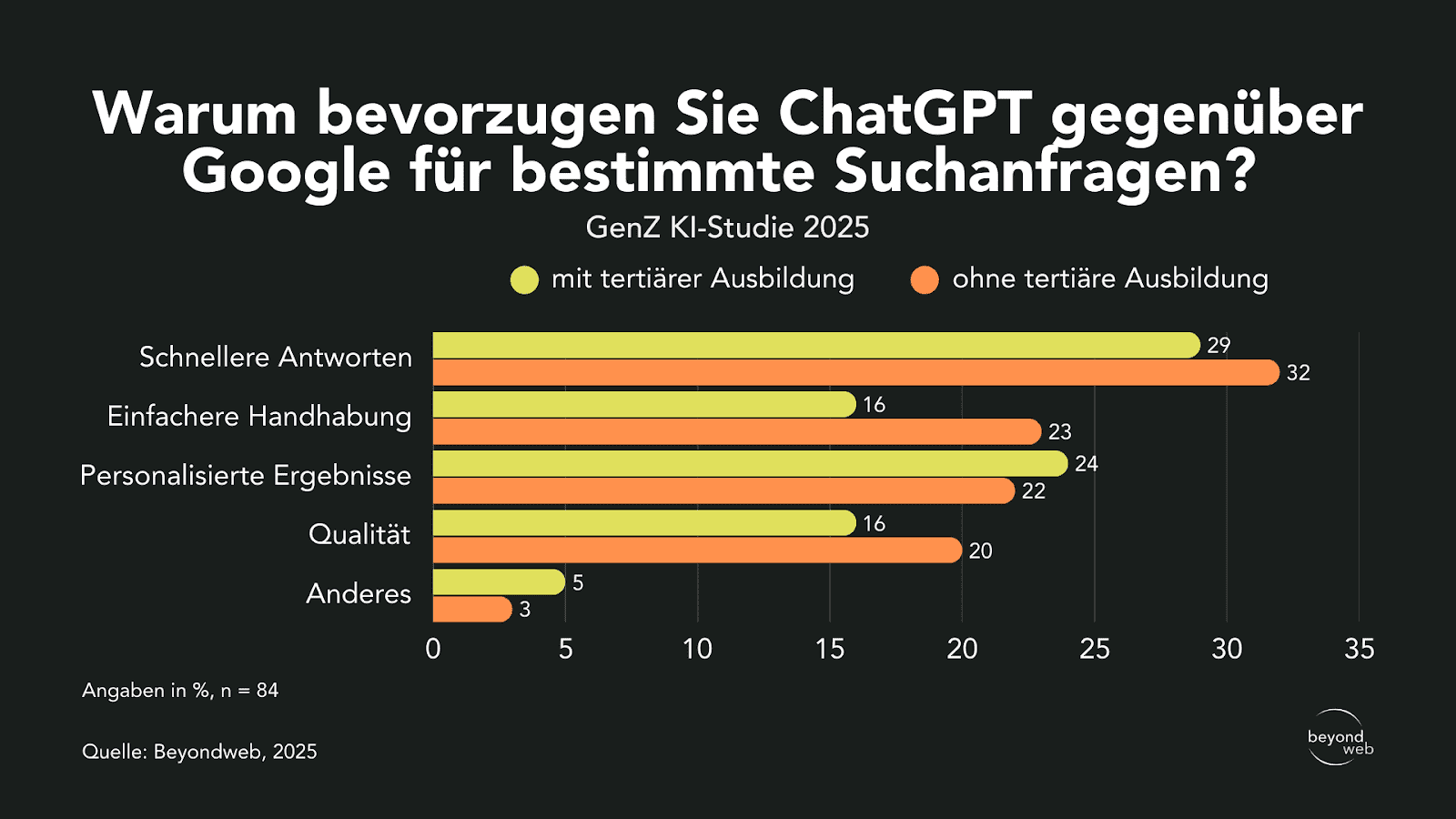
Die Gründe für die Bevorzugung von ChatGPT gegenüber Google variieren je nach Bildungsstand. 29 % der Befragten mit tertiärer Ausbildung und 32 % der Befragten ohne höheren Bildungsabschluss nutzen ChatGPT für bestimmte Suchanfragen, weil sie schnellere Antworten erhalten. 16 % der Akademiker und 20 % der Befragten ohne tertiäre Ausbildung bevorzugen das Tool aufgrund der besseren Qualität der Antworten. Die einfachere Handhabung ist für 16 % der Befragten mit tertiärem Abschluss und 23 % der Befragten ohne höheren Bildungsabschluss ein ausschlaggebender Faktor. 24 % der Akademiker und 22 % der Befragten ohne tertiäre Ausbildung schätzen die personalisierten Ergebnisse. 5 % der Personen mit tertiärer Ausbildung und 3 % der Befragten ohne höheren Bildungsabschluss nennen andere Gründe für ihre Präferenz.
Wenn Sie ChatGPT und Google vergleichen: Welches Tool nutzen Sie häufiger für die Suche nach Informationen?
Alle Befragten
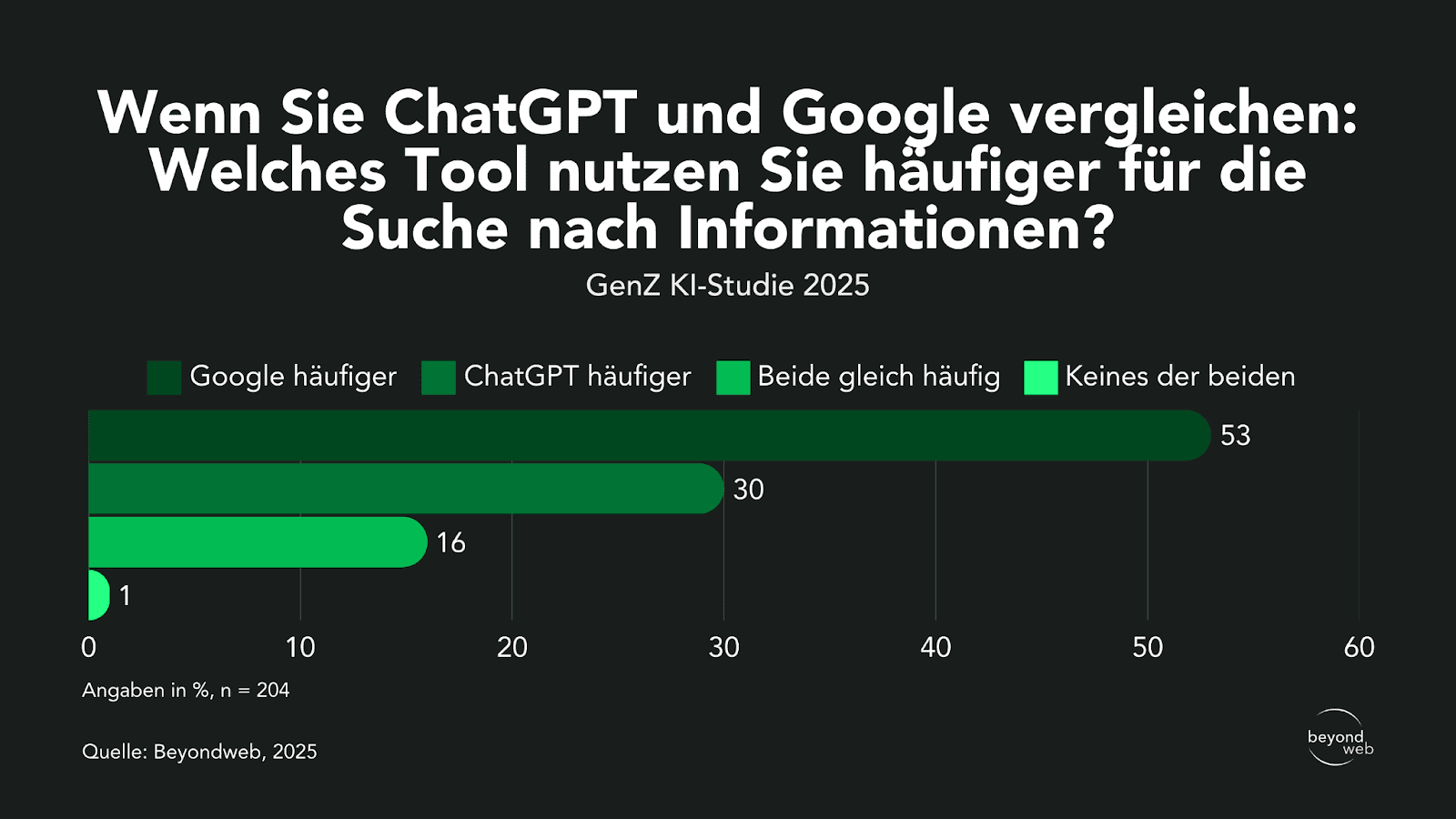
Die Nutzungshäufigkeit von Google und ChatGPT variiert unter den Befragten. 53 % der Teilnehmenden geben an, Google häufiger für die Suche nach Informationen zu nutzen als ChatGPT. 30 % der Befragten verwenden dagegen bevorzugt ChatGPT. 16 % nutzen beide Tools in etwa gleich häufig. 1 % der Befragten greift auf keines der beiden Werkzeuge zurück.
Unterteilung nach Geschlecht
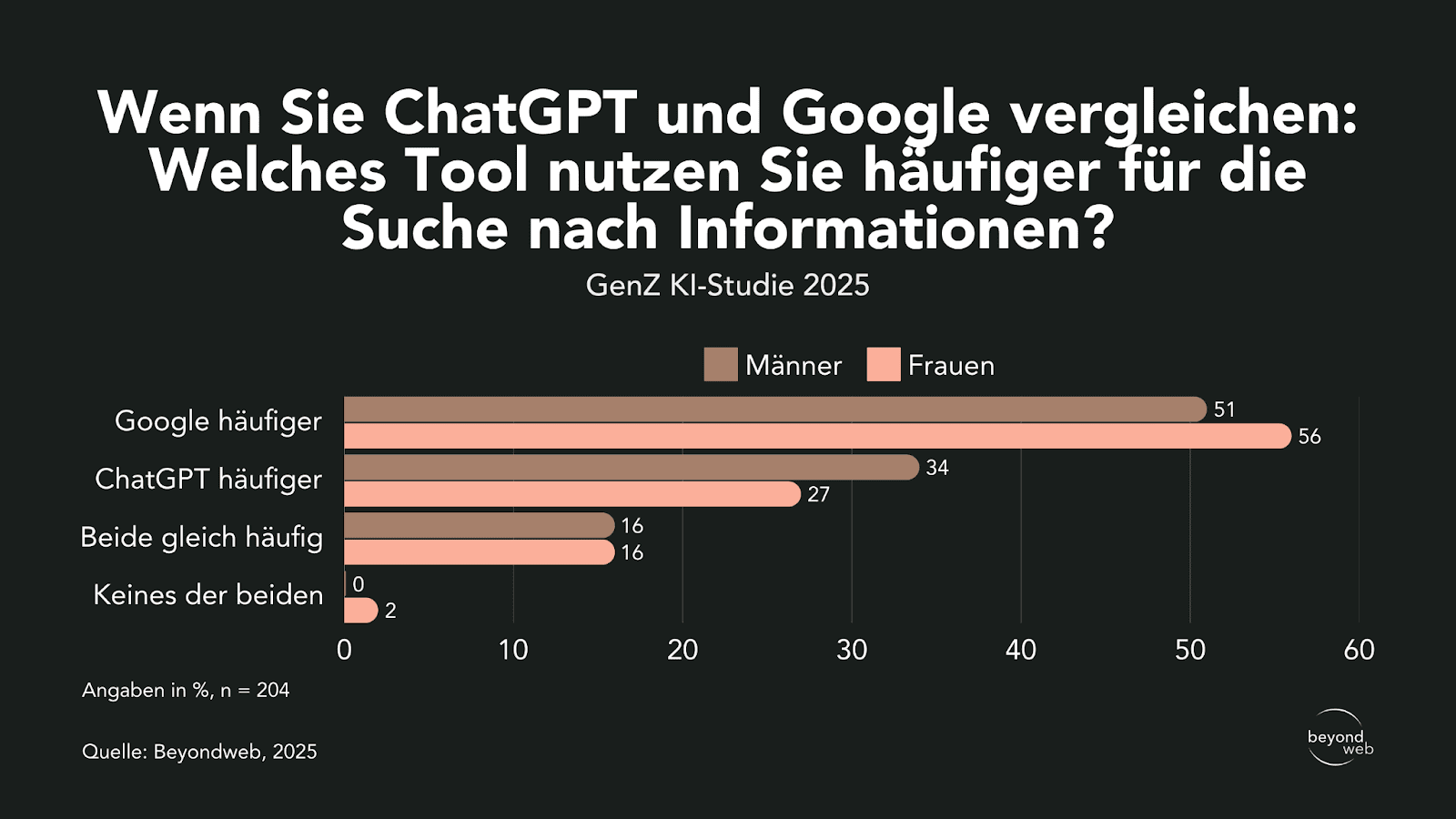
Die Nutzungshäufigkeit von Google und ChatGPT unterscheidet sich je nach Geschlecht. 51 % der befragten Männer und 56 % der Frauen nutzen Google häufiger als ChatGPT für die Suche nach Informationen. 34 % der Männer und 27 % der Frauen geben an, ChatGPT häufiger zu verwenden. Jeweils 16 % in beiden Gruppen nutzen beide Tools ungefähr gleich oft. Während kein befragter Mann auf beide Tools verzichtet, geben 2 % der Frauen an, keines von beiden zu nutzen.
Unterteilung nach Bildungsstand
Die Nutzungshäufigkeit von Google und ChatGPT unterscheidet sich je nach Geschlecht. 51 % der befragten Männer und 56 % der Frauen nutzen Google häufiger als ChatGPT für die Suche nach Informationen. 34 % der Männer und 27 % der Frauen geben an, ChatGPT häufiger zu verwenden. Jeweils 16 % in beiden Gruppen nutzen beide Tools ungefähr gleich oft. Während kein befragter Mann auf beide Tools verzichtet, geben 2 % der Frauen an, keines von beiden zu nutzen.

Die Nutzungshäufigkeit von Google und ChatGPT variiert je nach Bildungsstand. 56 % der Befragten mit tertiärer Ausbildung und 53 % der Befragten ohne höheren Bildungsabschluss nutzen Google häufiger als ChatGPT für die Suche nach Informationen. 28 % der Akademiker und 31 % der Befragten ohne tertiäre Ausbildung geben an, ChatGPT häufiger zu verwenden. 17 % der Personen mit tertiärer Ausbildung und 15 % der Befragten ohne höheren Bildungsabschluss nutzen beide Tools in etwa gleich häufig. Während kein Befragter mit tertiärem Abschluss auf beide Tools verzichtet, geben 1 % der Befragten ohne tertiäre Ausbildung an, keines von beiden zu nutzen.
Fühlen Sie sich durch KI-Anwendungen in Bezug auf Ihre Karriere bedroht?
(1 = gar nicht, 5 = sehr stark)
Alle Befragten
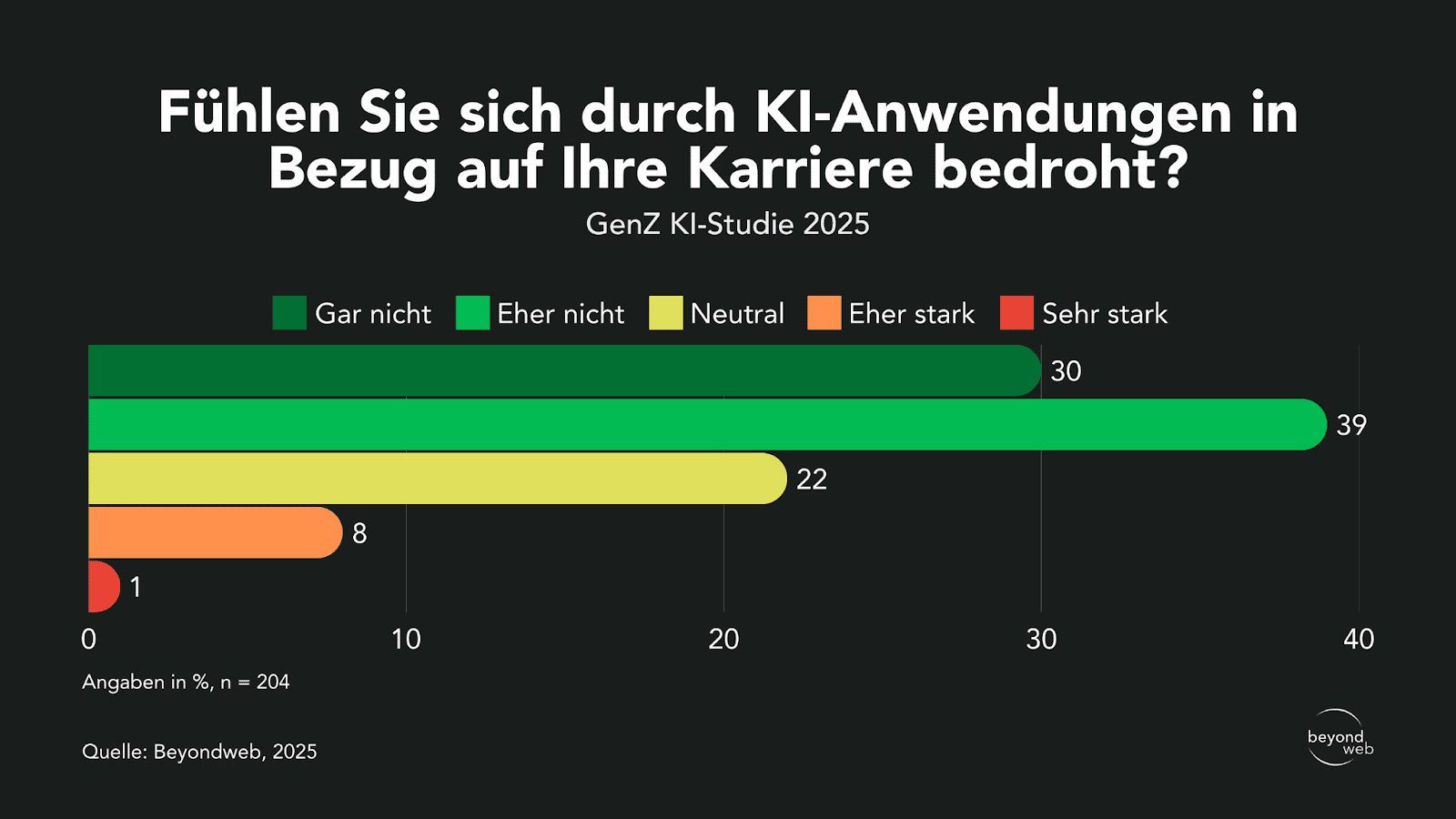
Die Wahrnehmung der Auswirkungen von KI auf die Karrierechancen variiert unter den Befragten. 30 % der Teilnehmenden sehen sich durch KI in ihrer beruflichen Zukunft überhaupt nicht bedroht. 39 % empfinden die potenziellen Auswirkungen als eher unbedenklich. 22 % stehen dem Einfluss von KI auf ihre Karriere neutral gegenüber. 8 % der Befragten nehmen eine eher starke Bedrohung wahr, während 1 % der Teilnehmenden KI als eine sehr starke Bedrohung für ihre berufliche Zukunft betrachtet.
Unterteilung nach Geschlecht
Die Wahrnehmung der Auswirkungen von KI auf die Karrierechancen variiert unter den Befragten. 30 % der Teilnehmenden sehen sich durch KI in ihrer beruflichen Zukunft überhaupt nicht bedroht. 39 % empfinden die potenziellen Auswirkungen als eher unbedenklich. 22 % stehen dem Einfluss von KI auf ihre Karriere neutral gegenüber. 8 % der Befragten nehmen eine eher starke Bedrohung wahr, während 1 % der Teilnehmenden KI als eine sehr starke Bedrohung für ihre berufliche Zukunft betrachtet.

Unterteilung nach Bildungsstand
Die Wahrnehmung der Auswirkungen von KI auf die Karrierechancen unterscheidet sich je nach Geschlecht. 31 % der befragten Männer und 29 % der Frauen fühlen sich durch KI in ihrer beruflichen Zukunft gar nicht bedroht. 46 % der Männer und 34 % der Frauen empfinden die potenziellen Auswirkungen als eher unbedenklich. 17 % der Männer und 25 % der Frauen schätzen den Einfluss von KI auf ihre Karriere neutral ein. 6 % der Männer und 10 % der Frauen fühlen sich eher stark bedroht. Während kein befragter Mann eine sehr starke Bedrohung wahrnimmt, sehen 2 % der Frauen KI als erhebliche Gefahr für ihre berufliche Zukunft.

Die Wahrnehmung der Auswirkungen von KI auf die Karrierechancen variiert je nach Bildungsstand. 28 % der Befragten mit tertiärer Ausbildung und 31 % der Befragten ohne höheren Bildungsabschluss fühlen sich durch KI in ihrer beruflichen Zukunft gar nicht bedroht. 48 % der Akademiker und 35 % der Befragten ohne tertiäre Ausbildung empfinden die potenziellen Auswirkungen als eher unbedenklich. 17 % der Befragten mit tertiärer Ausbildung und 24 % der Befragten ohne höheren Bildungsabschluss schätzen den Einfluss von KI auf ihre Karriere neutral ein. 7 % der Akademiker und 9 % der Befragten ohne tertiäre Ausbildung fühlen sich eher stark bedroht. Während kein Befragter mit tertiärem Abschluss eine sehr starke Bedrohung wahrnimmt, sehen 1 % der Befragten ohne höheren Bildungsabschluss KI als erhebliche Gefahr für ihre berufliche Zukunft.
Glauben Sie, dass KI-Systeme wie ChatGPT in der Lage sind, menschliche Kreativität zu replizieren?
Alle Befragten
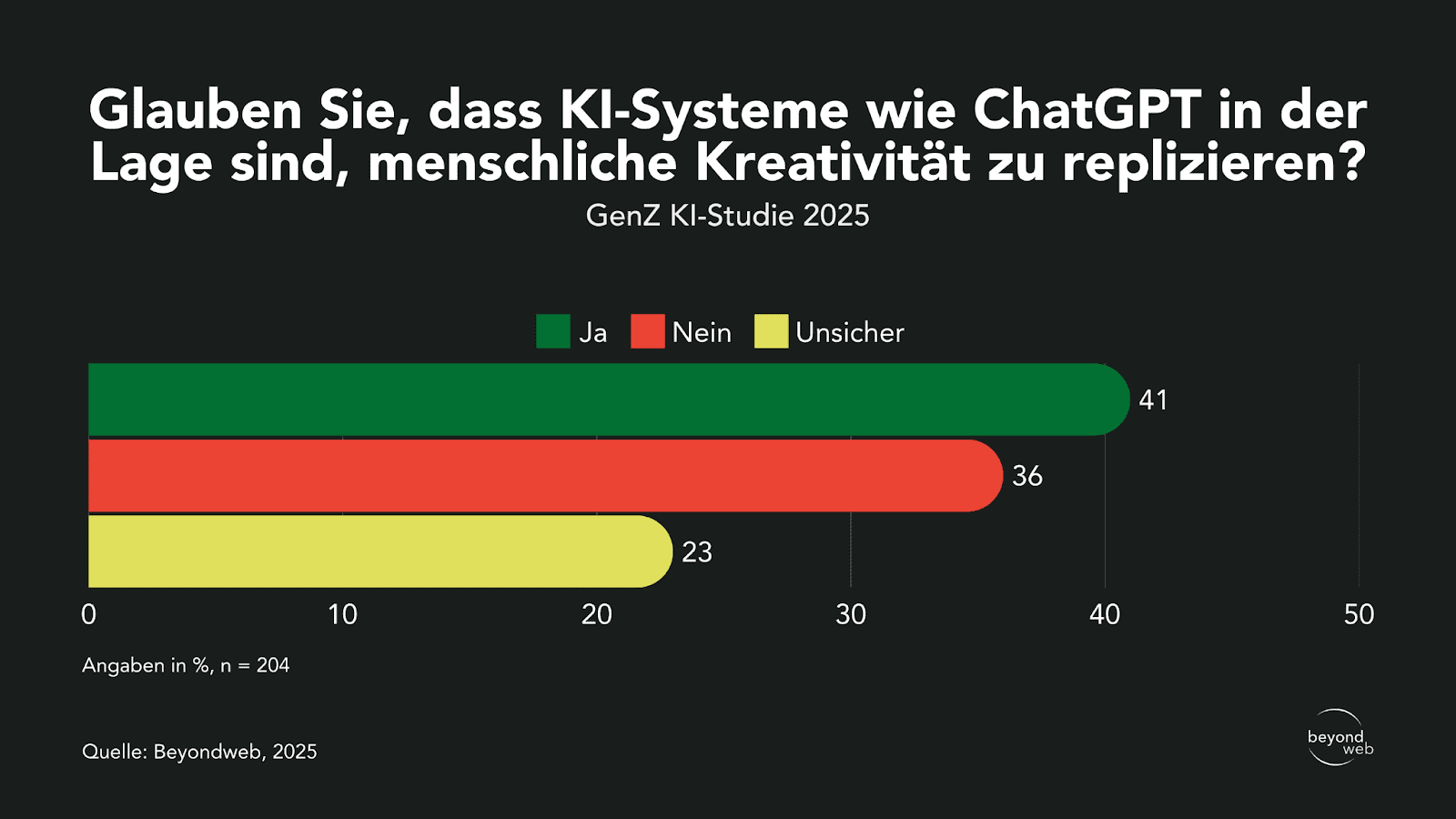
Die Meinungen darüber, ob KI-Systeme wie ChatGPT in der Lage sind, menschliche Kreativität zu replizieren, sind unterschiedlich. 41 % der Befragten sind der Ansicht, dass KI menschliche Kreativität nachbilden kann. 36 % verneinen diese Fähigkeit, während 23 % der Teilnehmenden unsicher sind.
Unterteilung nach Geschlecht
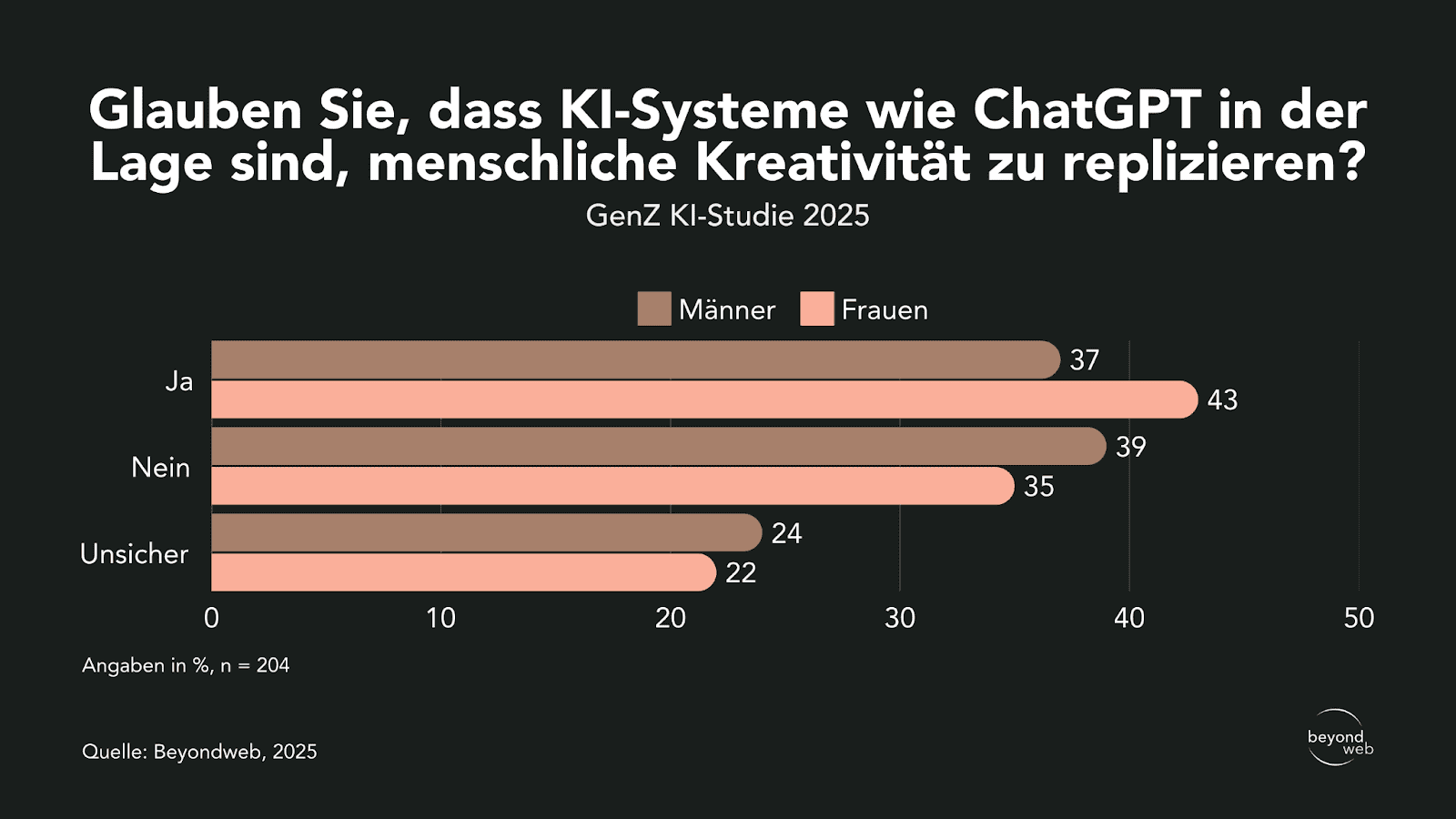
Die Einschätzung darüber, ob KI-Systeme wie ChatGPT menschliche Kreativität replizieren können, variiert je nach Geschlecht. 37 % der befragten Männer und 43 % der Frauen stimmen dieser Aussage zu. 39 % der Männer und 35 % der Frauen verneinen dies. 24 % der Männer und 22 % der Frauen sind sich unsicher.
Unterteilung nach Bildungsstand
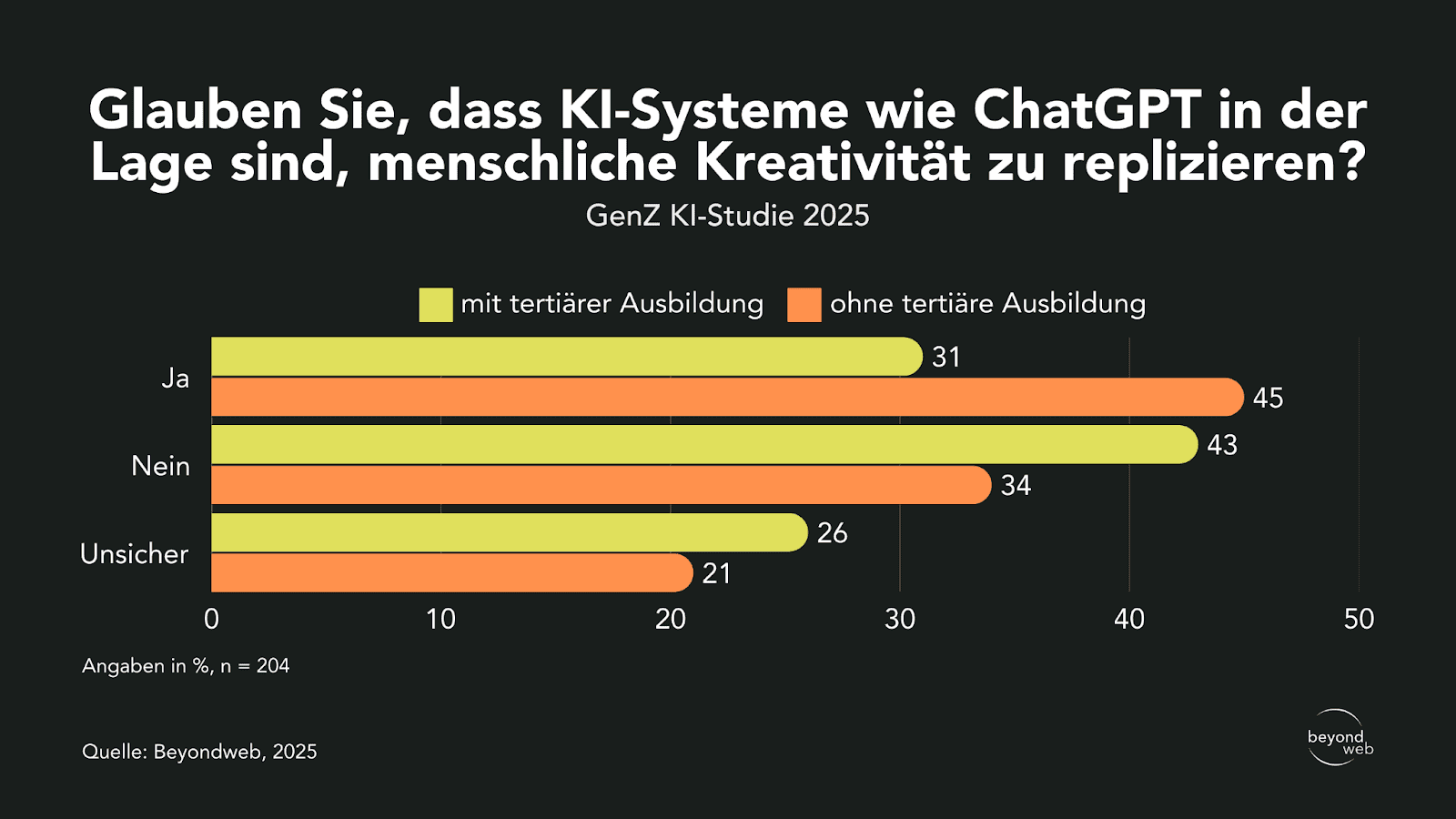
Die Einschätzung, ob KI-Systeme wie ChatGPT menschliche Kreativität replizieren können, unterscheidet sich auch je nach Bildungsstand. 31 % der Befragten mit tertiärer Ausbildung und 45 % der Befragten ohne höheren Bildungsabschluss stimmen dieser Aussage zu. 43 % der Akademiker und 34 % der Befragten ohne tertiäre Ausbildung verneinen dies. 26 % der Personen mit tertiärer Ausbildung und 21 % der Befragten ohne höheren Bildungsabschluss sind sich unsicher.
Glauben Sie, dass KI in Zukunft kreative Berufe ersetzen wird?
Alle Befragten
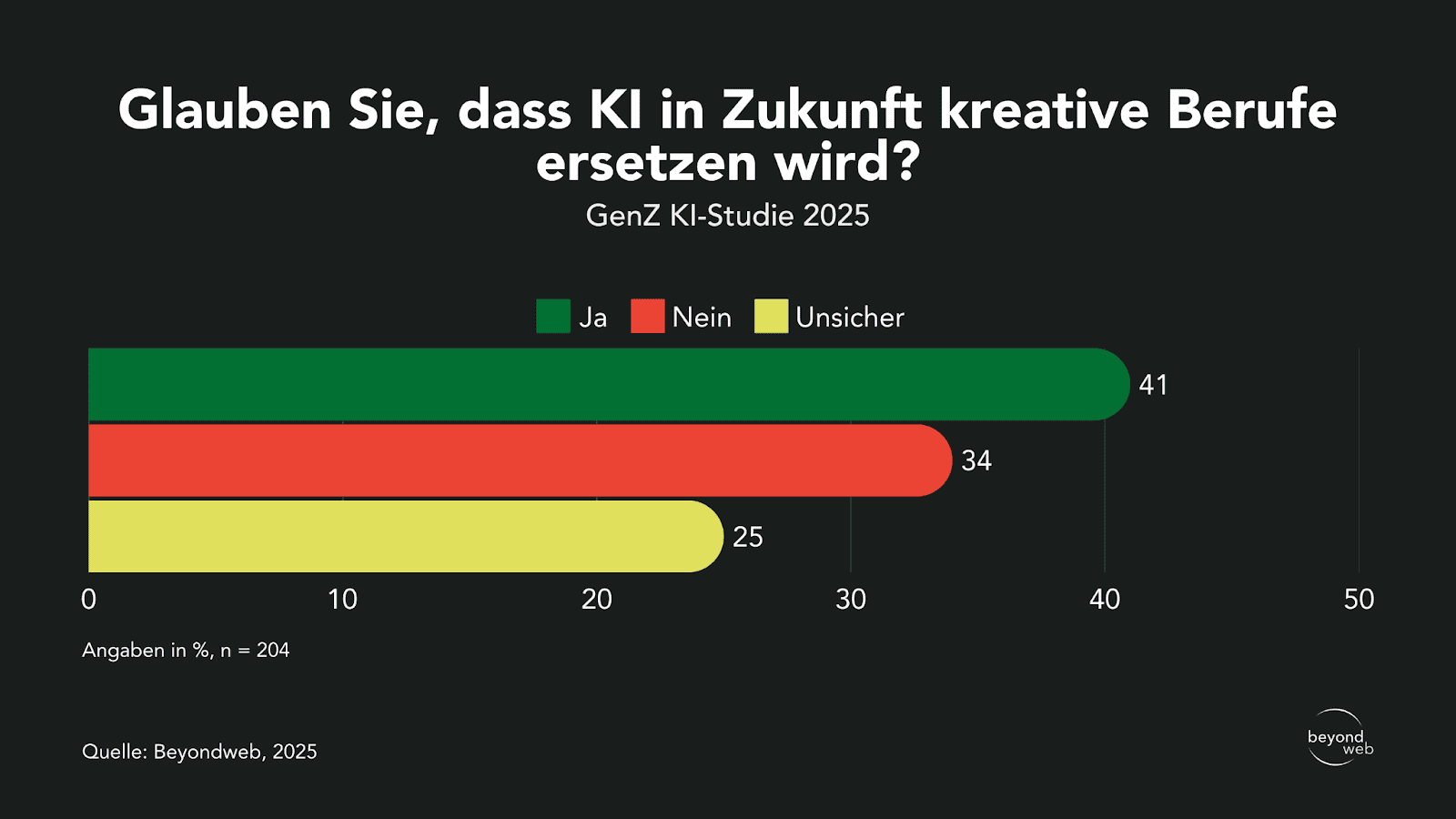
Die Einschätzung darüber, ob KI in Zukunft kreative Berufe ersetzen wird, ist unter den Befragten unterschiedlich. 41 % der Teilnehmenden glauben, dass KI kreative Berufe künftig ersetzen kann. 34 % sind gegenteiliger Ansicht, während 25 % sich unsicher sind.
Unterteilung nach Geschlecht
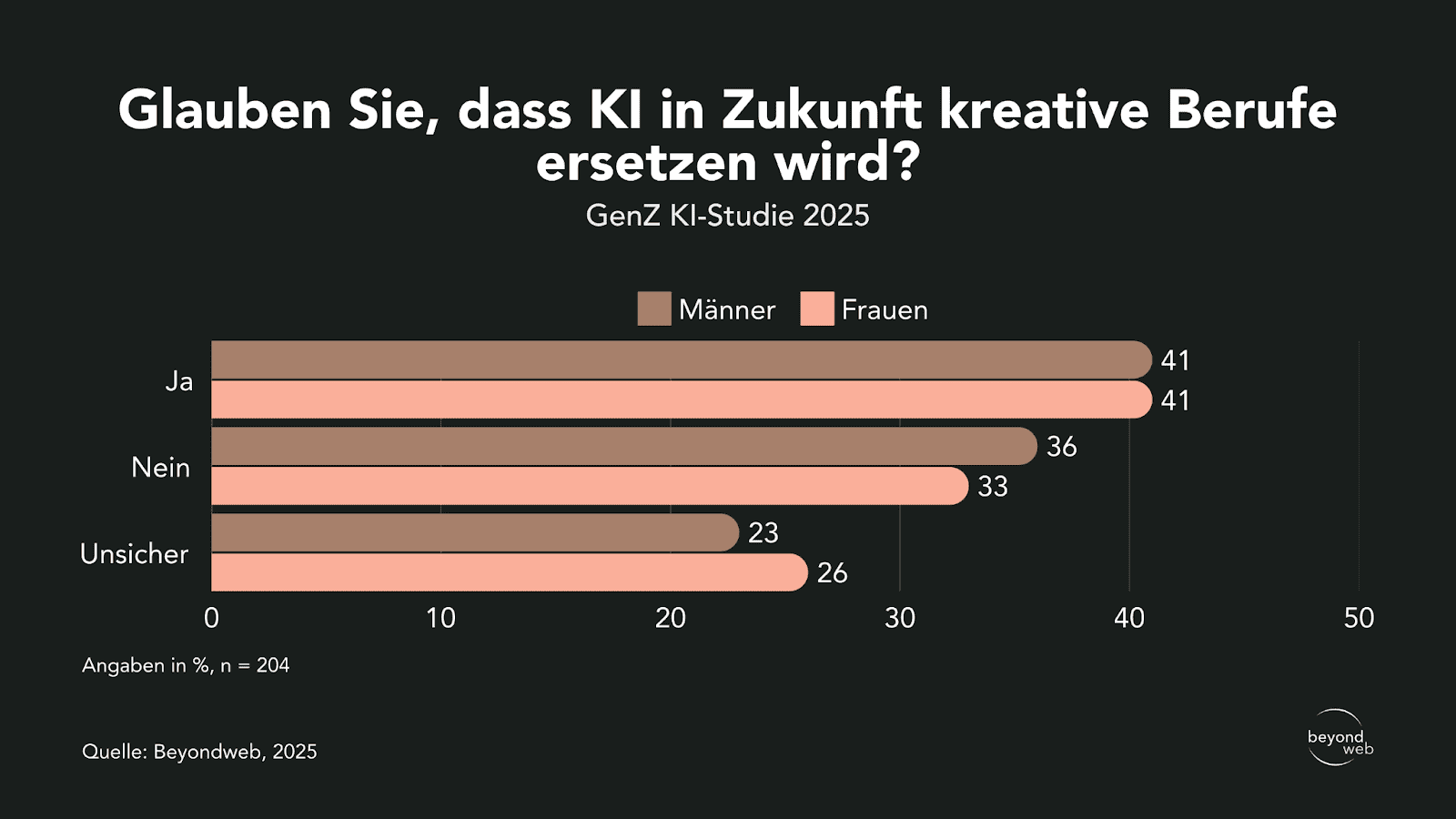
Die Einschätzung darüber, ob KI in Zukunft kreative Berufe ersetzen wird, unterscheidet sich kaum zwischen den Geschlechtern. 41 % der befragten Männer und Frauen stimmen dieser Aussage zu. 36 % der Männer und 33 % der Frauen sind gegenteiliger Ansicht. 23 % der Männer und 26 % der Frauen sind sich unsicher.
Unterteilung nach Bildungsstand
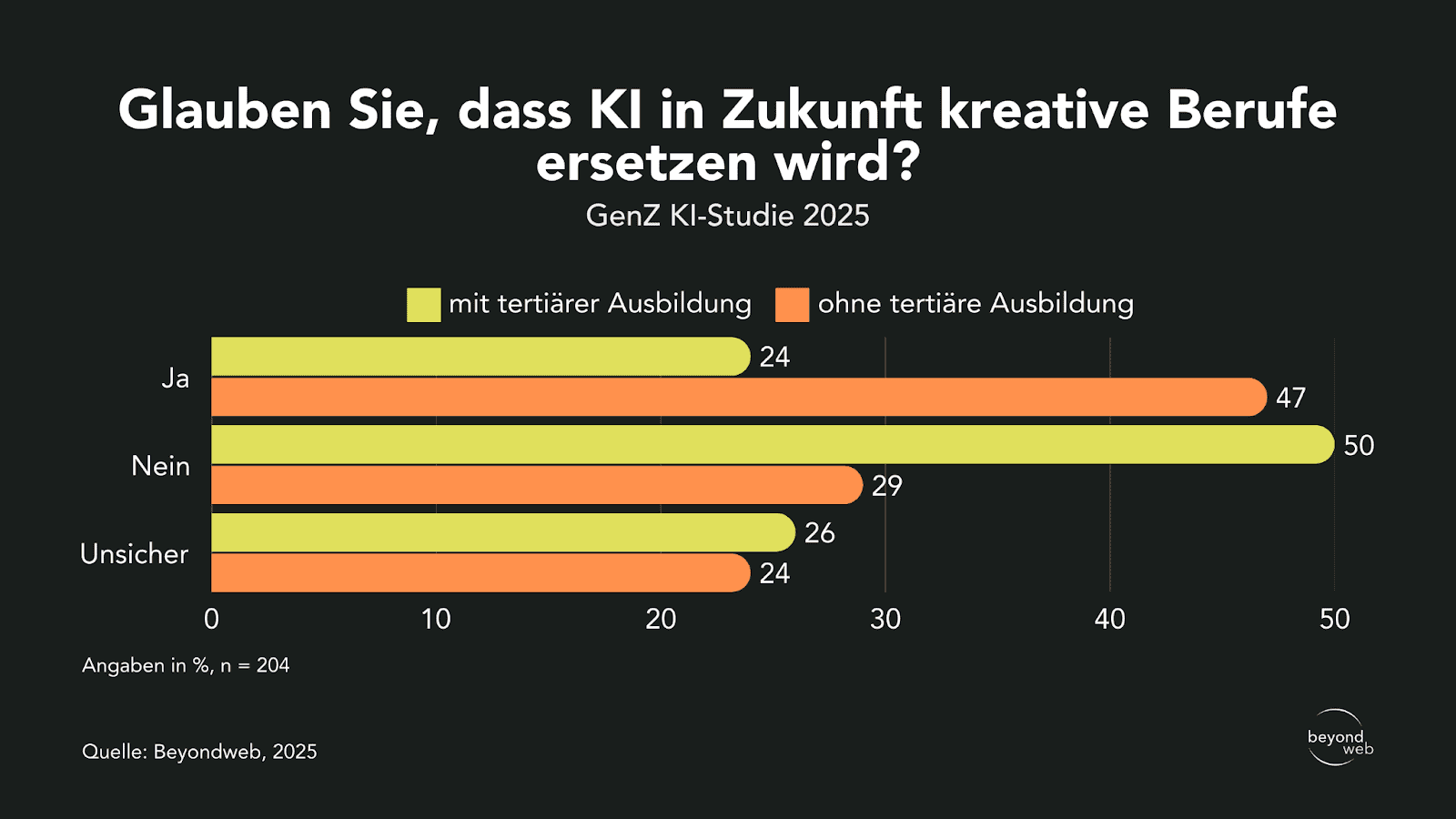
Die Einschätzung darüber, ob KI in Zukunft kreative Berufe ersetzen wird, variiert je nach Bildungsstand. 24 % der Befragten mit tertiärer Ausbildung und 47 % der Befragten ohne höheren Bildungsabschluss glauben, dass KI kreative Berufe künftig ersetzen kann. 50 % der Akademiker und 29 % der Befragten ohne tertiäre Ausbildung verneinen diese Möglichkeit. 26 % der Befragten mit tertiärer Ausbildung und 24 % der Befragten ohne höheren Bildungsabschluss sind sich unsicher.
Glauben Sie, dass KI in Zukunft akademische Berufe ersetzen wird?
Alle Befragten
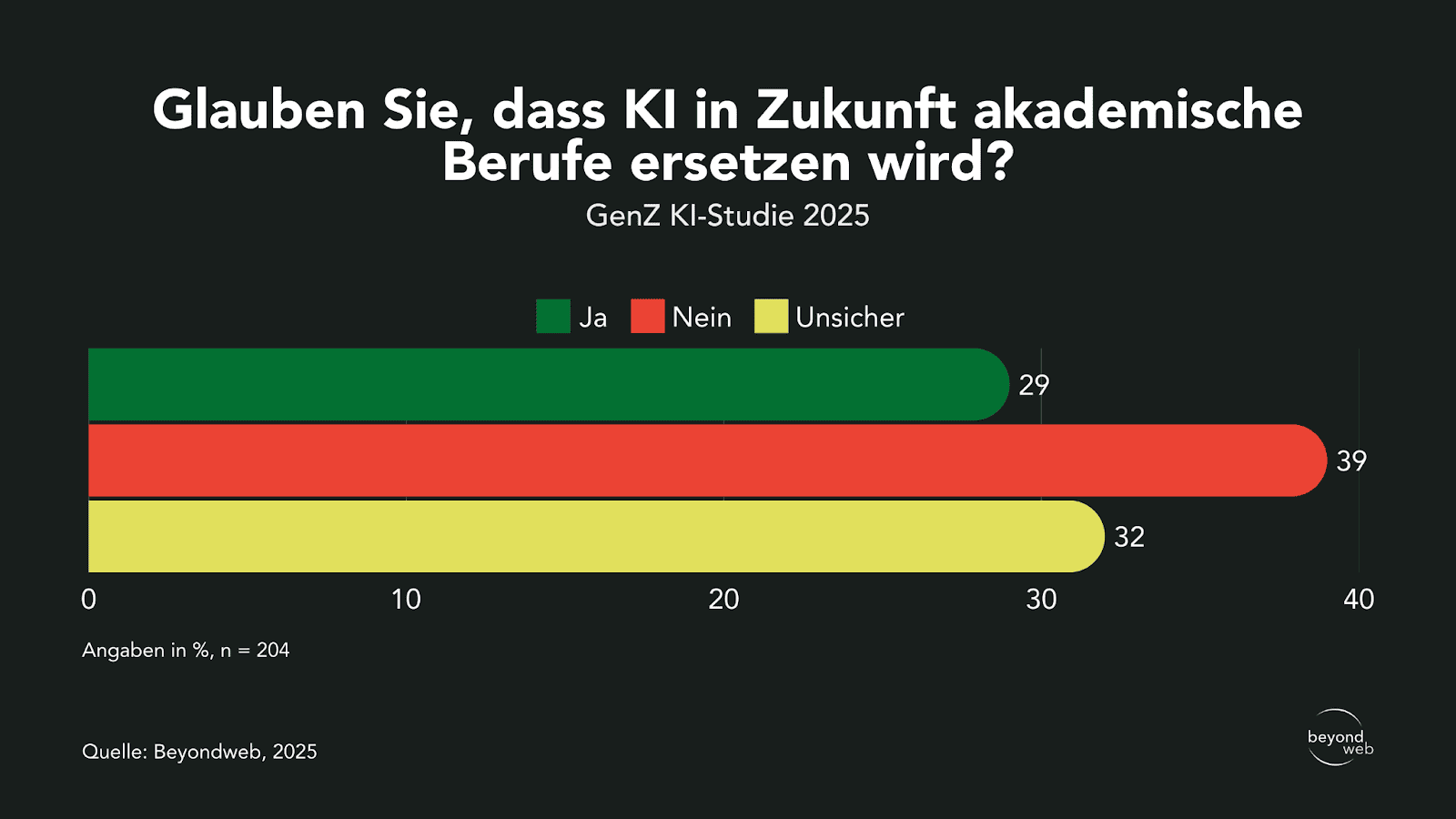
Die Einschätzung darüber, ob KI in Zukunft akademische Berufe ersetzen wird, ist unter den Befragten uneinheitlich. 29 % der Teilnehmenden glauben, dass KI akademische Berufe künftig ersetzen kann. 39 % verneinen diese Möglichkeit, während 32 % sich unsicher sind.
Unterteilung nach Geschlecht
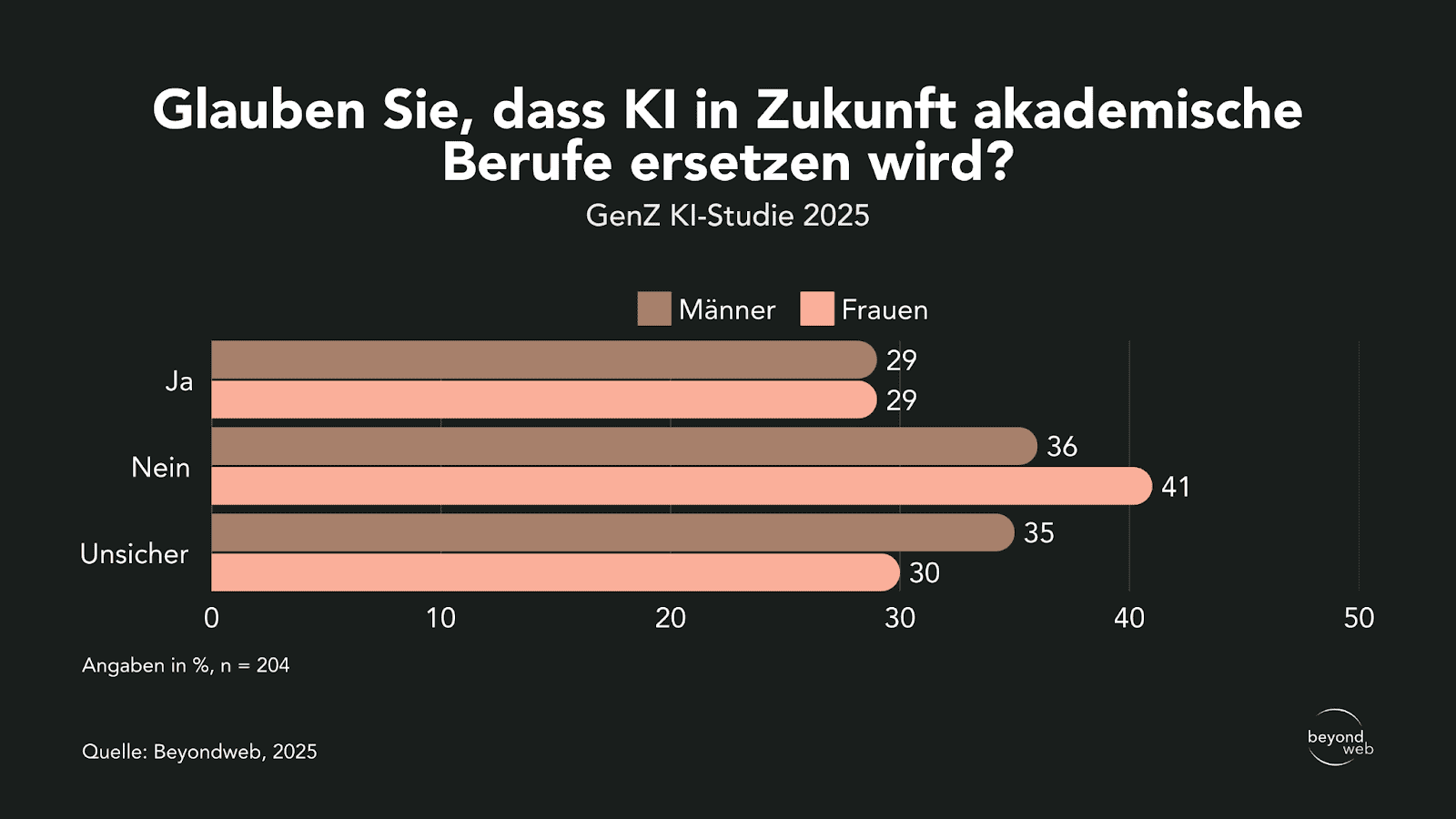
Die Einschätzung darüber, ob KI in Zukunft akademische Berufe ersetzen wird, unterscheidet sich je nach Geschlecht. 29 % der befragten Männer und Frauen stimmen dieser Aussage zu. 36 % der Männer und 41 % der Frauen verneinen diese Möglichkeit. 35 % der Männer und 30 % der Frauen sind sich unsicher.
Unterteilung nach Bildungsstand
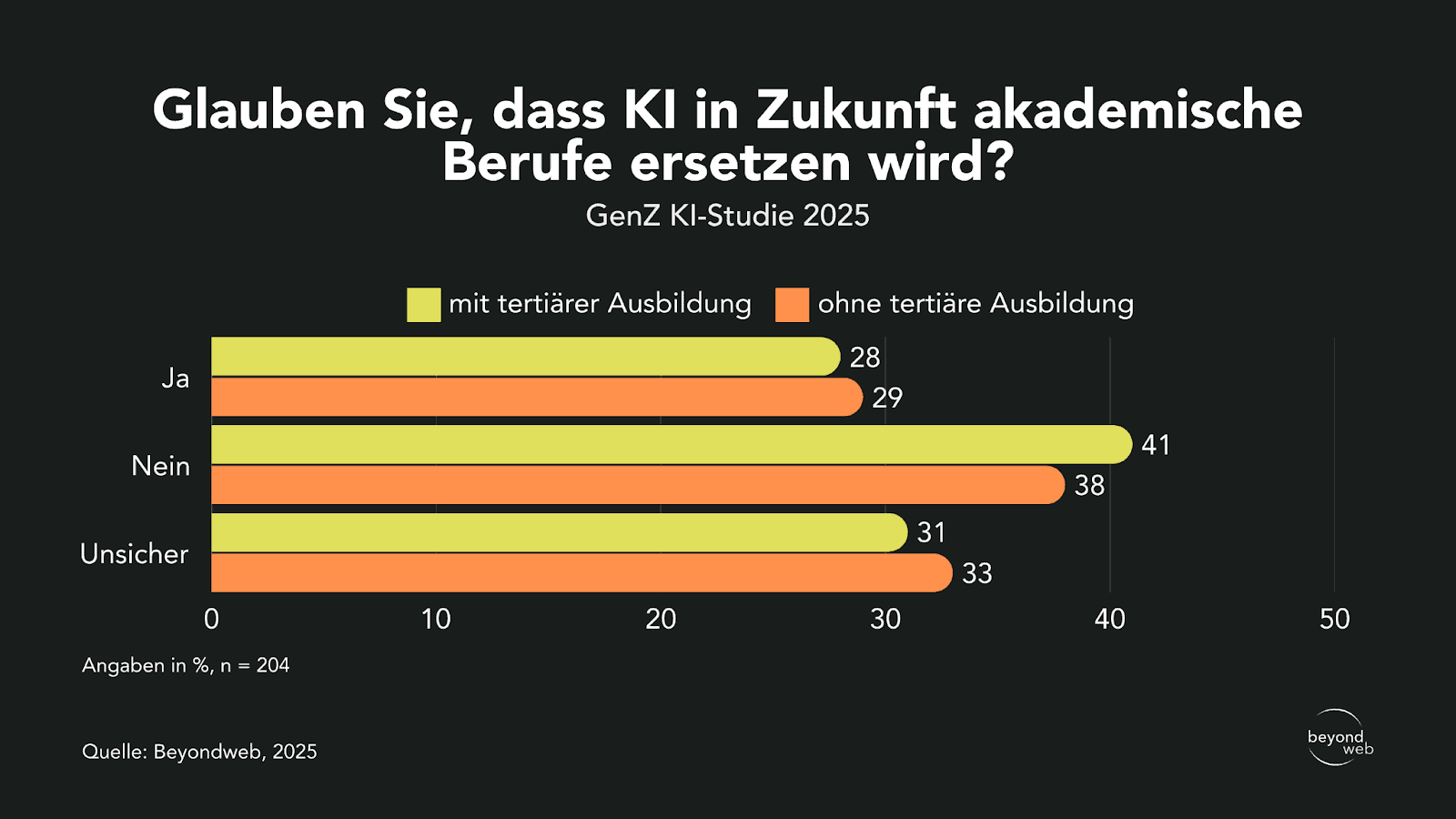
Die Einschätzung darüber, ob KI in Zukunft akademische Berufe ersetzen wird, variiert je nach Bildungsstand. 28 % der Befragten mit tertiärer Ausbildung und 29 % der Befragten ohne höheren Bildungsabschluss glauben, dass KI akademische Berufe künftig ersetzen kann. 41 % der Akademiker und 38 % der Befragten ohne tertiäre Ausbildung verneinen diese Möglichkeit. 31 % der Befragten mit tertiärer Ausbildung und 33 % der Befragten ohne höheren Bildungsabschluss sind sich unsicher.
Interpretation der Ergebnisse
Die Ergebnisse dieser qualitativen Umfrage bestätigen Erkenntnisse früherer Studien, aber liefern zugleich neue Einsichten in die Nutzung von KI der GenZ in der Schweiz.
Im Folgenden werden die zentralen Erkenntnisse näher beleuchtet und mit bestehenden Studien in Verbindung gebracht.
Gender-Gap bei der KI-Nutzung
Männer bevorzugen ChatGPT häufiger (58 %) als Google (39 %). Frauen hingegen zeigen genau das gegenteilige Verhalten. Nur 36 % bevorzugen ChatGPT bei der Informationsbeschaffung, wobei 51 % weiterhin auf Google setzen.
Zudem nutzenFrauen im Vergleich zu Männern seltener ChatGPT. Während nur 34 % der Frauen das Tool täglich nutzen, sind es bei Männern 52 %. Das zeigt: Bei der KI-Nutzung gibt es eine Gender-Gap.
Diese Ergebnisse stehen im Einklang mit einer umfassenden Studie der Bank for International Settlements (BIS) aus dem Jahr 2024 sowie den Erkenntnissen eines Working Papers der Harvard Business School („Global Evidence on Gender Gaps and Generative AI“).
Laut der BIS-Studie nutzen bereits 50 % der Männer generative AI-Tools, während der Anteil bei den Frauen bei nur 37 % liegt. Die Harvard-Studie zeigt auf, dass über alle Altersgruppen hinweg eine 10-40 % geringere KI-Adoption bei Frauen im Vergleich zu Männern vorhanden ist.
Die Ursachen für diese geschlechtsspezifischen Unterschiede sind aktuell noch nicht vollends geklärt.
Erste Ergebnisse der Harvard-Studie legen nahe, dass Frauen häufiger ethische Bedenken bei der Nutzung von KI-Tools haben als Männer (Blanding, 2025). Zudem zeigen sie im beruflichen Alltag eine grössere Zurückhaltung bei der Nutzung, da sie befürchten, der Einsatz von KI könnte als „unfaires Mittel“ angesehen werden (Blanding, 2025). Ob diese Verhaltensweisen jedoch auch auf die Generation Z in der Schweiz zutreffen, bleibt unklar.
Eine laufende Studie der Montclair State University (2023) hat zudem eine generell erhöhte Risikoaversität der GenZ im Vergleich zu vorherigen Generationen entdeckt. Zudem führt die Studie an, dass bisherige Studien meistens bestätigt haben, dass Männer sich weniger über potenzielle Risiken Gedanken machen als Frauen. Ob dieser Erklärungsansatz auch für die geschlechtsspezifischen Unterschiede der GenZ in der Schweiz zutreffend ist, muss jedoch weiter untersucht werden.
Eine interessante Beobachtung unserer Studie ist zudem, dass das Vertrauen bei Frauen, die KI-Tools nutzen, im Vergleich zu Männern wesentlich höher ist. 12 % der Frauen haben volles Vertrauen in KI-Antworten, während es bei Männern lediglich 2 % sind.
Die möglichen Gründe dafür können vielschichtig sein. Ein möglicher Erklärungsansatz besteht darin, dass Frauen in ihrer Interaktion mit KI-Tools andere Kommunikationsmuster aufweisen als Männer, welche zu einem höheren Vertrauen in die generierten Antworten führen könnte. Alternativ könnte die höhere Vertrauensbereitschaft auch darauf hindeuten, dass die Gruppe von Frauen, die KI-gestützte Anwendungen nutzen, tendenziell eine höhere Risikobereitschaft bzw. eine geringere Risikoaversion zeigen als Männer.
Um diese Hypothesen zu überprüfen und die zugrunde liegenden Mechanismen zu identifizieren, sind jedoch weiterführende wissenschaftliche Untersuchungen erforderlich.
Unabhängig von der theoretischen Erklärungsgrundlage zeigen unsere Ergebnisse, dass KI die Informationssuche geschlechtsspezifisch unterschiedlich beeinflusst.
Bildungsgraben bei der Auswirkung von KI auf kreative Berufe
Fast die Hälfte (45 %) der Befragten ohne tertiäre Ausbildung glaubt, KI könne menschliche Kreativität replizieren. Im Gegensatz dazu meinen aber nur 31 % der akademischen Befragten daran.
Wie kommt diese Divergenz zwischen unterschiedlichen Bildungsgruppen zustande?
Personen mit einer tertiären Ausbildung könnten eher dazu neigen, menschliche Kreativität als komplex und originell zu betrachten. Im Rahmen einer höheren Ausbildung setzt man sich oft tiefgreifender mit abstrakten Konzepten, Theorien und kritischen Analysen auseinander, wie in einem weniger akademischen oder handwerklichen Beruf.
Dadurch setzen Personen mit tertiärer Ausbildung möglicherweise höhere Ansprüche an die kreative Leistung von KI-Systemen.
Des Weiteren ist der Begriff der Kreativität natürlich subjektiv interpretierbar. Ein weiterer Erklärungsansatz könnte deshalb sein, dass Menschen ohne tertiäre Bildung ein breiteres, pragmatisches Kreativitätsverständnis haben als jene mit einer höheren Ausbildung.
Zu guter Letzt könnte auch eine gewisse Befangenheit bei den akademisch gebildeten Befragten vorhanden sein. Diese Personen arbeiten häufiger in Berufen, die Kreativität und eigenständige Denkleistungen voraussetzen. Da KI-Technologien als potenzielle Konkurrenz angesehen werden könnten, entsteht womöglich eine unbewusste Skepsis gegenüber der Fähigkeit von KI, menschliche Kreativität vollständig zu ersetzen.
Abschliessend lässt sich das warum mit dieser Studie nicht beantworten, aber die Resultate bieten möglicherweise Anknüpfpunkte für zukünftige Forschung.
Wenig Angst bei der GenZ vor Jobverlust durch KI
Erstaunlich ist, dass obwohl in Medien oft Ängste vor Arbeitsplatzverlust dominieren, 64 % der GenZ sich nicht oder kaum bedroht fühlen durch KI. Lediglich 9 % empfinden durch KI eine starke Bedrohung eines Jobverlusts.
Ebenso widersprechen diese Resultate bisherigen Studien, welche generationsübergreifend durchgeführt wurden. So hat eine Studie der Boston Consulting Group (BCG) in Deutschland ergeben, dass 40 % der Befragten Angst vor einem Jobverlust durch KI haben.
Die GenZ in der Schweiz zeichnet ein deutlich optimistischeres Bild. Diese Erkenntnis dürfte besonders für Arbeitgeber und Hochschulen relevant sein.
Ein bemerkenswerter Unterschied in diesem Kontext ist bei der Unterteilung nach Geschlecht und Bildungsstand feststellbar. Von den befragten Frauen fühlen sich 12 % entweder sehr stark oder eher stark von KI-Anwendungen in ihrer Karriere bedroht, wobei es bei Männern nur die Hälfte davon ist, also 6 %.
Dies könnte dadurch erklärt werden, dass zahlreiche Studien darauf hinweisen, dass Männer sich in ihrer Karriere weniger bedroht fühlen und Frauen häufiger an ihren Fähigkeiten zweifeln. Ein zentrales Konzept in diesem Zusammenhang ist das sogenannte Impostor-Syndrom, bei dem Betroffene ihre eigenen Leistungen unterschätzen.
Dieses Phänomen tritt bei Frauen häufiger auf als bei Männern. Laut dem KPMG Women’s Leadership Summit Report (2020) gaben 75 % der befragten weiblichen Führungskräfte an, im Laufe ihrer Karriere das Impostor-Syndrom erlebt zu haben. Zudem äusserten 56 % der Frauen, dass sie befürchten, dass ihre Kolleg:innen ihnen ihre Position nicht zutrauen oder dass sie den Erwartungen nicht gerecht werden. Fast die Hälfte der befragten Frauen (47 %) gab an, dass ihr Selbstzweifel aus der unerwarteten Erreichung ihres Karrierelevels resultiert, was ihr Gefühl verstärkt, nicht wirklich dorthin zu gehören.
Interessanterweise glauben 74 % der weiblichen Führungskräfte, dass Männer seltener von solchen Selbstzweifeln betroffen sind. Dabei spielen sowohl gesellschaftliche als auch persönliche Faktoren eine Rolle. Besonders herausfordernd ist die Situation für Frauen, die als „erste“ oder „einzige“ Vertreterinnen in Führungsrollen agieren, da dies das Gefühl verstärken kann, sich ständig beweisen zu müssen.
Die Studie zeigt auch Möglichkeiten auf, wie das Impostor-Syndrom reduziert werden kann: 47 % der Frauen nannten eine unterstützende Führungskraft als entscheidenden Faktor, um Selbstzweifel zu mindern, während 29 % betonten, dass Wertschätzung und eine faire Vergütung entscheidend für ein positives Arbeitsumfeld sind. (KPMG, 2020)
Beim Ausbildungsstand ist der Unterschied ebenfalls feststellbar, aber weniger signifikant. 76 % der Befragten mit tertiärer Ausbildung fühlen sich gar nicht oder eher nicht in ihrer Karriere durch KI bedroht, während es bei Befragten ohne tertiäre Ausbildung 10 % weniger sind, also 66 %.
Dies könnte man dadurch erklären, dass Personen mit tertiärer Ausbildung in spezialisierten Berufsfeldern tätig sind, die ein höheres Mass an Fachwissen und kognitive Fähigkeiten erfordern, wodurch sie schwerer durch KI ersetzbar sind. Studien bestätigen, dass hoch qualifizierte Arbeitskräfte seltener von Automatisierung betroffen sind, da ihre Tätigkeiten komplexe Problemlösungen, kreative Entscheidungen und tiefgehendes Expertenwissen erfordern (OECD, 2021). Zudem zeigt eine Untersuchung des Bayerischen Forschungsinstituts für Digitale Transformation (2024), dass Akademiker den technologischen Fortschritt oft als Chance wahrnehmen, da sie durch den Einsatz von KI ihre Effizienz steigern können, anstatt durch sie ersetzt zu werden.
Diese Faktoren könnten erklären, warum sich Befragte mit höherer Bildung in ihrer Karriere weniger bedroht fühlen als jene ohne tertiären Abschluss.
KI verdrängt Google als bevorzugte Informationsquelle
41 % aller Befragten bevorzugen bereits heute ChatGPT gegenüber Google für bestimmte Suchanfragen. Hauptgründe sind Geschwindigkeit (31 %), einfachere Bedienung (22 %) und die Qualität der Antworten (19 %).
Trotzdem haben bei der Frage, welches Tool für die Informationssuche mehr genutzt wird, mehr Befragte (53 %) angegeben, dass sie Google häufiger nutzen als ChatGPT (30 %). Das scheint im Widerspruch – warum wird Google mehr genutzt, obwohl ein grösserer Anteil der Befragten, KI-Tools für die Informationssuche bevorzugt?
Zwei mögliche Erklärungsansätze sind, dass Google für mehr steht als nur reine Informationssuche (mit Tools wie Google Maps, Google docs, Forms etc.) und die Befragten daher die Google-Nutzung höher einschätzen, da sie Informationen aus verschiedenen Google Tools herbeiziehen, im Vergleich zu ChatGPT, welches als alleinstehendes Tool fungiert.
Ein anderer Grund könnte die Gewohnheit sein. Die GenZ ist mit Google gross geworden. Auch wenn es nun bessere Alternativen gibt, wird aus Gewohnheit trotzdem noch häufig gegoogelt.
Unabhängig davon zeigt die Studie, dass sich das Nutzerverhalten der GenZ seit der Einführung von KI-Tools signifikant verändert hat.
Diese Erkenntnis ist hochrelevant für Unternehmen und Marketingunternehmen in den Bereichen Suchmaschinenoptimierung (SEO) und Search Engine Advertising (SEA), die sich auf dieses veränderte Nutzerverhalten einstellen müssen.
Der Bildungsgrad korreliert stark mit der KI-Nutzung
56 % der Befragten mit tertiärer Ausbildung nutzen ChatGPT täglich, bei Personen ohne tertiärer Ausbildung sind es lediglich 37 %. Gleichzeitig gibt es nur 1% an Befragten mit tertiärer Ausbildung, die KI-Tools nie nutzen, während es 11 % der Befragten ohne tertiäre Ausbildung sind.
Die starke Korrelation vom Bildungsgrad zur Nutzung mit ChatGPT wurde bereits in der gesamtschweizerisch repräsentativen Studie von Michael Latzer und Noemi Festic (2024) von der Universität Zürich bestätigt. Unsere Umfrage bestätigt diese Erkenntnis.
Schlusswort
Die Ergebnisse dieser Studie liefern wertvolle Einblicke in das Nutzungsverhalten von KI-Tools innerhalb der GenZ in der Schweiz. Die geschlechtsspezifischen Unterschiede, die Korrelation zwischen Bildungsgrad und Nutzung sowie die veränderte Position von Google als bevorzugte Informationsquelle zeigen, dass sich die digitale Landschaft im Zuge der KI-Entwicklung dynamisch verändert.
Besonders bemerkenswert ist, dass die GenZ insgesamt eine optimistische Haltung gegenüber KI einnimmt und sie als Chance statt als Bedrohung betrachtet. Gleichzeitig lassen sich bestehende Unterschiede in der Nutzung und Akzeptanz von KI-Tools durch soziokulturelle und bildungsbezogene Faktoren erklären. Diese Erkenntnisse bieten nicht nur Anknüpfungspunkte für zukünftige Forschung, sondern sind auch für Unternehmen und Bildungseinrichtungen von hoher Relevanz.
Die Transformation digitaler Informationssuche und das wachsende Vertrauen in KI werden sich weiter fortsetzen. Dies stellt sowohl die Wissenschaft als auch Wirtschaft und Gesellschaft vor neue Herausforderungen, eröffnet aber ebenso neue Möglichkeiten für Innovation und Weiterentwicklung.
Quellen
Aldasoro, I., Armantier, O., Doerr, S., Gambacorta, L., & Oliviero, T. (2024). The gen AI gender gap. 1197. https://www.bis.org/publ/work1197.htm
Blanding, M. (2025, Februar 20). Women Are Avoiding AI. Will Their Careers Suffer? | Working Knowledge. Harvard Business School. https://www.library.hbs.edu/working-knowledge/women-are-avoiding-using-artificial-intelligence-can-that-hurt-their-careers
Byrnes, J. P., Miller, D. C., & Schafer, W. D. (1999). Gender differences in risk taking: A meta-analysis. Psychological Bulletin, 125(3), 367–383. https://doi.org/10.1037/0033-2909.125.3.367
Beyondweb GmbH (2025). Webagentur. https://www.beyondweb.ch/
Hargittai, E., & Shafer, S. (2006). Differences in Actual and Perceived Online Skills: The Role of Gender*. Social Science Quarterly, 87(2), 432–448. https://doi.org/10.1111/j.1540-6237.2006.00389.x
Klöckner, J., & Specht, F. (2025, März 20). KI: Die Angst der Deutschen vor der Künstlichen Intelligenz. https://www.handelsblatt.com/politik/deutschland/ki-die-angst-der-deutschen-vor-der-kuenstlichen-intelligenz/29190948.html
KPMG. (2021). [Advancing the Future of Women in Business](The 2020 KPMG Women’s Leadership Summit Report). https://assets.kpmg.com/content/dam/kpmg/sk/pdf/2020/2020-KPMG-Womens-Leadership-Summit-Report.pdf
Lane, M., & Saint-Martin, A. (2021). Die Auswirkungen von KI auf die Arbeitsmärkte: Was wir bislang wissen. https://doi.org/10.1787/540444e1-de
Otis, N. G., Cranney, K., Delecourt, S., & Koning, R. (2024). Global Evidence on Gender Gaps and Generative AI. https://doi.org/10.31219/osf.io/h6a7c
Schlude, A., Harles, D., Stürz, R. A., & Stumpf, C. (2024). Verbreitung generativer KI im privaten und beruflichen Alltag 2024. https://doi.org/10.35067/XYPQ-KN72
Schnetzer, S. (2025, März 20). Generation Z: Digitale Jugend mit klaren Werten. https://www.simon-schnetzer.com/wissen/generation-z